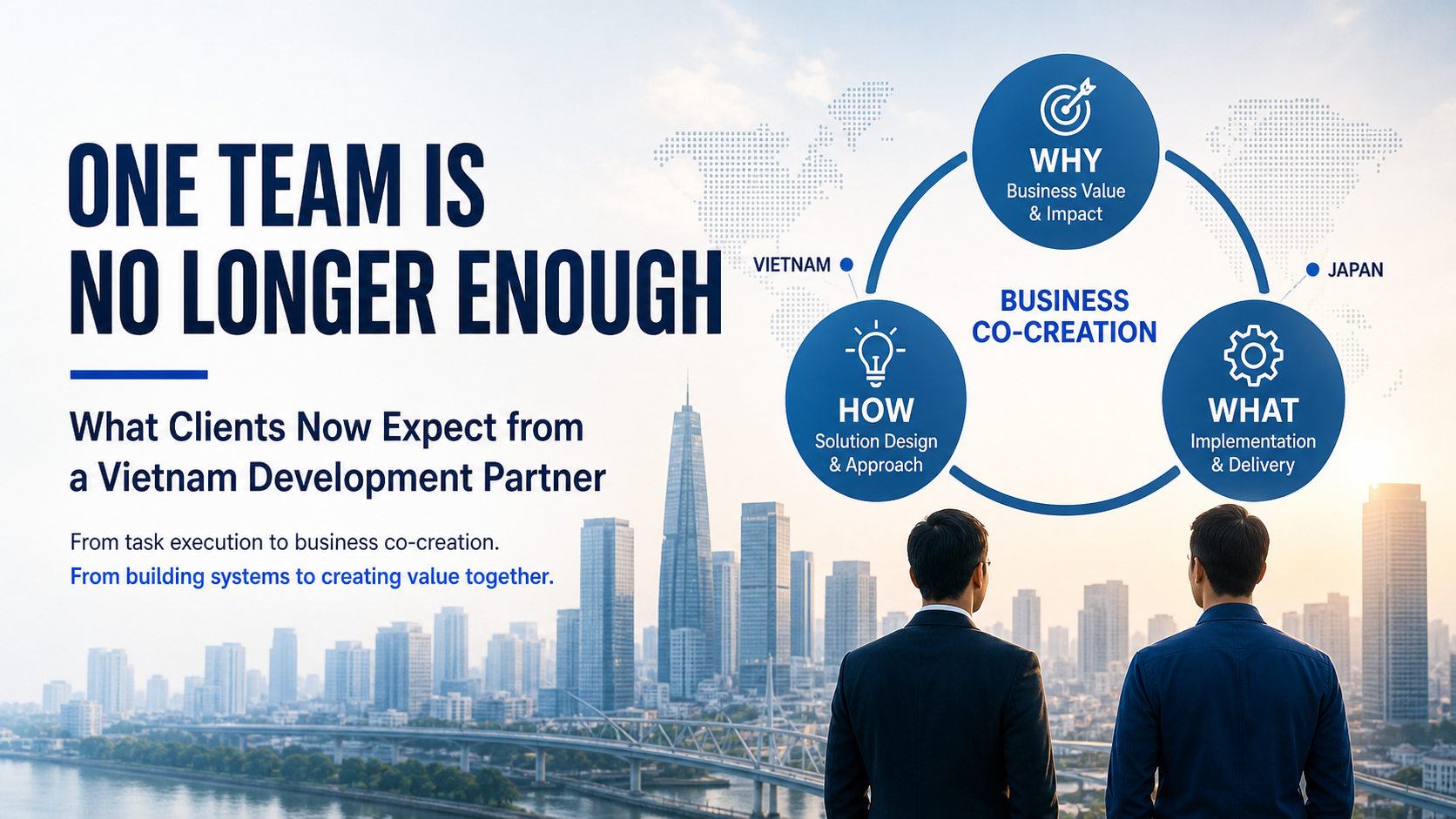
For many years, Vietnam software vendors have been evaluated using a familiar set of criteria:
- technical capability
- communication quality
- Japanese language support
- cost efficiency
- delivery speed
These factors still matter.
But they are no longer enough.
As AI changes software development, the market is also changing the way it evaluates development partners.
Clients are beginning to ask a different question.
Not:
“Can this team build what we ask?”
But:
“Can this team help us think about what we should build, why it matters, and how it creates business value?”
This shift is important.
Because in the AI era, coding alone becomes easier to accelerate.
What remains difficult — and valuable — is understanding the business problem, structuring the right solution, and helping the client make better decisions.
That is why the next generation of development partners will not be chosen only for communication or implementation skill.
They will be chosen for their ability to act as a real business partner.
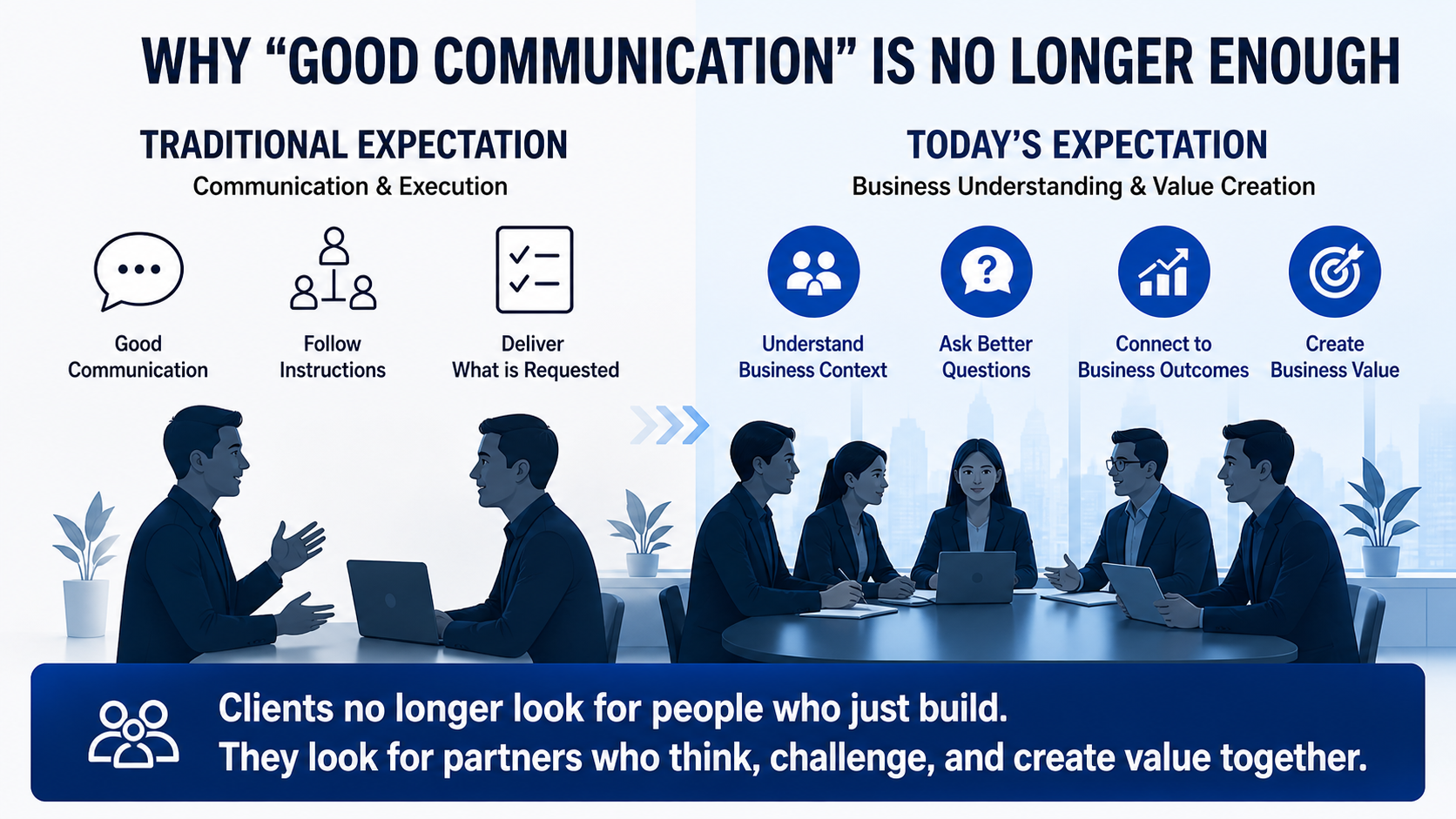
Why “Good Communication” Is No Longer Enough
For many offshore and nearshore vendors, “good communication” has long been a key selling point.
And to be fair, it still matters.
Poor communication creates delays, misunderstandings, and rework.
But the market is moving beyond that baseline.
Clients no longer want a partner who is simply easy to talk to.
They want a partner who can:
- understand the business context
- ask better questions
- challenge weak assumptions
- identify risks early
- connect requirements to business outcomes
In other words, communication is now expected — not differentiated.
Being responsive is important.
Being bilingual is useful.
Being easy to work with is good.
But none of those alone is enough to define strong value.
In a more mature market, communication quality is only the starting point.
The Real Shift: From “What” to “Why”
Traditionally, many software vendors operated at the “what” layer.
The client already knew what they wanted.
The vendor received the scope.
The team implemented the requested features.
That model still exists, but AI is making that layer more competitive.
If coding becomes faster, cheaper, and more standardized, then implementation alone becomes easier to compare — and easier to replace.
This is why the market is shifting upward.
The more valuable layers are now:
- How: solution design, architecture thinking, execution method
- Why: business context, problem definition, value creation
A development partner that only receives tickets and builds features will become easier to commoditize.
A partner that can help define the right problem and shape the right solution becomes much harder to replace.
Why This Matters Especially in Japan-Facing Projects
In Japan-facing projects, many Vietnam vendors have historically positioned themselves around:
- Japanese language fluency
- smooth communication
- process discipline
- offshore cost efficiency
These are still useful strengths.
But if a company wants to move upmarket, those strengths must be connected to something bigger.
The client does not only want:
“a team that can communicate in Japanese.”
The client increasingly wants:
“a team that can understand our business and think with us.”
That difference is strategic.
Because language support helps reduce friction.
But business understanding helps increase value.
The first improves collaboration.
The second improves results.
What Business Co-Creation Actually Means
A true co-creation partner is not just a vendor that says “we can join from upstream.”
That phrase has become common.
The more meaningful question is:
What does upstream participation actually look like?
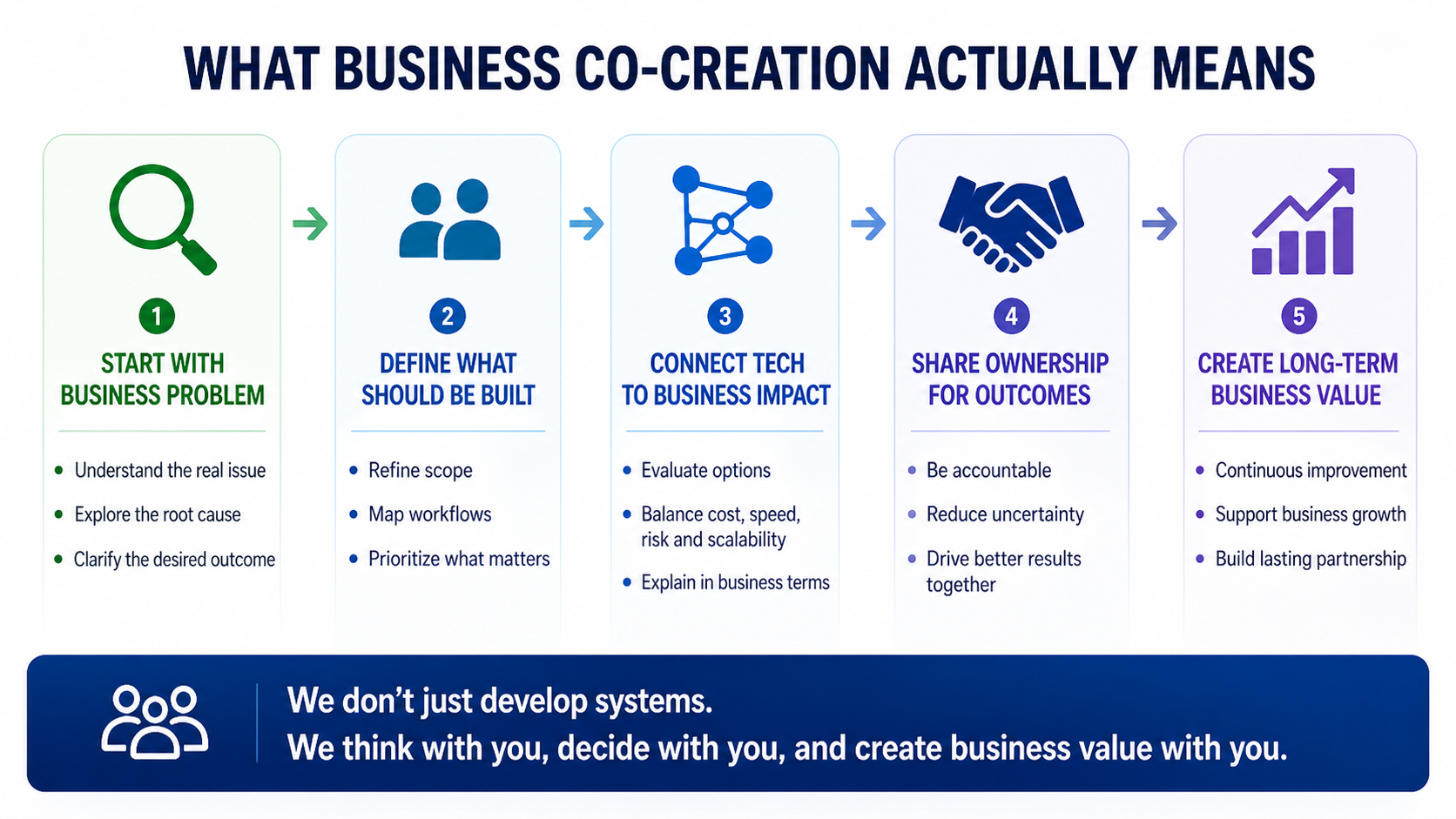
A real business co-creation partner does the following:
1. Starts from the business problem, not only from the feature request
Instead of asking only:
“What screens do you need?”
or
“Do you already have a specification?”
the partner also asks:
- What business problem is this project trying to solve?
- What outcome does the client actually want?
- What happens if we do nothing?
- Which assumption is still unclear?
These questions move the conversation above implementation.
2. Helps define what should be built — not only how to build it
In many projects, the first specification is not the final answer.
It is only the first visible expression of the client’s current understanding.
A strong partner can help refine:
- the scope
- the workflow
- the user journey
- the priority logic
- the ROI path
This is where true upstream value begins.
3. Connects technical decisions to business impact
Technology choices should not be presented as isolated engineering preferences.
A stronger partner explains architecture, delivery structure, and implementation trade-offs in business terms:
- speed
- maintainability
- cost
- risk
- scalability
- operational impact
This gives the client better decision clarity.
4. Shares responsibility for project outcomes
A real partner does not hide behind the phrase:
“We built exactly what was requested.”
Instead, they take responsibility for helping the client reduce ambiguity, improve decision quality, and avoid predictable project risks.
This does not mean replacing the client’s ownership.
It means contributing actively to better outcomes.
Why Smaller Boutique Firms May Have an Advantage
There is another important shift happening.
Large development companies still have scale advantages.
But smaller founder-led firms may have a different strength:
depth of engagement.
In many mid-sized projects, clients do not only want capacity.
They want:
- faster feedback from senior people
- closer business understanding
- more direct communication
- stronger ownership
- practical solution thinking from leadership level
This is where a boutique partner can become very attractive.
A smaller team that brings:
- founder involvement
- upstream participation
- AI-enabled delivery
- strong business context understanding
can sometimes create more value than a much larger vendor structure.
Not because it is bigger.
But because it is closer.
How Development Partners Should Reposition Themselves
For vendors in Vietnam, this means the message must evolve.
It is no longer enough to say:
- we provide a one-team model
- we have strong engineers
- we support Japanese communication
- we can join from requirement definition
Those are still useful points.
But they describe how the team works, not why the client should choose them.
A stronger positioning sounds more like this:
- We help clients clarify what should be built.
- We connect system decisions to business outcomes.
- We work as a partner in problem definition, not only implementation.
- We contribute from business context to delivery.
- We focus on value, not only man-month capacity.
That is a much stronger message in today’s market.
Final Takeaway
“One team” is still a good operating model.
But it is no longer enough as the main value proposition.
In the AI era, the market is moving beyond communication quality and execution support alone.
Clients increasingly look for partners who can:
- understand the business context
- challenge assumptions
- shape better solutions
- connect delivery to business value
That is the next level of trust.
And for development companies that want to move beyond price competition, this is also the next level of positioning.
VAON believes the strongest development partnership is not just about working as one team.
It is about thinking together, deciding together, and creating business value together.