When companies look for a software development partner, price is often one of the first things they compare.
That is understandable.
Budgets are limited.
Internal pressure is real.
Procurement wants numbers that look reasonable.
Management wants to control cost before a project grows larger.
So when one vendor offers the lowest estimate, the choice can look simple.
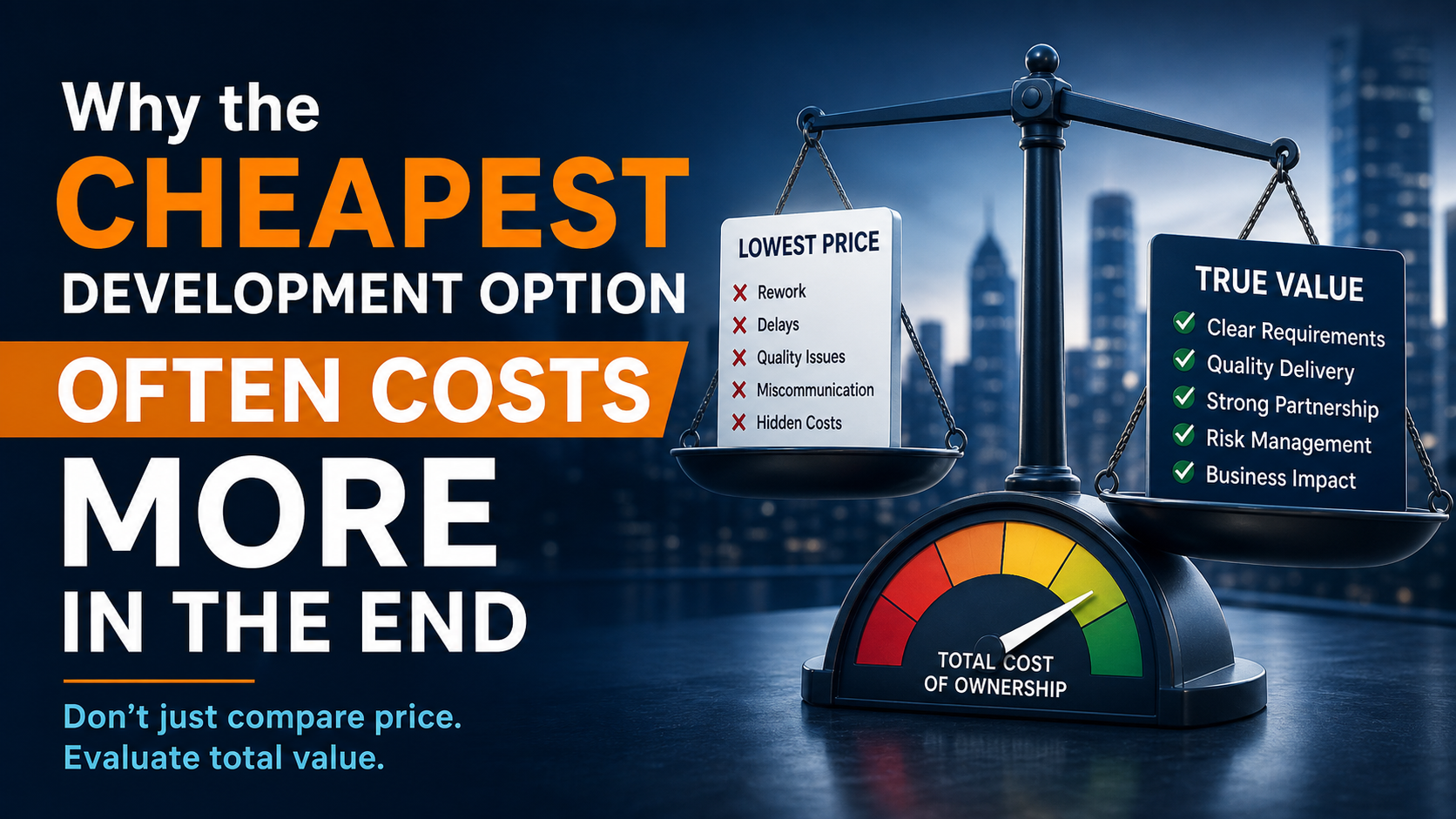
But in software development, the lowest initial price is not always the lowest total cost.
In many projects, the “cheap” option becomes expensive later through:
- rework
- delays
- weak quality
- unclear ownership
- poor communication
- missed business timing
That is why experienced buyers do not only ask:
“How much does it cost to start?”
They also ask:
“What will it cost us if this project slows down, drifts, or needs to be rebuilt?”
That second question is usually more important.
Why the Cheapest Option Looks Attractive at First
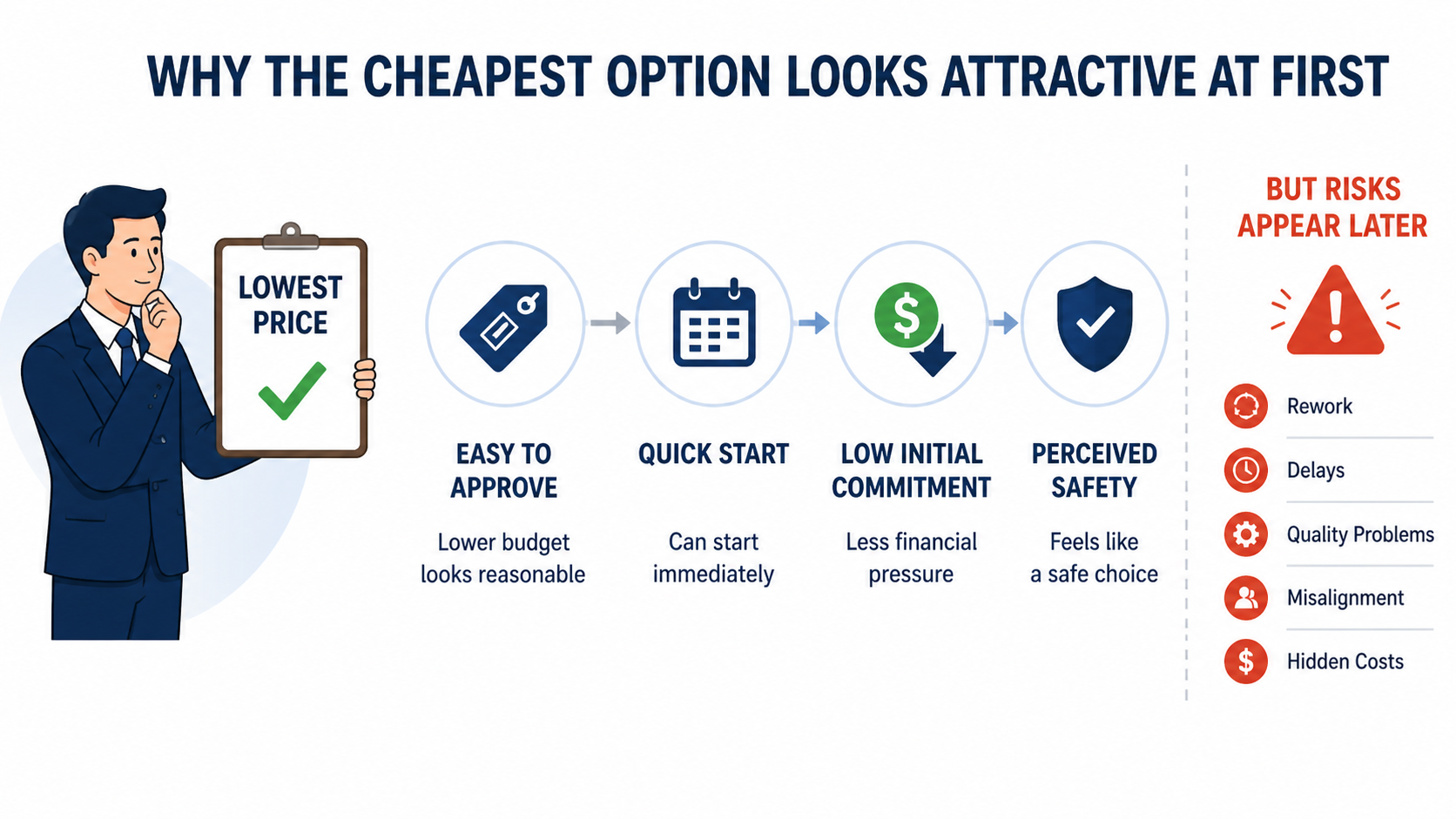
The cheapest proposal often wins attention for obvious reasons.
It gives the appearance of:
- faster decision-making
- easier internal approval
- lower commitment
- safer short-term spending
On paper, that looks efficient.
But software projects are rarely simple purchases.
They are not like buying a fixed product with fixed quality.
A development project is a process of:
- interpreting requirements
- making trade-offs
- handling ambiguity
- aligning expectations
- adapting to changes
- protecting quality under pressure
If the project structure is weak, the initial savings often disappear later.
Cheap Estimates Often Hide Expensive Risks
1. Requirements are accepted too quickly
A low-cost vendor may accept unclear or incomplete requirements without asking enough questions.
At first, this feels convenient.
The customer feels the vendor is flexible and easy to start with.
But later, those missing clarifications return as:
- change requests
- unexpected assumptions
- delivery gaps
- misunderstandings in UAT
- features that technically work but do not solve the real business need
In this case, the cost is not only financial.
It is also the cost of lost time and weakened trust.
2. Communication seems smooth until complexity appears
Some vendors perform well when the project is still simple.
But once the project becomes more complex, communication weaknesses start to surface.
Examples include:
- slow answers to important questions
- unclear escalation paths
- weak business understanding
- repeated explanation loops
- difficulty aligning across roles
This creates invisible cost.
The project may still move, but with more friction in every decision.
Over time, that friction becomes schedule risk.
3. Quality issues are discovered too late
A low-cost estimate is often made possible by reducing hidden effort in:
- test planning
- review cycles
- requirement analysis
- documentation quality
- risk management
- technical design depth
These reductions are not always visible at the beginning.
But they appear later as:
- unstable releases
- repeated bug fixing
- QA confusion
- more time spent by the customer reviewing basic issues
- more stress across both teams
Cheap delivery can become expensive maintenance.
4. The vendor optimizes for scope coverage, not business outcome
Some low-cost models focus on delivering everything that was written down, as quickly as possible.
That sounds reasonable — until the customer realizes the team is not thinking with them.
The result is often:
- tickets completed, but weak product thinking
- features delivered, but low user value
- schedule reported, but business impact unclear
This is one of the biggest hidden costs in software outsourcing.
The project is moving, but not necessarily in the right direction.
5. Rework destroys the original cost advantage
A cheap project becomes expensive when the team has to:
- rebuild misunderstood logic
- redesign broken workflows
- rewrite unstable modules
- re-align scope after development started
- re-test large parts of the system
Rework is one of the most expensive forms of waste in system development.
And it rarely appears in the first estimate.
That is why comparing proposals only by initial price creates a false sense of savings.
What Businesses Should Evaluate Instead
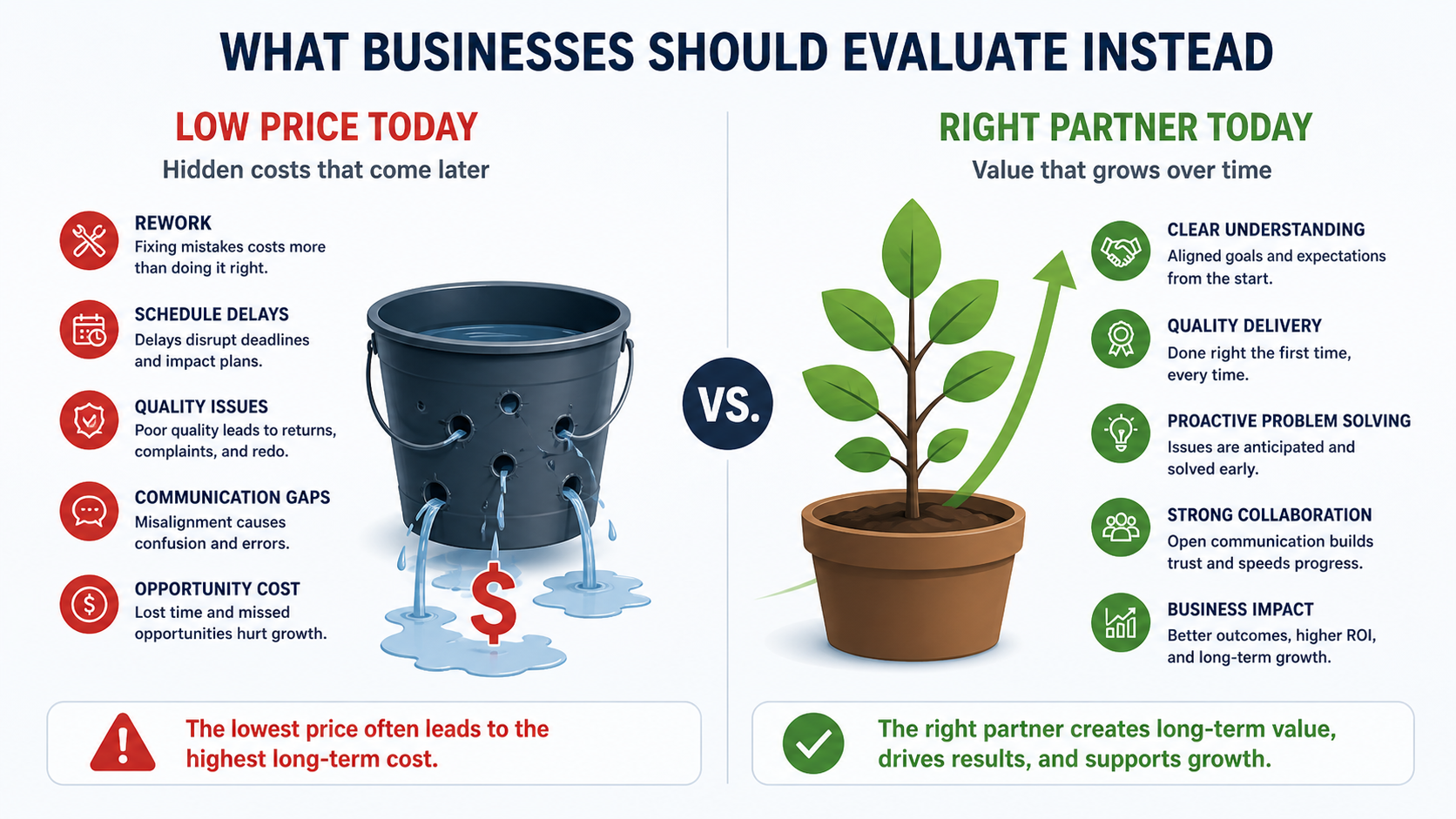
A stronger way to evaluate vendors is not to ask only who is cheapest.
It is to ask which partner is most likely to create a stable and valuable delivery outcome.
1. Can they reduce ambiguity early?
A strong partner does not rush into implementation just because the customer wants to move quickly.
They help clarify:
- what is still unclear
- what must be decided now
- what assumptions are risky
- what should be prioritized first
This reduces expensive confusion later.
2. Can they think beyond implementation?
The best vendors do not only build what is written.
They help shape:
- the workflow
- the business logic
- the delivery sequence
- the architecture trade-offs
- the risk areas
That creates value beyond pure coding.
3. Is quality built into the process?
A healthy delivery model includes:
- clear acceptance criteria
- visible QA responsibility
- review discipline
- realistic escalation
- structured feedback loops
These reduce long-term cost far more than a superficially lower estimate.
4. Do they act like a team or just a supplier?
A true delivery partner does not operate like a disconnected external factory.
They work with:
- shared context
- shared rhythm
- shared responsibility
- direct communication when needed
- active issue prevention
This is where the “one team” mindset matters.
5. Do they understand business timing?
In many projects, the biggest cost is not development cost.
It is business delay.
Missing a launch window, extending an internal process problem, or slowing a business initiative by several months can easily cost more than the difference between two vendor quotes.
That is why decision-makers should evaluate total business impact, not only engineering cost.
The Real Question Is Not “Who Is Cheapest?”
The real question is:
Who can help us move forward with less waste, less confusion, and less risk?
A low estimate can still be the right choice — if the structure behind it is strong.
But if the estimate is low because important work is being ignored, postponed, or hidden, the project will pay for it later.
In software development, cheap is not dangerous because it is cheap.
It is dangerous when it creates false confidence.
Final Takeaway
The cheapest development option may look efficient at the start.
But if it creates rework, weak quality, unclear communication, and delayed decisions, it often becomes more expensive in the end.
That is why smart vendor selection should not focus only on:
- lowest initial cost
- fastest short-term approval
- surface-level delivery promises
It should focus on:
- clarity
- quality
- ownership
- business alignment
- long-term delivery stability
The best development partner is not the one that simply looks cheapest today.
It is the one most likely to reduce risk and create real value tomorrow.
VAON believes software development should be evaluated not only by estimate size, but by the quality of thinking, delivery discipline, and business value created throughout the project.