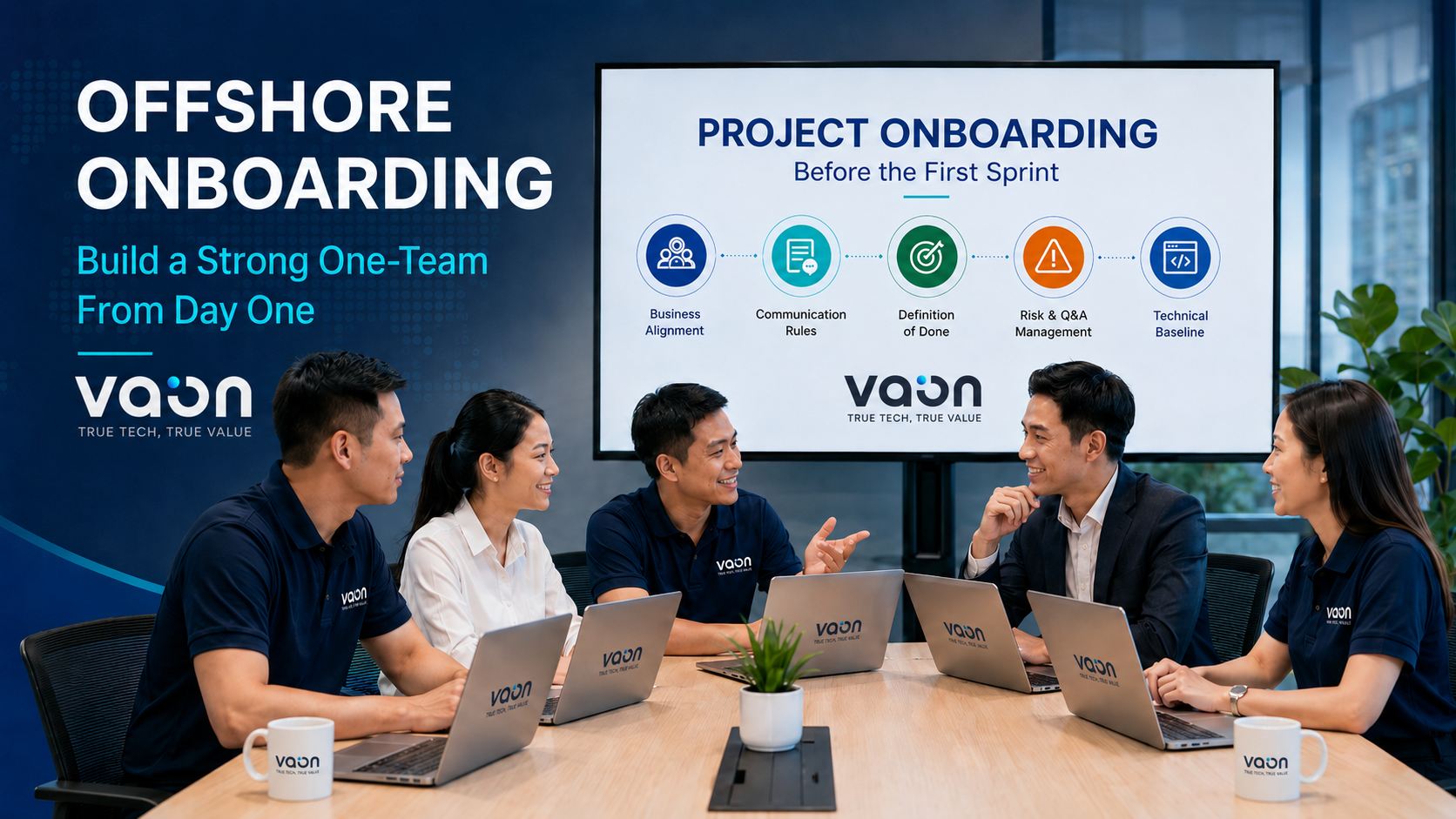
Before the First Sprint: Why Offshore Onboarding Determines Project Success
When companies start an offshore development project, they often focus immediately on execution.
How many developers are needed?
When can coding start?
How fast can the team deliver the first version?
These are important questions. But they are not the first questions that determine project success.
Before the first sprint begins, there is a more fundamental phase that is often underestimated: offshore onboarding.
In many projects, onboarding is treated as a simple handover. Documents are shared, accounts are created, meetings are scheduled, and the offshore team is expected to start development quickly. However, in real software development, onboarding is not just an administrative step. It is the foundation for shared understanding, communication quality, and long-term delivery stability.
At VAON, we believe that successful offshore development does not begin with coding. It begins with alignment.
Offshore Projects Rarely Fail Because of Coding Alone
When an offshore project becomes difficult, the visible symptoms usually appear during development.
Requirements are misunderstood.
Questions take too long to resolve.
Specifications change without clear decisions.
The delivered feature does not match the customer’s expectation.
Testing reveals gaps that should have been discussed earlier.
At first glance, these may look like development issues. But very often, the root cause is not coding capability. The root cause is insufficient onboarding.
The team may not fully understand the business background.
The communication rules may be unclear.
The decision-making flow may not be defined.
The definition of done may differ between the customer and the development team.
The offshore team may know what to build, but not why it matters.
This is why the first few days or weeks of a project are so critical. If the team starts coding without shared context, speed can actually become a risk. The faster the team moves in the wrong direction, the more rework the project creates later.
Onboarding Is Not Just a Kickoff Meeting
A kickoff meeting is important, but it is not enough.
Many projects have a kickoff meeting where the customer explains the business, the vendor introduces the team, and both sides confirm the schedule. After that, development begins.
However, real onboarding should go deeper than that.
A good offshore onboarding process should answer questions such as:
What business problem are we solving?
Who are the end users?
Which features are most important and why?
What are the non-negotiable quality expectations?
How should questions, risks, and decisions be managed?
Who has the authority to confirm specifications?
What should the offshore team do when requirements are unclear?
Without clear answers to these questions, the development team may still be able to write code, but they cannot make good decisions independently.
And in agile or semi-agile development, this becomes a major problem.
Modern software development requires daily judgment. Developers, testers, BrSEs, and PMs constantly make small decisions. If they do not understand the project context, they must ask the customer about every detail. This slows down the project and increases communication cost.
A strong onboarding process gives the team enough context to think, propose, and act as part of the same team.
The Japan–Vietnam Context: Detail Meets Speed
In Japan–Vietnam offshore development, onboarding is especially important because the working cultures often have different strengths.
Japanese companies tend to value precision, documentation, long-term reliability, and careful confirmation. Vietnamese development teams often bring speed, flexibility, and strong technical execution.
When these strengths are connected well, the result can be very powerful. But without proper onboarding, the gap between expectation and execution can become visible very quickly.
For example, a Japanese customer may expect the team to understand implicit business rules from context. Meanwhile, the Vietnamese team may expect requirements to be described explicitly in tickets or documents.
Neither side is wrong. They simply operate with different assumptions.
This is exactly where onboarding creates value.
A good onboarding process makes implicit expectations explicit. It defines how the team will communicate, how decisions will be recorded, how unclear requirements will be handled, and how quality will be judged.
In other words, onboarding converts cultural differences into a structured working model.
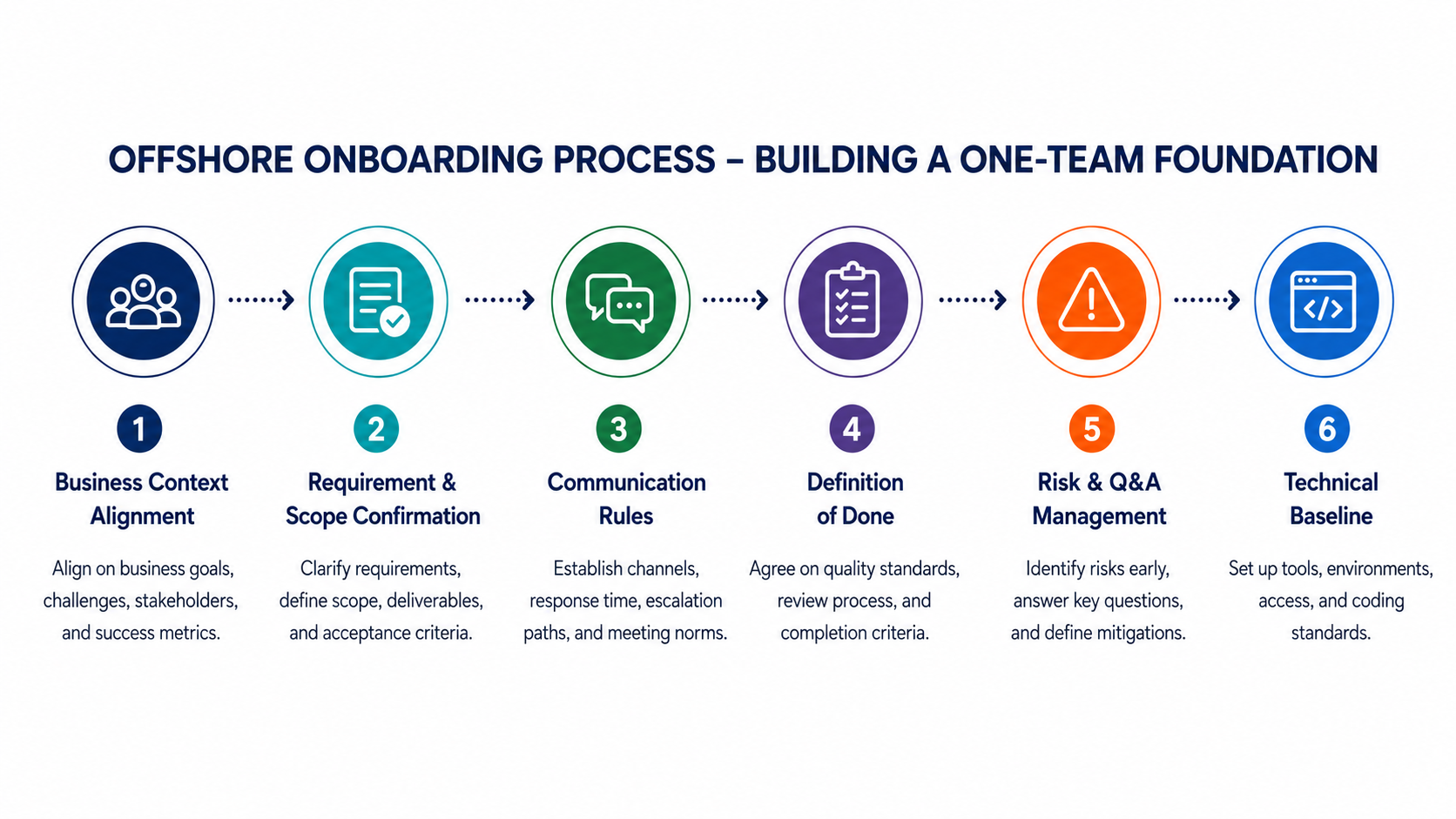
What Effective Offshore Onboarding Should Include
A practical offshore onboarding process should cover more than project introduction. It should create a working environment where both sides can collaborate smoothly from the beginning.
1. Business Context Alignment
The offshore team should understand not only the functions to be developed, but also the business purpose behind them.
This includes the service concept, target users, operational flow, customer pain points, and business priorities.
When the team understands the business context, they can ask better questions and make better technical suggestions.
2. Requirement and Scope Confirmation
Before development starts, the team should confirm what is included, what is excluded, and what is still under discussion.
This prevents one of the most common offshore problems: both sides believe they have the same understanding, but they actually do not.
Clear scope confirmation also helps prevent unnecessary conflict later when additional requests appear during development.
3. Communication Rules
Communication should not depend only on individual effort.
The project should define where discussions happen, how urgent issues are escalated, how meeting minutes are recorded, and how decisions are confirmed.
For example, chat tools may be used for quick communication, while Backlog or ticket systems are used for official task and decision management.
This separation is important because chat is fast, but it is easy to lose important decisions if they are not recorded properly.
4. Definition of Done
Different teams may have different interpretations of “done.”
For one team, done may mean development is completed.
For another team, done may mean unit testing is completed.
For the customer, done may mean the feature has passed acceptance testing and is ready for production.
If this is not aligned early, delivery reports can create misunderstanding.
A clear definition of done helps all sides evaluate progress with the same standard.
5. Risk and Q&A Management
Every project has unclear points. The problem is not the existence of questions. The problem is leaving them unmanaged.
A strong onboarding process should define how questions are raised, who answers them, how deadlines for answers are managed, and how unresolved issues affect the schedule.
This is especially important in offshore development because small unanswered questions can easily become blockers for the development team.
6. Technical Baseline Confirmation
The team should align on architecture, coding rules, development environment, repository management, deployment flow, testing scope, and security requirements.
This reduces technical rework and makes it easier for new members to join the project later.
From Vendor Handover to One-Team Onboarding
Traditional offshore development often starts with a vendor-style handover.
The customer prepares requirements.
The offshore team receives them.
The offshore team develops.
The customer reviews.
This model can work for simple and stable tasks. But for complex software development, it is not enough.
A stronger model is One-Team onboarding.
In this model, onboarding is not a one-way transfer of information. It is a joint process where the customer and offshore team build a shared operating system for the project.
The customer explains the business and priorities.
The offshore team confirms assumptions and identifies risks.
Both sides define communication rules and decision flows.
The project starts with shared ownership, not just task assignment.
This creates a very different relationship.
The offshore team does not simply wait for instructions. They understand the goal, detect risks earlier, and propose better solutions. The customer does not need to manage every small detail manually. Instead, they can rely on a team that understands both the technical side and the business direction.
That is the real value of a One-Team model.
Faster Start Does Not Always Mean Faster Delivery
Many companies want offshore teams to start development as soon as possible. This is understandable, especially when schedules are tight.
But skipping onboarding to save time often creates the opposite result.
The project may appear to move quickly in the first week, but delays appear later through rework, repeated questions, unclear acceptance criteria, and mismatched expectations.
A few days spent on proper onboarding can save weeks of correction later.
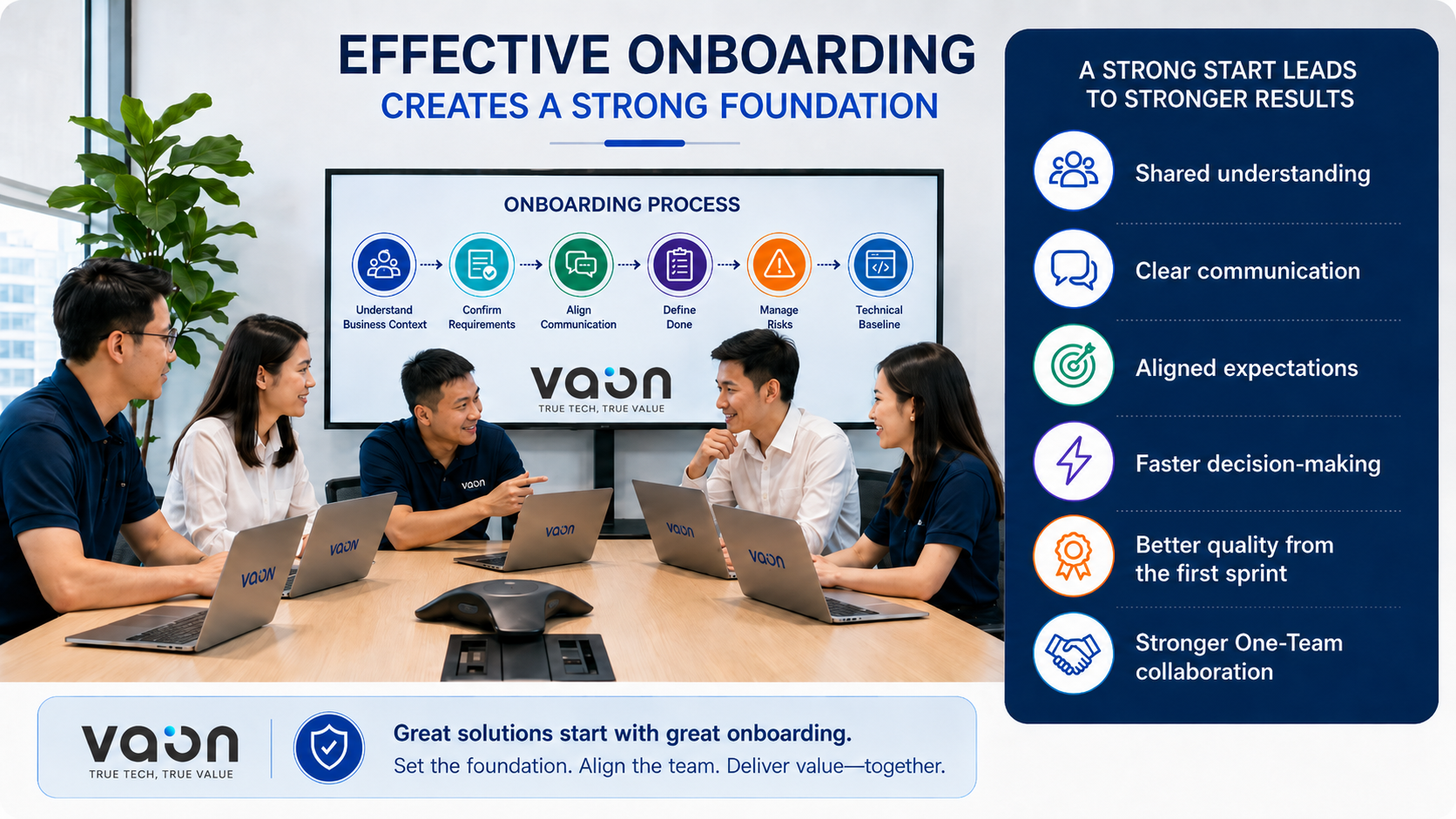
Good onboarding reduces communication waste.
It prevents avoidable misunderstandings.
It helps the team make decisions faster.
It improves quality from the first sprint.
It builds trust between the customer and the offshore team.
In this sense, onboarding is not a delay before development. It is an investment in delivery speed.
Conclusion: The First Sprint Starts Before Sprint Planning
Offshore development success is not determined only by the number of engineers, the hourly rate, or the technical stack.
It is determined by how well the team understands the project before execution begins.
Before the first sprint, both sides need to align on business goals, scope, communication rules, technical standards, risks, and decision-making flow.
When onboarding is weak, the offshore team becomes only an external development resource.
When onboarding is strong, the offshore team becomes a true project partner.
At VAON, we see onboarding as one of the most important steps in offshore development. It is where trust begins, where assumptions are clarified, and where the foundation of a One-Team collaboration is built.
Because successful offshore development does not start when the first line of code is written.
It starts when everyone begins moving in the same direction.