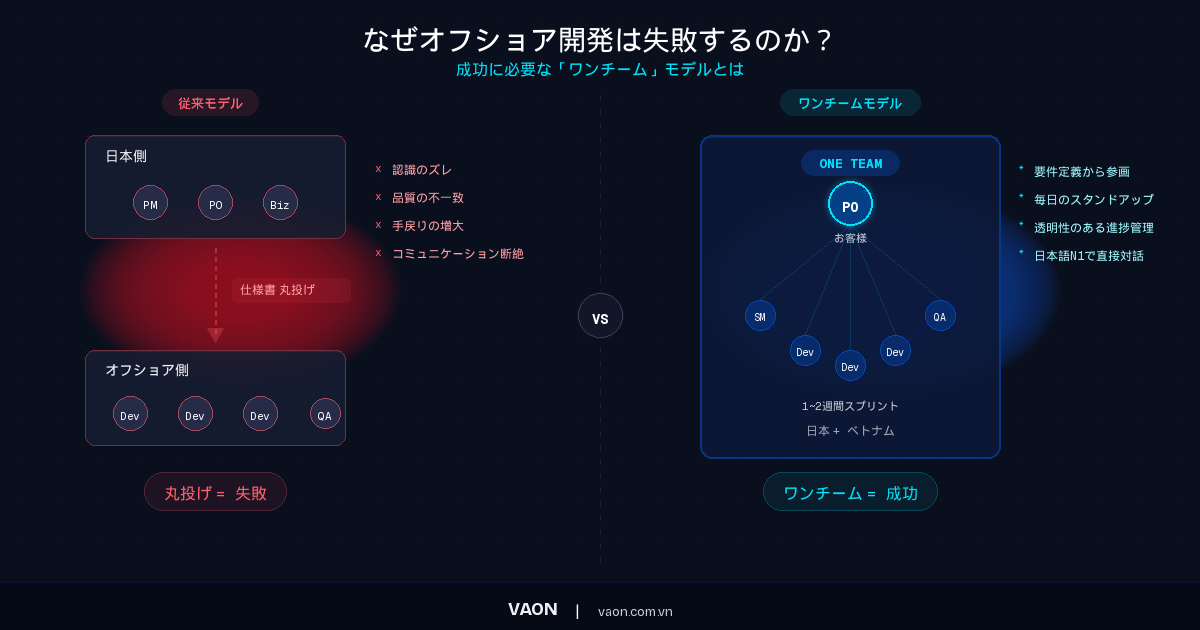
The Reality of Offshore Development: Why Projects Fail
Offshore development is often seen as the ultimate cost-cutting solution, but in practice, it carries a surprisingly high failure rate. According to a survey by Japan's Ministry of Economy, Trade and Industry (METI), approximately 40% of offshore development projects fail to complete on schedule.
Most failures don't come down to budget overruns or missed deadlines alone. The root cause is almost always a fundamental breakdown in communication.
3 Common Failure Patterns
1. The "Spec Dump" Problem
The most classic failure: handing a completed requirements document to the vendor and saying "take it from here."
In this model:
- The Japanese team's tacit knowledge never reaches the offshore team
- Every undocumented judgment call is left to the offshore team to figure out
- Revision cycles multiply, and the project scope balloons out of control
The result: a product that's technically "complete", but completely unusable.
2. Timezone & Cultural Gaps Create Misalignment
An issue reported at midnight Japan time can arrive the next morning interpreted in an entirely different way. When engineering culture and prioritization frameworks don't align, even a clear message gets lost in translation.
3. Quality as an Afterthought
Testing gaps and missing documentation only surface when the deadline is already looming. Without involvement in the upstream phases, quality standards are never properly aligned from the start.
The Key to Success: The "One Team" Model
To avoid these failures, offshore development must stop being treated as a "hand-off." Instead, the Japanese-side team and the offshore team need to function as a single, unified team.
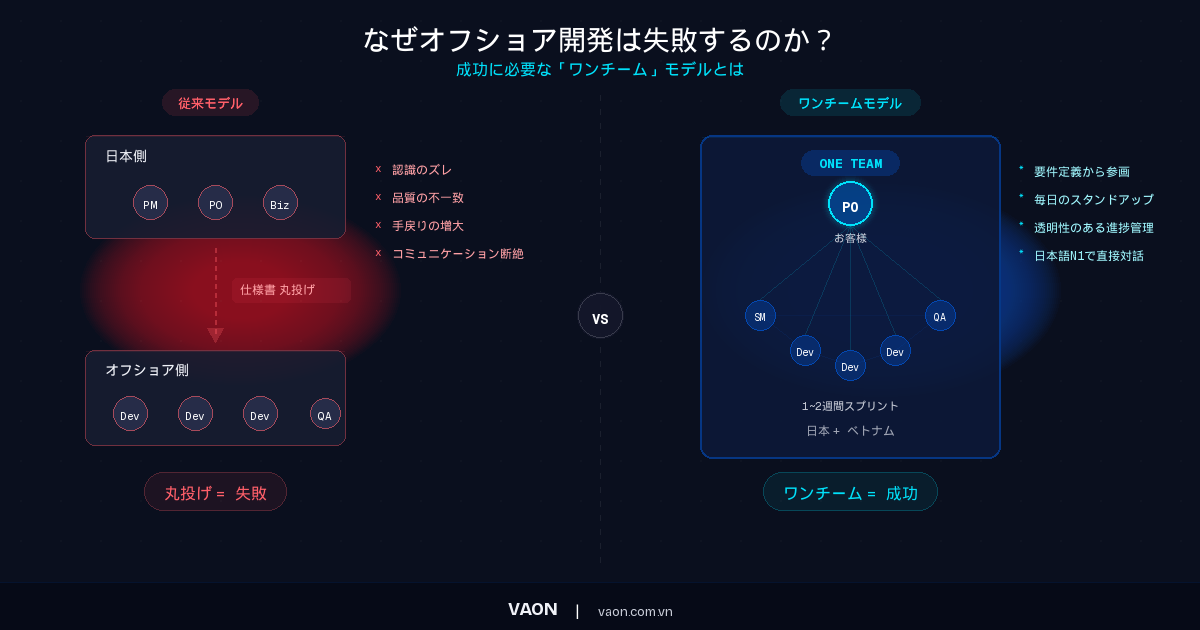
What a One Team Looks Like
- Involved from requirements definition: Offshore engineers build requirements together with the Japanese PM. Understanding the why behind each requirement minimizes rework downstream.
- Continuous communication: Daily standups. Japanese PO always in the loop. Issues are raised as discussions, not formal reports.
- Quality baked into the process: Japanese quality standards are shared from day one. Continuous code review. Testing scope agreed upon and executed jointly.
What Makes One Team Work
Three conditions must be in place:
- Language capability: Offshore team reads requirements in Japanese and communicates directly
- Agile experience: Sprint-based delivery with incremental, reviewable results
- Domain knowledge: Not just coding execution, but genuine understanding of the business context
VAON Vietnam brings all three and builds a true One Team with Japanese-side organizations.