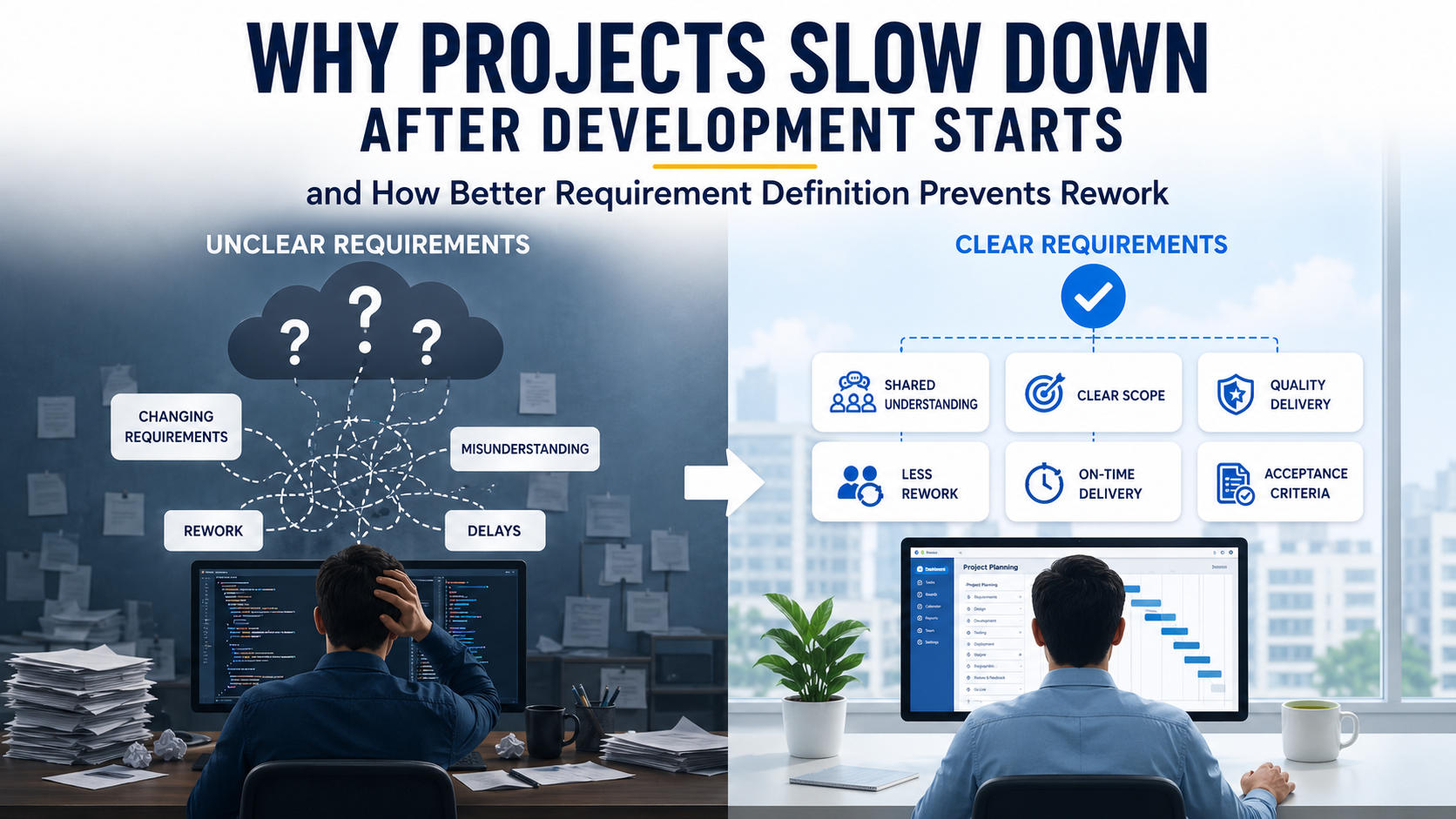
Many software projects do not fail at the beginning.
They fail after development has already started.
At first, everything looks positive:
- the kickoff has been completed
- the team has started implementation
- tasks are assigned
- progress appears visible
Then, a few weeks later, the project starts slowing down.
Questions increase.
Specifications keep changing.
Developers wait for clarification.
QA finds issues that were not clearly defined.
The customer feels the output is “not quite what was expected.”
Rework begins.
This pattern is common in system development.
And in many cases, the problem is not weak engineering.
The problem is weak requirement definition.
When requirements are unclear, incomplete, or only partially aligned between stakeholders, development may start quickly — but delivery slows down later, when changes become more expensive.
That is why strong upstream work matters more than many teams realize.
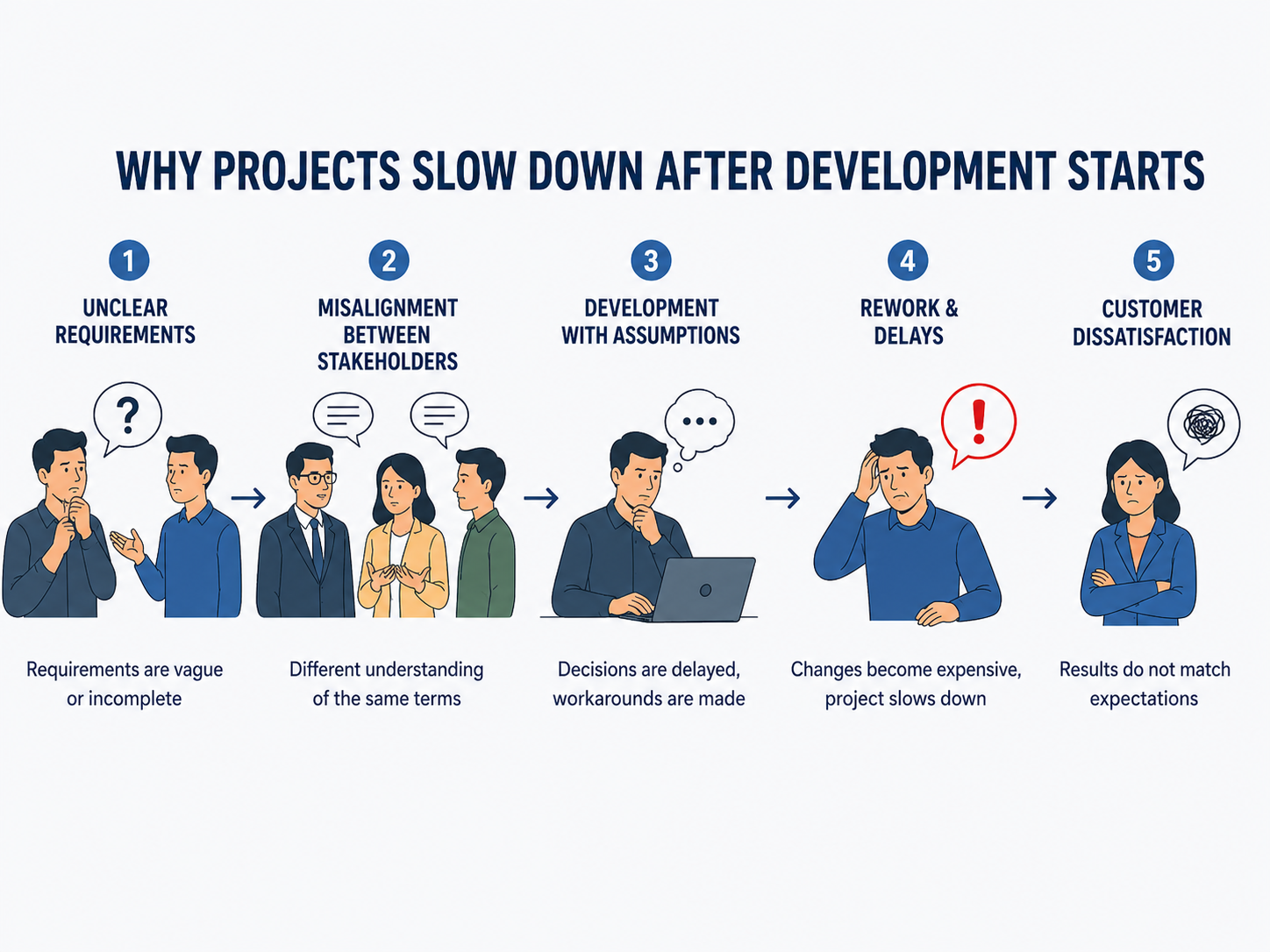
Why Projects Slow Down After Development Starts
1. The team starts building before decisions are stable
In many projects, coding begins while important points are still unresolved.
Examples include:
- unclear screen behavior
- incomplete business rules
- undefined edge cases
- unclear approval flow
- missing error handling
- inconsistent data definitions
At first, the team may still be able to move forward by making assumptions.
But later, those assumptions become conflicts.
When decisions are postponed, the project does not become faster. It only shifts uncertainty into the development phase.
That uncertainty usually returns as rework.
2. Different stakeholders imagine different outcomes
A common issue in business system projects is that people use the same words, but imagine different results.
For example:
- “approval flow”
- “completed order”
- “urgent case”
- “admin user”
- “customer support status”
These terms may sound simple, but unless the project defines them clearly, each side may interpret them differently.
The business team thinks in operations.
The design team thinks in screens.
The developer thinks in logic and data.
QA thinks in test conditions.
Without alignment, each role moves in a different direction while believing they are working on the same thing.
That is when projects start to drift.
3. Change becomes more expensive after implementation begins
Changing a requirement in a document is cheap.
Changing it after code, test cases, and UI behavior are already built is much more expensive.
That cost grows further when:
- related functions are already implemented
- APIs are already connected
- QA has already started testing
- customer review has already begun
This is why vague requirements at the beginning often create large schedule and cost pressure later.
The team is not only changing one idea.
It is changing everything attached to that idea.
4. QA is forced to discover missing requirements
QA should verify whether the implementation matches the requirement.
But when requirements are weak, QA is pushed into a different role:
discovering what the requirement should have been.
That is not efficient.
It leads to:
- repeated clarification loops
- unstable acceptance criteria
- confusion between bug and change request
- longer review cycles
- tension between customer and delivery team
A project moves much more smoothly when QA works against a clearly defined target.
5. Progress becomes visible, but certainty becomes weaker
This is one of the most dangerous patterns.
The team looks busy.
Tasks are moving.
Screens are being built.
APIs are being connected.
So everyone feels the project is progressing.
But if the foundation is weak, visible activity does not mean real certainty.
In fact, some projects become riskier precisely because they move forward before the requirement baseline is truly aligned.
The later the gap is discovered, the more expensive it becomes.
What Good Requirement Definition Looks Like
A strong requirement definition document is not just a list of features.
It should reduce ambiguity and create shared understanding before detailed implementation begins.
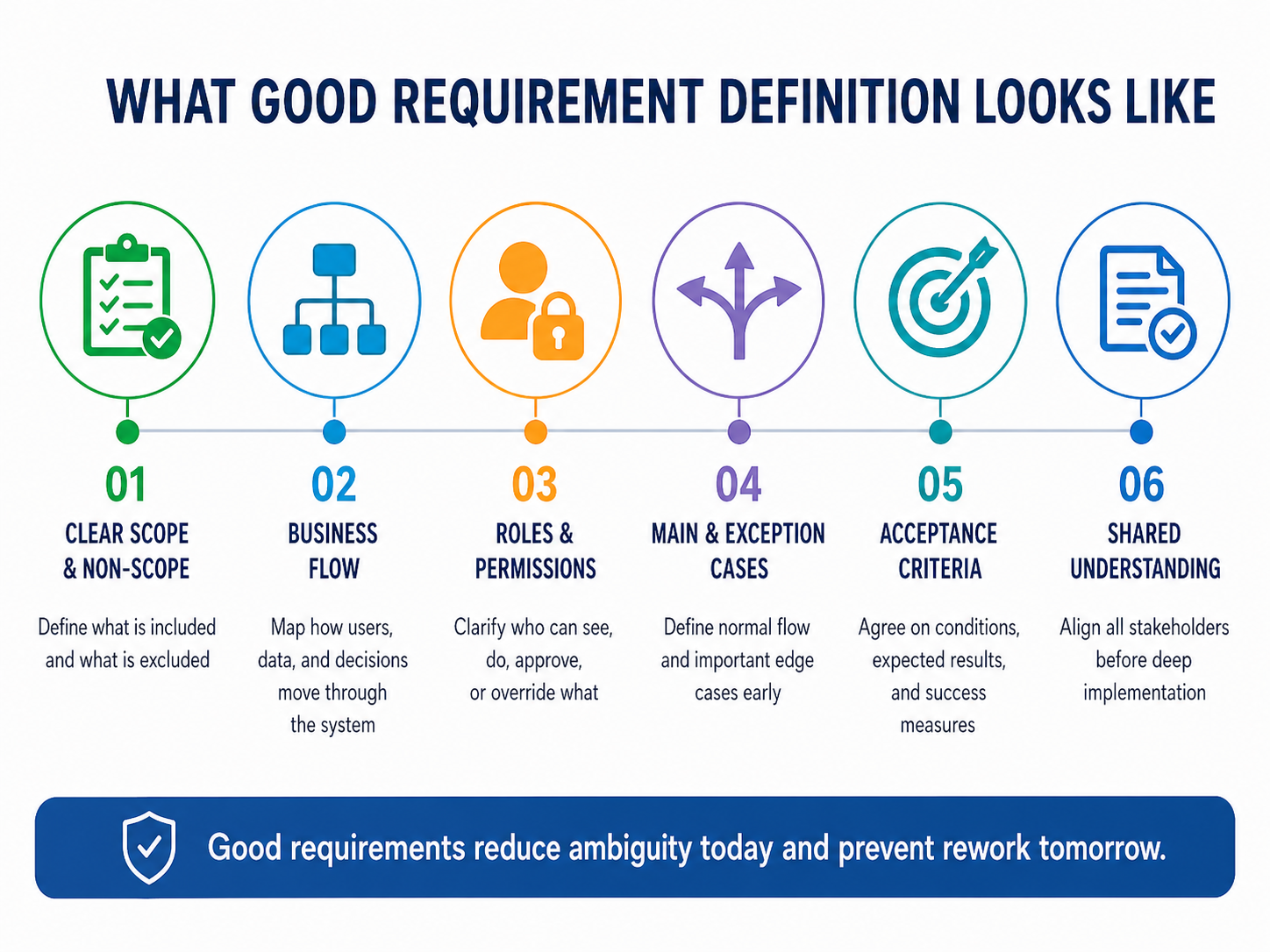
A good requirement definition usually makes the following clear:
1. Scope and non-scope
The team must know not only what is included, but also what is excluded.
This prevents assumptions from growing silently during the project.
2. Business flow
The project should define how users, data, and decisions move through the process.
Without a business flow, features often become disconnected.
3. Role and permission logic
Many problems come from unclear role definitions.
Who can see what?
Who can approve what?
Who can edit, cancel, or override?
These points should be agreed early.
4. Main cases and exception cases
Teams usually define the normal flow, but skip unusual conditions.
Real systems fail in the edge cases:
- duplicate requests
- missing input
- timeout behavior
- unexpected status transitions
- partial completion
- approval rejection
If these are not defined early, they return later as bugs or rework.
5. Acceptance criteria
A feature is not “done” just because it was coded.
A feature is done when both sides can agree:
- what should happen
- under what conditions
- what output is expected
- what counts as success
This is why acceptance criteria should be written before implementation becomes too deep.
Requirement Definition Is Not Documentation for Its Own Sake
Some teams see requirement definition as paperwork that slows delivery.
In reality, bad requirement definition slows delivery far more than good documentation ever will.
The purpose of requirement definition is not to create more files.
Its purpose is to reduce:
- assumption gaps
- unnecessary change
- decision delay
- QA confusion
- delivery risk
Good upstream work makes downstream execution faster.
That is not bureaucracy.
That is project discipline.
A Practical Way to Improve Requirement Quality
Teams do not need perfect documents before starting.
But they do need enough structure to prevent ambiguity from spreading.
A practical approach includes:
- Clarify business terms early
Define key terms before screens and APIs are discussed. - Separate confirmed items from open items
Do not mix assumptions with approved decisions. - Review workflows before UI details
A correct process matters more than early screen polish. - Define exception handling explicitly
Edge cases should be discussed before coding becomes deep. - Align acceptance criteria before QA starts
QA should validate agreed behavior, not discover the target.
Final Takeaway
Projects usually do not slow down because coding is difficult.
They slow down because uncertainty was allowed to enter the project too early — and stay too long.
When requirement definition is weak, rework becomes inevitable.
When requirement definition is strong, delivery becomes more stable, QA becomes clearer, and customer alignment becomes much easier.
The fastest projects are not the ones that rush into development.
They are the ones that reduce ambiguity before complexity grows.
VAON supports system development from upstream to downstream — helping teams clarify requirements, reduce rework, and build with greater delivery confidence.