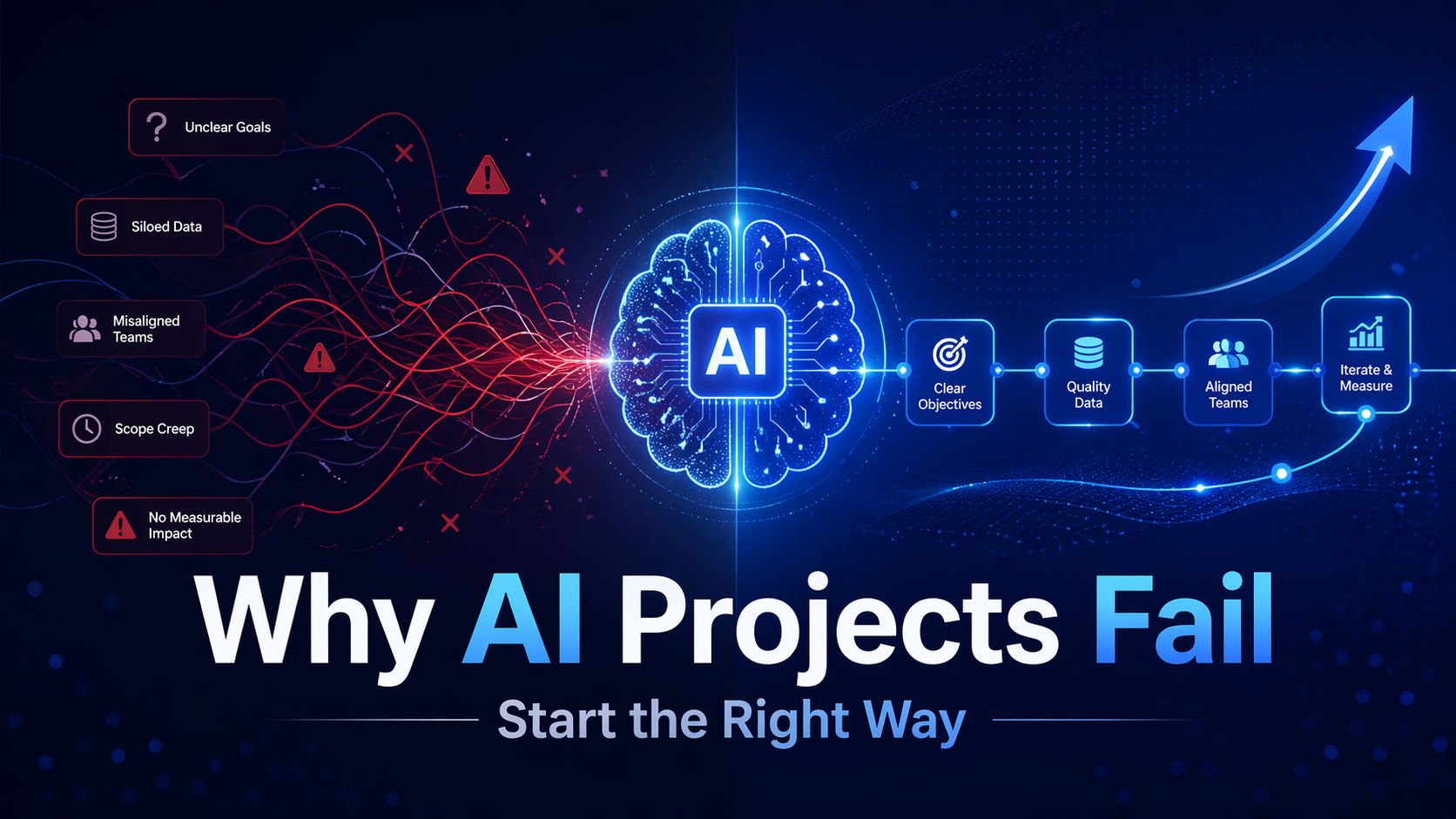
Artificial intelligence is no longer a future concept. For many businesses, it has already become a real priority. Companies want to use AI to improve response time, reduce repetitive work, and create more value from existing data and workflows.
However, many AI initiatives still fail before they create measurable business impact.
The reason is often misunderstood.
Most companies do not fail because the AI model is weak. They fail because the surrounding system, business process, and implementation structure are not ready to support AI in production.
An AI project becomes valuable only when it is built on top of a clear workflow, a scalable architecture, and a practical rollout plan.
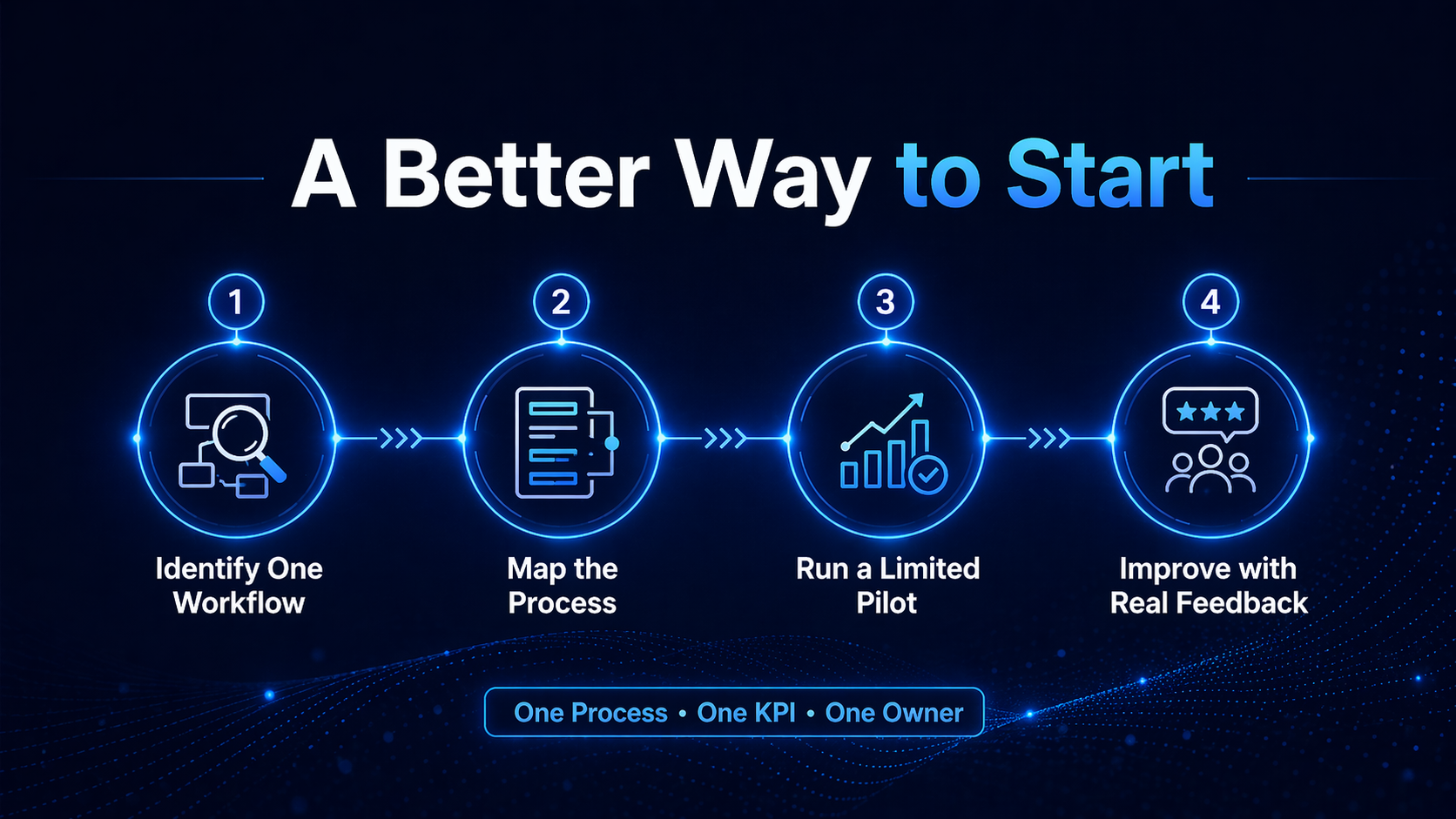
Why AI Projects Fail Early
1. Overly broad scope
A common mistake is trying to solve too many problems at once.
Some companies want one AI initiative to handle customer support, internal search, reporting, lead qualification, and content creation at the same time. This usually leads to unclear priorities, slow implementation, and weak adoption.
A better approach is to start with one process that is repetitive, time-consuming, and clearly measurable.
2. Unclear business process
AI cannot fix a process that the company itself does not understand.
If a team cannot clearly explain how the current workflow works, where the exceptions happen, and what a successful output should look like, then AI will only automate confusion.
Before implementation begins, the workflow must be visible.
3. No clear owner
Many AI projects have executive attention but no real owner.
The business team assumes the IT team will define the solution. The IT team assumes the vendor will clarify the business requirement. Leadership expects results, but no one is responsible for adoption after launch.
Without ownership, AI remains a side project rather than a business initiative.
4. Weak or vague success metrics
If success is defined too broadly, progress becomes impossible to evaluate.
Statements such as “improve productivity” or “use AI in operations” are not enough. A real AI initiative needs a metric that can be measured within a realistic period.
Examples include:
- reducing response time
- cutting repetitive workload
- increasing qualified leads
- shortening search or processing time
A Better Way to Start
The most practical way to introduce AI is to begin with one process, one KPI, and one owner.
This keeps the project focused, measurable, and easier to improve over time.
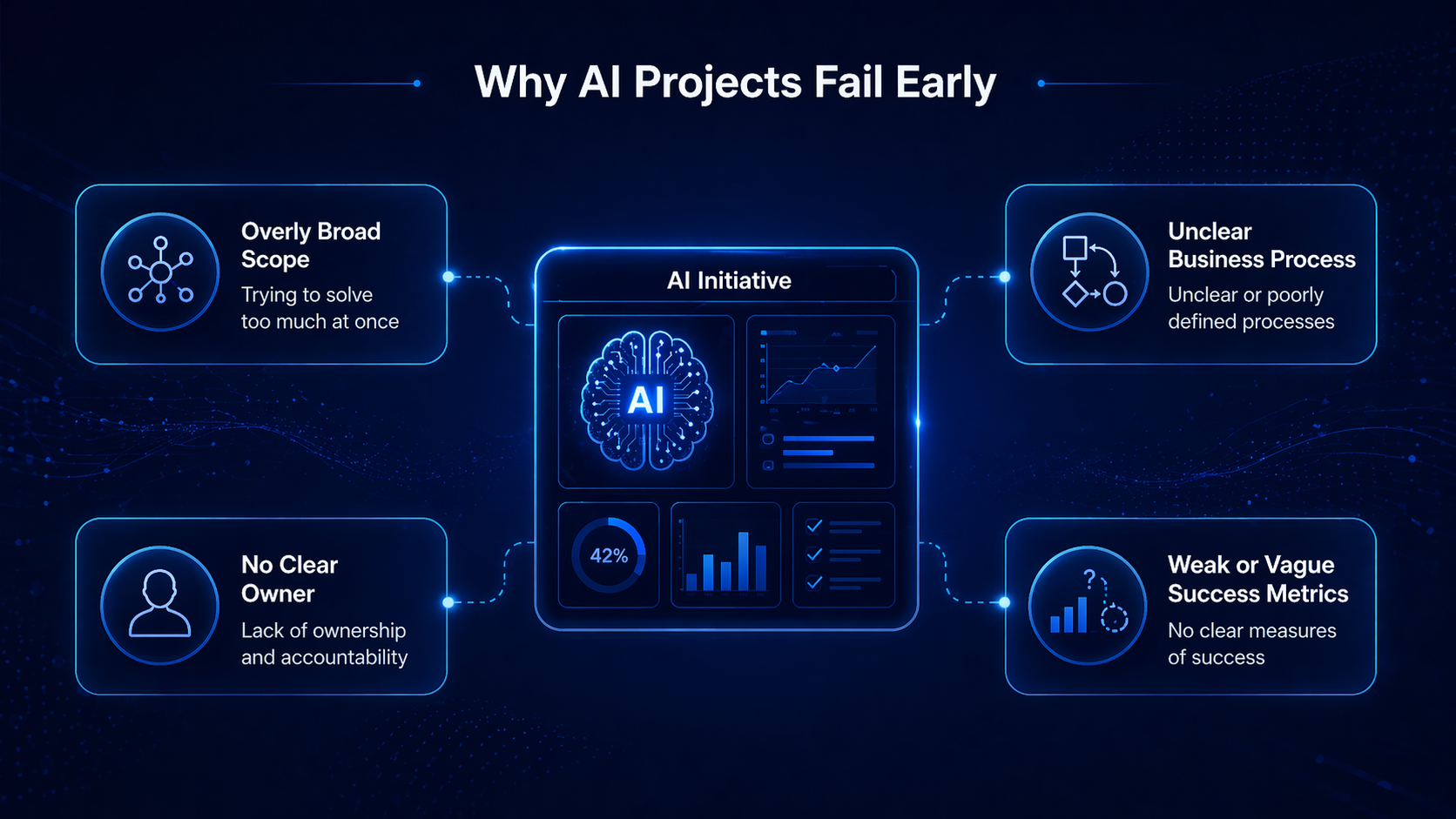
1. Identify one workflow
Choose a workflow that already creates friction in daily operations.
Good candidates are processes where employees repeatedly answer the same questions, move data between tools, check similar documents, or review predictable requests.
2. Map the process
Before selecting tools or models, make the workflow visible.
Document the current steps, decision points, exceptions, inputs, outputs, and source of truth. This stage is often more important than the AI model itself.
3. Run a limited pilot
Do not try to launch the solution across the entire company in the first phase.
Start with one use case, one department, and one clear review cycle. Keep the scope small enough to manage, but meaningful enough to prove value.
4. Improve with real feedback
The first version should not be treated as the final version.
AI systems improve when teams observe real usage, identify failure points, refine prompts or rules, improve data quality, and adjust the workflow based on actual behavior.
What an AI-Ready System Should Look Like
A system that is ready for AI usually has the following characteristics:
- the business process is already defined
- responsibilities are clear
- integration points are visible
- success criteria are measurable
- the architecture can evolve without breaking the core platform
In practice, this often means separating the AI layer from the operational system as much as possible.
For example, instead of inserting AI logic directly into the core transaction flow, companies can use APIs, message queues, webhooks, or modular services. This reduces risk and makes future upgrades easier.
The goal is not just to “use AI.”
The goal is to make AI sustainable inside real business operations.
Final Takeaway
Most AI projects fail early not because the technology is immature, but because the business starts with the wrong scope, unclear processes, and weak implementation discipline.
The strongest AI initiatives do not begin with hype.
They begin with:
- one practical use case
- one measurable KPI
- one accountable owner
- one architecture that can scale safely
If your business wants AI to create real value, the first question should not be “Which model should we use?”
The better question is:
“What process should we improve first, and is our system ready to support that change?”
If you start there, AI becomes more than an experiment. It becomes part of a scalable business system.
VAON helps businesses design and implement practical AI-ready systems — from workflow clarification and architecture planning to development and delivery.