Here's a number that stops most Japanese CTOs in their tracks: ¥720,000 per month per engineer.
That's the average fully-loaded cost of a mid-level software engineer at a Japanese IT firm in 2026 — salary, bonuses, social insurance, office overhead, equipment, HR overhead. At five engineers, you're spending over ¥43 million annually on a team that's still writing boilerplate code by hand.
The Japanese enterprises getting ahead aren't cutting corners. They're changing the formula.
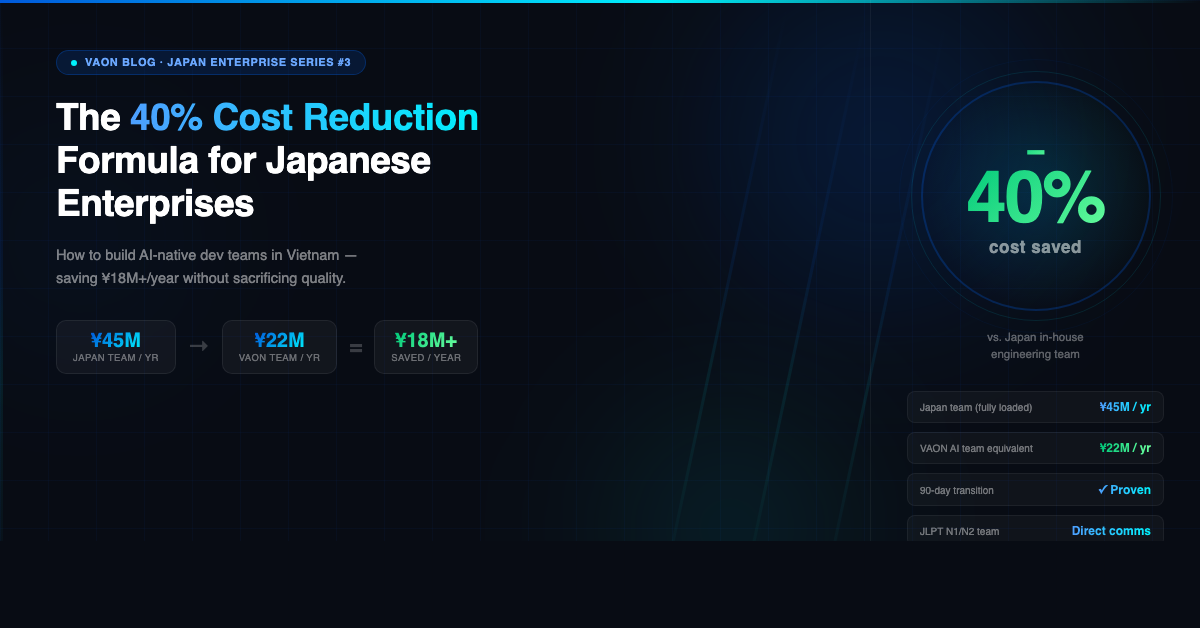
Across our client base at VAON Việt Nam, we're consistently seeing a 38–42% reduction in total development cost when companies transition to AI-augmented Vietnam-based teams — with no compromise on delivery speed or software quality. In several cases, delivery speed improved.
This article breaks down exactly where that 40% comes from, what the risks are, and how to start extracting this advantage in the next 90 days.
1. The Real Cost Breakdown (Japan vs. Vietnam)
Most cost comparisons are dishonest. They compare gross salary figures and ignore everything else. Let's do this properly.
・A 5-person in-house team in Japan (annual)
| Cost Item | Annual (¥M) |
| Base salaries (avg ¥5.5M × 5) | ¥27.5M |
| Social insurance / bonuses (×1.3) | ¥8.25M |
| Recruitment & HR overhead | ¥3.5M |
| Office space (Tokyo avg) | ¥3.6M |
| Tools, licenses, equipment | ¥1.2M |
| Training & onboarding | ¥1.0M |
| Total fully-loaded | ¥45.05M |
・A 5-person AI-native Vietnam team via VAON (annual)
| Cost Item | Annual (¥M) |
| Team cost (VAON all-inclusive) | ¥18M–¥22M |
| Communication overhead | ¥0.5M |
| Onboarding / transition | ¥0.8M (year 1 only) |
| Total year 1 | ¥19.3M–¥23.3M |
| Total year 2+ | ¥18.5M–¥22.5M |
The math is simple: 48–59% lower cost at team level. But why does the actual realized saving land at 40% rather than 50%+?
Because smart companies don't just swap headcount. They reinvest a portion of savings into:
- One Japanese liaison / project manager in-house
- Quarterly on-site visits to Vietnam
- Slightly larger Vietnam team (6–7 engineers vs 5) to absorb the productivity delta
When you account for this smart reinvestment, the net saving settles at 38–42% — which is still transformative at scale.
2. The Three Multipliers That Make This Work
Cost arbitrage alone never produces this result sustainably. Three specific factors at VAON multiply the base savings:
・Multiplier 1: AI-Native Workflow = Higher Output per Engineer
Every VAON engineer uses AI tools as a baseline workflow, not a nice-to-have. This means:
- Claude Code-class code generation for routine implementation (30–40% of typical sprint work)
- Automated test generation achieving 80%+ coverage without manual test-writing
- AI code review integrated into every PR — catches bugs before humans see them
- LLM-assisted documentation kept synchronized with code automatically
The compounding effect: a VAON team of 5 delivers the equivalent output of a traditional team of 7, measured by story points, feature velocity, and bug rate.
For Japanese clients, this means you're not just paying less — you're getting more.
・Multiplier 2: JLPT N1/N2 Communication = Near-Zero Translation Overhead
Traditional offshore development bleeds cost through communication failure: requirements get lost in translation, sprint goals misalign, bugs proliferate from misunderstood specs.
VAON engineers hold JLPT N2 or N1 certifications. Technical requirements written in Japanese are understood directly. Client meetings happen in Japanese without interpreters. This eliminates:
- External translation costs (¥150,000–¥300,000/year for mid-size projects)
- Rework cycles caused by specification misunderstandings (typically 15–20% of sprint velocity)
- Management overhead from coordinating bilingual liaisons
This single factor is responsible for roughly 8–12% of the total cost advantage.
・Multiplier 3: Direct Engineer Access = Faster Decisions, Less Bureaucracy
Traditional outsourcing models insert account managers, project coordinators, and middle layers between you and the engineers building your product. Every layer adds latency and cost.
VAON operates on a direct model: Japanese clients communicate directly with their assigned engineering team. When you have a question, you get an engineer, not a project manager paraphrasing an engineer.
This creates measurable efficiency gains:
- Decisions that take 3–5 days in traditional outsourcing take 4–8 hours with direct access
- Scope changes propagate in real-time rather than through formal change request cycles
- Sprint retrospectives are honest rather than diplomatically filtered
3. The Risk Register (Honest Assessment)
Any article that tells you offshore AI development is without risk is selling you something. Here are the real risks and how to manage them.
・Risk 1: First 90 days are rough
The transition period is the hardest. Requirements documentation needs to improve. Communication norms need to be established. The team needs to learn your codebase. Budget 20% more management time in months 1–3.
- Mitigation: Start with a bounded pilot project — not your core production system. Choose a standalone service, a new feature, or a non-critical module. Validate the working relationship before expanding scope.
・Risk 2: Time zone friction (Vietnam is UTC+7, Japan is UTC+9)
The 2-hour difference is manageable but requires intentional scheduling. Async communication quality becomes critical.
- Mitigation: Establish a 2-hour daily overlap window (e.g., 10:00–12:00 JST / 08:00–10:00 ICT). All blocking questions must be answered within this window. VAON teams are structured for this by default.
・Risk 3: Knowledge concentration in the Vietnam team
If key engineers leave, institutional knowledge leaves with them.
- Mitigation: VAON maintains documentation-first workflows — every technical decision, architecture choice, and non-obvious implementation is documented as part of the team's standard process. Knowledge lives in the codebase and docs, not just engineers' heads.
・Risk 4: Quality drift without visibility
Without proper observability, quality degrades silently.
- Mitigation: Weekly demos (not reports), AI-enforced code review standards, and automated quality metrics (test coverage, bug rate, deployment frequency) make quality measurable and visible at all times.
4. Your 90-Day Transition Roadmap
The companies that fail at Vietnam offshore transitions try to do too much too fast. Here's the framework that works:
・Month 1: Foundation (Days 1–30)
Kick off with one bounded pilot project (one new feature or one standalone service) Complete documentation audit: what does your current team know that isn't written down? Establish communication protocol: which tools, which cadence, which channels Set quality baseline: what are your current bug rate, deployment frequency, and test coverage?
・Month 2: Integration (Days 31–60)
Vietnam team achieves first production deployment Retrospective: what worked, what didn't? Calibrate team size if needed (expand or contract based on pilot results) Begin knowledge transfer: architecture review sessions, onboarding documentation for core systems
・Month 3: Expansion (Days 61–90)
Expand scope to second project or increase team allocation to core system Formalize communication patterns that emerged organically in months 1–2 Measure cost reduction against baseline (you should be tracking toward the 40% target) Decision point: full transition, partial transition, or hybrid model
Most VAON clients see measurable results by day 45. By day 90, the working model is established enough to make an informed long-term decision.
5. Who This Works For (And Who It Doesn't)
- This model works well for:
Japanese SaaS companies with established codebases looking to accelerate feature development
Enterprises building internal tools, automations, or AI integrations alongside a core team
Startups post-product-market-fit scaling their engineering capacity
Companies whose Japanese engineers are bottlenecked on high-value strategic work because of execution overhead
- This model is harder for:
Companies without any technical documentation (we can help build it, but it takes time)
Products in highly regulated domains requiring Japanese-certified infrastructure from day one
Teams where cultural friction with offshore collaboration is a leadership-level blocker (this needs to be addressed before the technical engagement begins)
- The Bottom Line
The 40% cost reduction is real. It's not a sales number — it's a calculation our clients audit themselves, quarterly.
But the more important number is what that 40% buys you. For a team spending ¥45M annually on development, freeing ¥18M/year is not just a cost saving. It's the budget for:
- One senior product hire in Japan to drive strategy
- One additional AI-native team in Vietnam for a new product line
- Three months of aggressive paid growth experiments
- A year of design, marketing, and sales investment
The companies winning in the Japan B2B tech market in 2026 aren't the ones with the largest engineering headcount. They're the ones who figured out how to spend their engineering budget more intelligently.
Ready to calculate your specific 40%?
Book a 30-minute consultation with VAON's team at vaon.com.vn/en/contact.
We'll model your current cost structure, show you the Vietnam equivalent, and outline a realistic 90-day transition plan.