
In modern software discussions, microservices are often treated as the “correct” architecture by default.
For many teams, the logic seems simple:
microservices mean scalability, flexibility, and modern engineering.
But in practice, that assumption is often wrong.
Microservices are not automatically better. In the wrong context, they can increase complexity, slow delivery, and create more operational overhead than business value.
The real question is not:
“Should we use microservices because the market does?”
The better question is:
“What architecture fits our current product, team, and business stage?”
In this article, we will look at when microservices are the wrong choice, what problems they often create, and what a more practical alternative looks like.
Why Microservices Are Often Chosen Too Early
Many companies choose microservices for the wrong reasons.
Common examples include:
- wanting to look “modern”
- copying the architecture of large tech companies
- assuming future scale will justify present complexity
- believing microservices automatically improve speed and quality
However, architecture should be based on actual operational needs, not architectural fashion.
A company with one product, one engineering team, and one shared release cycle usually does not need distributed services on day one.
In many such cases, microservices solve future problems that may never arrive, while creating immediate costs that are very real.
When Microservices Are the Wrong Choice

1. The product is still evolving quickly
If the product scope changes frequently, microservices can become a burden.
Why?
Because every time business logic changes, the team may need to adjust multiple services, API contracts, deployment flows, monitoring rules, and data consistency behavior.
When the domain is still changing, too much separation can slow down learning.
At an early stage, speed of iteration is usually more valuable than architectural purity.
2. The engineering team is still small
Microservices require more than coding skill.
They also require maturity in:
- service boundaries
- DevOps
- observability
- CI/CD
- infrastructure automation
- incident handling
- version management
If one small team is still building everything together, splitting the system into many services may not increase autonomy. It may only increase communication cost.
A small team often works better with a simpler architecture that is easier to understand, maintain, and release.
3. There is no real scaling bottleneck yet
Many teams introduce microservices before they have any actual performance or scaling problem.
This is risky.
A monolith can often support far more traffic and business complexity than people expect — especially when:
- the codebase is clean
- modules are separated logically
- queries are optimized
- caching is used properly
- infrastructure is sized correctly
If there is no proven bottleneck, adding service boundaries too early may simply create more moving parts without measurable benefit.
4. The business domain is not yet clearly separated
Microservices work best when business capabilities are already well understood.
For example:
- order management
- billing
- notifications
- identity
- reporting
If those domain boundaries are still unclear, service boundaries will also be unclear.
That usually leads to:
- duplicated logic
- unclear ownership
- too many cross-service dependencies
- constant API adjustments
In other words, the architecture becomes distributed, but the confusion also becomes distributed.
5. The team is not ready for operational overhead
Microservices increase operational responsibility.
Once a system is split into many services, the team must manage:
- deployment pipelines for each service
- inter-service communication
- network failures
- retries and timeouts
- logging and tracing
- monitoring and alerting
- service discovery
- security between services
These are real costs.
If the organization is not ready to operate such a system properly, microservices can reduce reliability rather than improve it.
A Better Alternative: The Modular Monolith
When microservices are too early, the best alternative is often not a “big messy monolith.”
It is a modular monolith.
A modular monolith keeps the system as one deployable application, but organizes the internal structure into clear modules with defined responsibilities.
For example:
- Customer module
- Order module
- Billing module
- Notification module
- Admin module
This approach gives several advantages:
- simpler deployment
- easier debugging
- lower infrastructure overhead
- better development speed
- cleaner future migration path
Most importantly, it allows the team to learn the real business boundaries before distributing them physically.
A modular monolith is often the most practical architecture for companies that want both speed and long-term maintainability.
When It Really Makes Sense to Move to Microservices
Microservices become more reasonable when several conditions are already true.
For example:
- different domains are stable and clearly separated
- different teams own different business areas
- some modules need to scale independently
- release cycles need to be separated
- one part of the system changes much faster than others
- operational maturity is already in place
At that stage, splitting services is no longer driven by hype.
It is driven by real organizational and technical needs.
That is the right moment to move.
How to Decide in a Practical Way
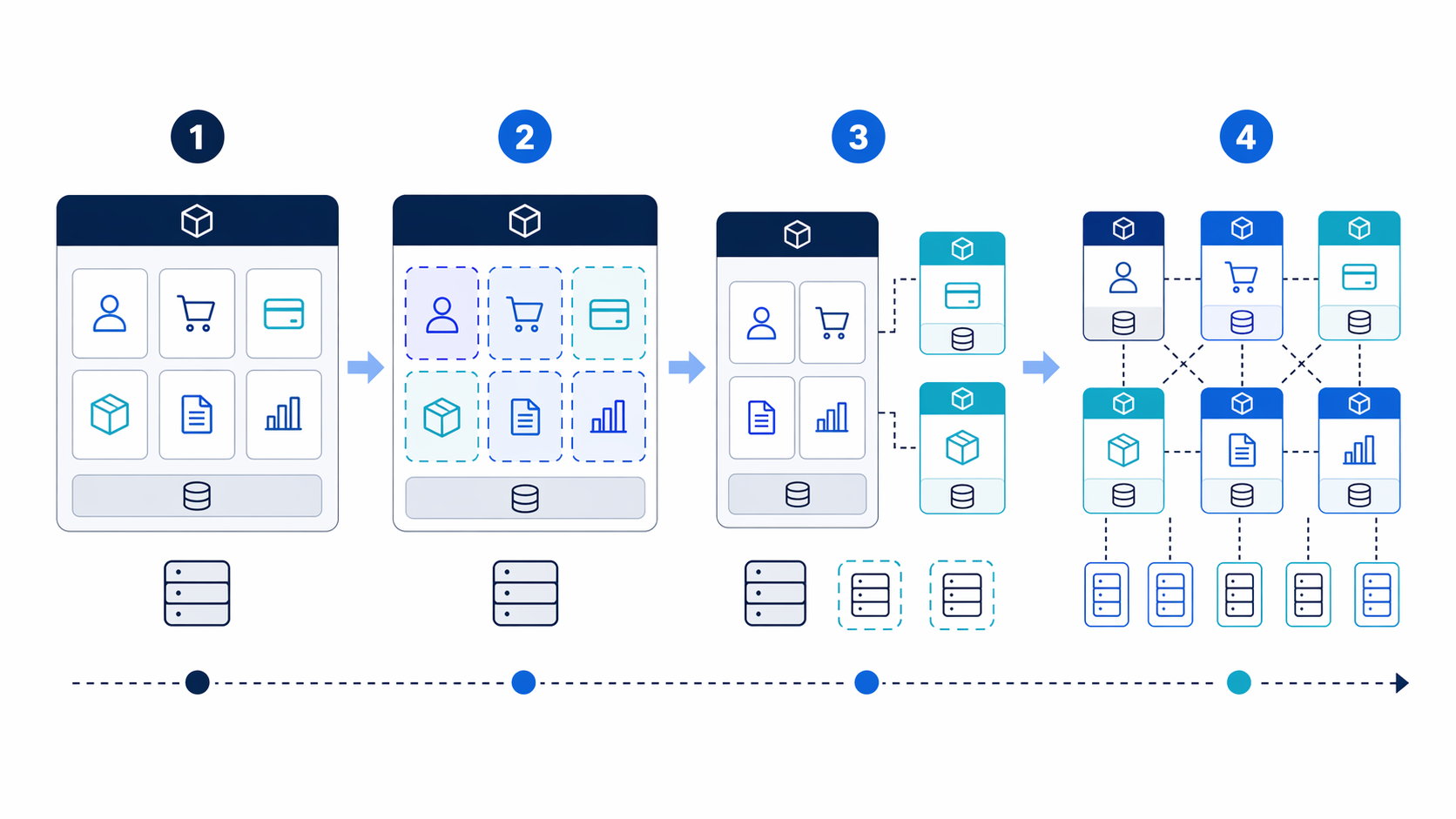
If you are deciding between a monolith, modular monolith, or microservices, start with these questions:
- Is the business domain already stable?
- Do we have real scaling pain today?
- Do different teams need independent release cycles?
- Are we operationally ready for distributed systems?
- Will this decision reduce complexity now, or increase it?
The goal of architecture is not to impress other engineers.
The goal is to support product delivery, business clarity, and sustainable growth.
Final Takeaway
Microservices are not wrong.
But they are often chosen too early.
For many growing businesses, the better approach is:
- start simple
- structure clearly
- separate modules internally
- move to distributed services only when real conditions require it
Good architecture is not about choosing the most fashionable pattern.
It is about choosing the structure that helps your business move faster with less unnecessary complexity.
VAON supports businesses in making practical architecture decisions — from early system planning to scalable implementation and long-term delivery.