AI-Native Development Teams: The 2026 Competitive Advantage Japanese CTOs Are Banking On
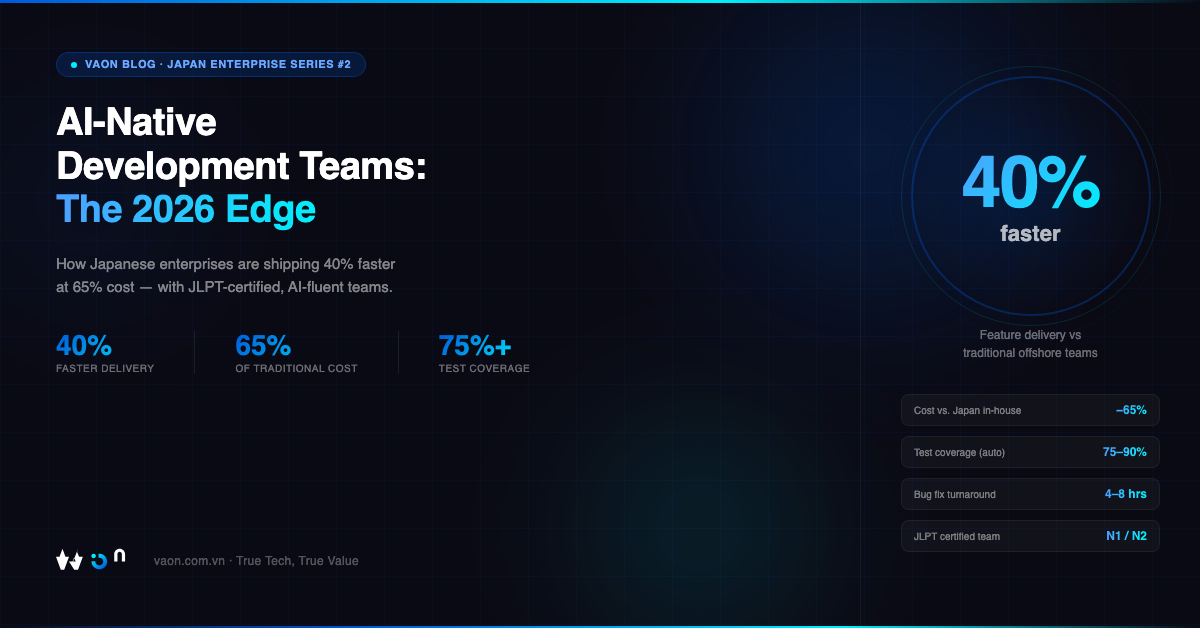
The year is 2026. Japanese enterprises that embraced AI-augmented development workflows 18 months ago are now shipping features 40% faster, with 30% fewer bugs, at 65% of their previous cost structure. Their competitors — still running traditional offshore engagements — are watching the gap widen in real time.
This isn't a prediction. It's a pattern we're seeing directly with clients at VAON Viet Nam. And it's fundamentally reshaping how Japanese companies think about software development partnerships.
In this article, we break down exactly what "AI-native development" means in practice, why Vietnam has become the leading hub for AI-augmented teams targeting the Japanese market, and how enterprises can capture this advantage now — before their competitors do.
1. What "AI-Native" Actually Means (And What It Doesn't)
The term gets thrown around constantly. Let's be precise.
AI-native development is not using ChatGPT to write code comments or asking an AI to generate a CRUD endpoint once a month. It's a systematic, workflow-level integration of AI tools across every phase of the development lifecycle:
- AI-assisted code generation: GitHub Copilot-class tools that help engineers write boilerplate, suggest context-aware patterns, and catch common errors in real-time — not as a gimmick, but as a baseline expectation for every line of code
- Automated testing pipelines: AI-driven test generation achieving 80%+ code coverage without manual test-writing — tests that run on every commit, not just before release
- AI code review: Static analysis combined with LLM-powered review that catches security vulnerabilities, performance bottlenecks, and architectural anti-patterns before they reach production
- Intelligent documentation: Auto-generated API docs, user guides, and inline comments that stay synchronized with code changes — documentation that's always current, not always outdated
- Predictive quality assurance: ML models trained on project history that flag where bugs are statistically most likely to emerge — shifting QA left, before problems become incidents
The compounding effect of these tools, applied consistently, is significant.
An AI-native team of 5 engineers delivers the output that a traditional team of 7–8 engineers would produce — with better consistency, higher test coverage, and significantly fewer late-night debugging sessions.
For Japanese enterprises currently paying ¥600,000+ per engineer per month — with overhead pushing the real cost well above ¥1,000,000 per head — this arithmetic matters enormously.
2. Why Vietnam Leads the AI-Native Development Race
Vietnam didn't become the AI-native offshore hub by accident. Three converging factors created this opportunity, and they reinforce each other.
Factor 1: A Young, Fast-Adopting Talent Base
Vietnam's developer community has a median age of 28. This demographic adopted AI tools early and enthusiastically — not as a replacement for engineering skills, but as a multiplier. The learning curve for AI development tooling among Vietnamese engineers is steeper than any other offshore market, partly because there's no legacy mindset to overcome.
When GitHub Copilot launched, Vietnamese developers were among its fastest adopters globally. When AI code review tools emerged, they were benchmarking them within weeks. This isn't coincidence — it's generational.
Factor 2: English and Japanese Language Capability
Here's a practical point that most analyses miss: AI tools produce their best outputs in English. Having engineers who can effectively prompt, evaluate, and iterate with AI tools in English — while communicating technical specifications fluently in Japanese — creates a unique advantage.
This "bilingual AI fluency" means the team isn't losing value in translation. Prompts are precise, outputs are evaluated critically, and the results translate back to Japanese client requirements without distortion.
Factor 3: Two Decades of Japanese Quality Alignment
Japan has been Vietnam's #1 offshore technology partner since the early 2000s. This isn't just a business relationship — it's a cultural transmission. Thousands of Vietnamese engineers have spent careers in Japanese-oriented teams, absorbing the quality standards that define Japanese enterprise expectations:
- Meticulous attention to edge cases and specification details
- Documentation discipline that matches client requirements exactly
- Communication patterns that prioritize clarity over speed
- A work ethic that treats "good enough" as not good enough
JLPT certification isn't just a language credential in this context. It's a marker of engineers who chose to invest in understanding Japanese professional culture deeply — and that self-selection matters.
At VAON Viet Nam, our teams are built around exactly this convergence: JLPT N1/N2 certified engineers who are AI-tooling fluent, operating through direct client communication that eliminates the project manager bottleneck that slows down traditional offshore engagements.
3. The Numbers: AI-Native vs. Traditional Development
Concrete comparisons, based on observed performance patterns:
Development Velocity:
| Metric | Traditional Offshore Team | AI-Native Team |
|--------|--------------------------|----------------|
| Feature delivery cycle | 2–3 weeks | 1–1.5 weeks |
| Bug fix turnaround | 2–3 days | 4–8 hours |
| Code review completion | 1–2 days | 2–4 hours |
| Documentation lag | Weeks (often months) | Real-time |
Quality Indicators:
| Metric | Traditional | AI-Native |
|--------|-------------|-----------|
| Test coverage baseline | 40–60% | 75–90% |
| Code review depth | Syntax + obvious bugs | Security + Performance + Architecture |
| Bug escape rate (to production) | 8–12% | 3–5% |
| Documentation currency | Frequently outdated | Continuously updated |
Cost Efficiency:
A 5-person AI-native development team at VAON typically costs 60–70% less than an equivalent in-house Japanese team, while delivering 20–30% more monthly output. Factoring in AI tooling multipliers, the total productivity-adjusted value advantage compared to traditional Japanese in-house development often exceeds 75%.
This isn't offshoring for the sake of cutting corners. It's a structural efficiency that frees capital for product innovation, market expansion, or competitive investment.
4. Real-World Applications: What This Looks Like for Japanese Clients
Abstract percentages need grounding. Here's how AI-native development plays out in practice:
Scenario A: Legacy System Modernization
A Japanese manufacturer needs to modernize a 15-year-old inventory management system. Traditional approach: 8 engineers, 18–24 months, high risk of scope drift.
With AI-native development:
- AI-assisted code analysis maps legacy data flows and dependencies in days, not weeks
- Automated refactoring recommendations identify 60% of changes that can be executed safely without manual inspection
- AI-generated regression tests create a safety net before any migration begins
- Outcome: 5 engineers, 10–12 months, verifiable safety at each migration stage
Scenario B: New B2B Platform Development
A Japanese SaaS company needs to build a new B2B platform from scratch. Traditional approach: 6–8 engineers, 12–15 months to first production release.
With AI-native development:
- Rapid AI-assisted prototyping compresses the MVP from 3 months to 6 weeks
- Architecture review tools catch scalability problems before they become expensive rework
- Auto-generated API documentation means the platform is developer-ecosystem-ready at launch
- Outcome: 4–5 engineers, 8–10 months, production-quality with comprehensive documentation
Scenario C: Ongoing Product Development Partnership
A Japanese enterprise running continuous product development (sprints, regular releases, feature backlog). Traditional approach: overhead-heavy with PM coordination costs eating into velocity.
With AI-native direct-communication model:
- Engineers communicate directly with product owners, eliminating 2–3 day latency in requirement clarification
- AI tooling maintains a living architecture document that onboards new team members without knowledge transfer sessions
- Automated monitoring flags regressions within the sprint they're introduced
- Outcome: Consistent 40%+ velocity advantage over comparable traditional offshore teams
5. The Hidden Risk: What Happens If You Wait
Here's the uncomfortable reality for Japanese enterprises still evaluating AI-native partnerships: the competitive disadvantage doesn't stay constant. It compounds.
Every month a company continues running traditional development workflows, they accumulate:
Technical debt that becomes harder to migrate. AI-native development produces cleaner, more modular, better-documented code. Traditional offshore development often produces code that's tightly coupled, under-tested, and dependent on tribal knowledge that lives in a project manager's notes. Over time, this structural difference means migration costs grow, not shrink.
Market timing losses. Competitors using AI-native teams ship features 40% faster. Over 12 months, that's a significant product roadmap advantage — features launched, customer feedback incorporated, iterations completed — that simply didn't happen on the slower track.
Widening cost gap. Japanese engineer salaries are projected to increase 8–12% annually through 2028. At the same time, AI tooling continues to improve, widening the productivity advantage of AI-native offshore teams. The financial case for AI-native partnerships will only strengthen — but the time to establish the relationship on favorable terms is now, not after competitors have locked in the best partners.
6. How to Evaluate an AI-Native Development Partner: 5 Questions That Separate Real from Marketing
Not every vendor claiming "AI-native" actually delivers it. Vague positioning is easy. Here's how to test substance:
1. “Show me your AI toolchain.”
A genuine AI-native team can enumerate the specific tools they use at each development stage — code generation, testing, review, documentation, monitoring. They have opinions about why they use each tool and what its limitations are. Vague answers about "leveraging AI" without specifics are a red flag.
2. “What's your test coverage baseline for a typical engagement?”
AI-native teams should achieve 75%+ test coverage as a standard outcome, not an exceptional achievement. Below 60% suggests automated testing isn't actually integrated — it's just a talking point.
3. “How do you handle AI hallucinations in production code?”
This question reveals the maturity of their AI governance. Good teams have explicit human review checkpoints for AI-generated code before it enters the main branch. "We trust the AI" is not an acceptable answer.
4. “What does your client communication structure look like?”
The best AI-native partnerships eliminate the project manager layer between engineers and clients. Direct technical communication — engineers talking to product owners and CTOs — is what enables the 40% velocity advantage. If the answer is "you'll have a dedicated PM who relays all communication," the velocity gain evaporates.
5. “Can you share documentation from a completed project?”
AI-native teams produce comprehensive documentation as a natural byproduct of their workflow — architecture diagrams, API references, decision logs, onboarding guides. Ask to see a real example. If documentation is sparse or obviously after-the-fact, the team isn't truly AI-native.
Conclusion: The 2026 Decision Point
The enterprises that establish AI-native development partnerships today will enter 2027 with compounding structural advantages: faster product velocity, lower cost structures, cleaner codebases, and development partners who understand their systems deeply.
Those that wait will face not just the cost of catching up, but the opportunity cost of everything they didn't ship — every feature delayed, every bug that took three days to fix instead of four hours, every documentation request that became a month-long project.
VAON Viet Nam was built for exactly this inflection point. Our JLPT N1-certified, AI-native engineering teams work as an extension of your internal team — with the speed and cultural alignment that Japanese enterprise clients expect, and the AI tooling discipline that modern development demands.
The question isn't whether to partner with an AI-native development team. It's whether you'll do it before your competitors do.
*Ready to see what AI-native development looks like in your specific context?*
*[Book a 30-minute discovery call with VAON's engineering team →](https://vaon.com.vn/en)*