
Good System Architecture Starts Before Coding
In software development, many projects begin with a simple question:
“When can we start coding?”
This is an understandable question. Companies want to move fast, release early, and see visible progress. Developers also want to start building as soon as possible.
But before coding begins, there is one important question that should not be skipped:
“What kind of system are we actually building?”
This is where system architecture becomes critical.
System architecture is not just a technical diagram. It is the foundation that determines how the system will grow, how easily it can be maintained, how safely it can operate, and how much it will cost in the future.
A project can start quickly without architecture.
But it may not scale smoothly without architecture.
At VAON, we believe good system architecture starts before the first line of code is written.
Architecture Is a Business Decision, Not Only a Technical One
Many people think system architecture is only a technical topic for engineers.
Of course, architecture includes technical decisions: programming languages, frameworks, databases, cloud services, API design, security models, and deployment methods.
But the impact of architecture goes far beyond engineering.
Architecture affects business speed.
Architecture affects maintenance cost.
Architecture affects user experience.
Architecture affects security and reliability.
Architecture affects how quickly the business can respond to change.
For example, if a system is built without considering future expansion, adding new features later may become slow and expensive.
If data structure is poorly designed, reports and analytics may become difficult.
If roles and permissions are not considered early, security issues may appear later.
If deployment and monitoring are ignored, production operation becomes risky.
These are not only engineering problems.
They are business risks.
That is why architecture should be discussed together by both business and technical teams.
Fast Coding Can Create Slow Projects
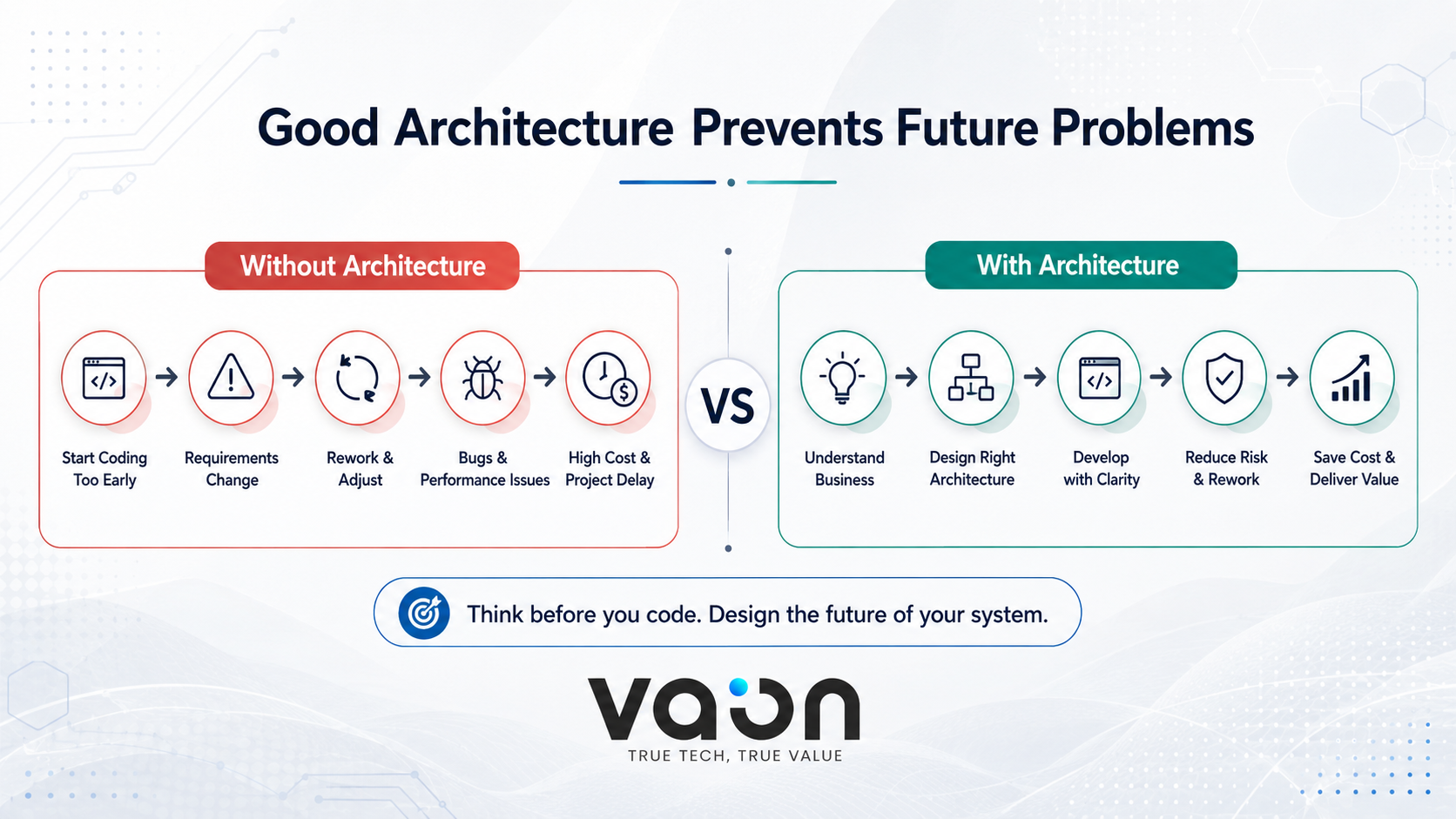
Starting development too quickly may create the feeling of progress.
Screens are created. APIs are implemented. Features appear in the test environment. The project seems to be moving fast.
However, if the foundation is weak, the project may slow down later.
Developers may need to rewrite core logic.
New features may conflict with old assumptions.
Testing may become complicated.
Performance issues may appear after user growth.
Bug fixing may take longer because the system is tightly coupled.
Operational problems may appear after release.
In this situation, the project did not really move fast.
It only postponed the cost.
Good architecture helps avoid this trap.
It does not mean spending too much time on abstract design.
It means making the right level of design decisions before implementation becomes expensive to change.
What Good Architecture Should Clarify
Good architecture does not need to be complicated. In many cases, a simple architecture is better than an over-engineered one.
But it should clarify the key foundations of the system.
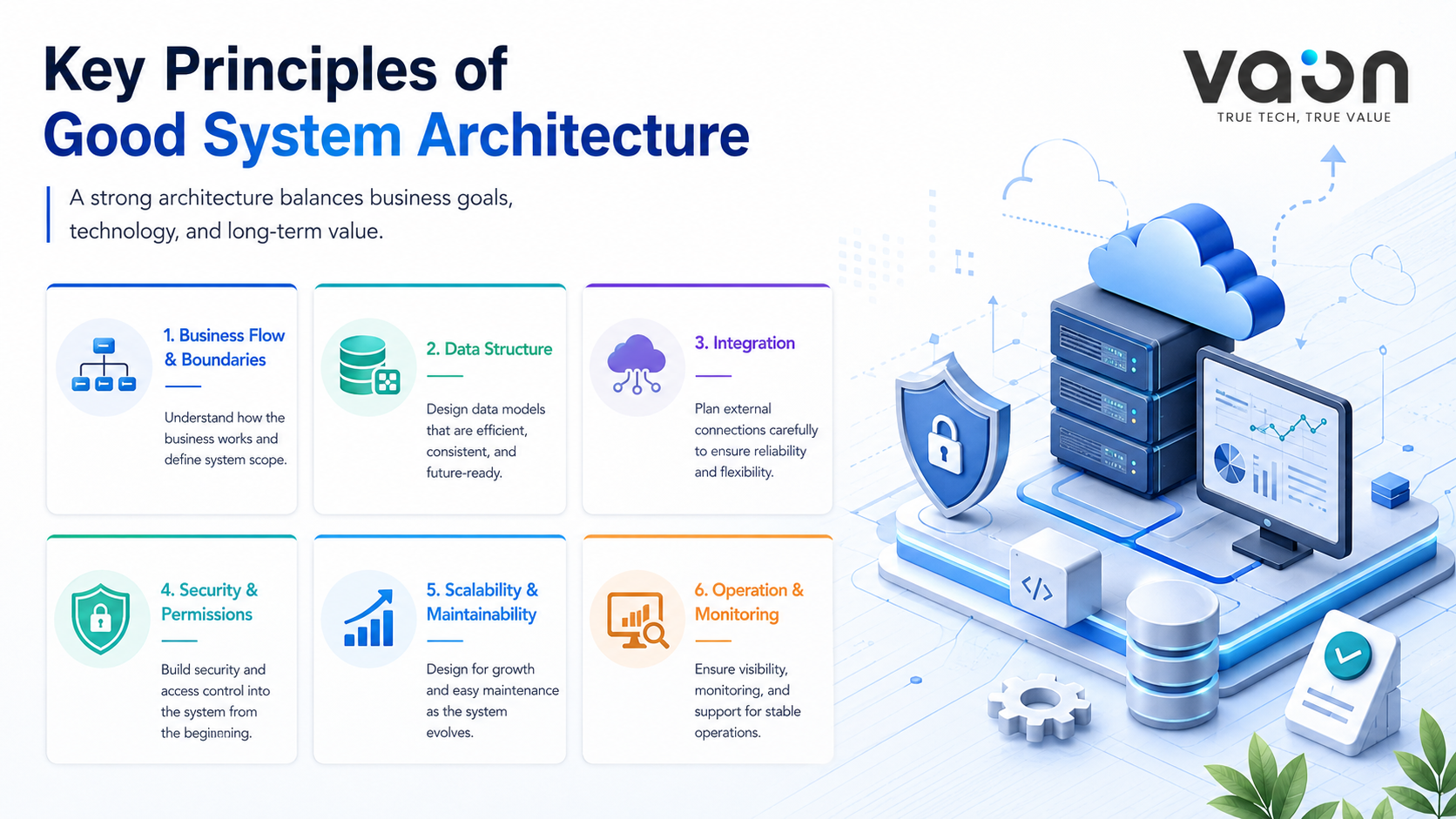
1. Business Flow and System Boundaries
Before designing technology, the team needs to understand the business flow.
Who uses the system?
What actions do they perform?
Which parts are handled by people?
Which parts are handled by the system?
Where does the system connect with external services?
Without this understanding, technical design may not fit the actual operation.
2. Data Structure
Data is one of the most important assets of any system.
The architecture should clarify what data is stored, how it is related, who can access it, and how it will be used for future reporting or integration.
Poor data design often becomes one of the most expensive problems to fix later.
3. Integration Design
Modern systems rarely work alone.
They often connect with payment services, CRM, accounting systems, logistics systems, AI services, cloud storage, notification tools, and other platforms.
Integration should be designed carefully from the beginning.
A good integration design reduces dependency, makes errors easier to handle, and helps the system remain flexible when external services change.
4. Security and Permission Model
Security should not be added at the end.
User roles, access rights, authentication, authorization, data privacy, audit logs, and operation rules should be considered early.
If permission logic is added too late, it can affect almost every part of the system.
5. Scalability and Maintainability
Not every project needs a complex architecture from day one.
But every project should consider how the system can grow.
Can new features be added without breaking existing functions?
Can the system handle more users or more data?
Can new developers join the project easily?
Can bugs be isolated and fixed quickly?
Good architecture supports long-term maintainability.
6. Operation and Monitoring
A system does not end when it is released.
After release, the team needs to monitor errors, performance, storage, access logs, security events, and user behavior.
Architecture should include operational visibility from the beginning.
Without monitoring, the team only discovers problems after users complain.
Simple Does Not Mean Weak
Some teams misunderstand architecture as something heavy, complex, and slow.
But good architecture is not about making the system complicated.
Good architecture is about making the system understandable, maintainable, and ready for change.
In many projects, the best architecture is simple.
Simple enough for the team to understand.
Simple enough to maintain.
Simple enough to release quickly.
Flexible enough to grow when needed.
Over-engineering is also a risk.
If the system is designed for problems that may never happen, development cost increases and the team becomes slower.
The key is balance.
Architecture should match the business stage, budget, timeline, risk level, and growth expectation.
Architecture Requires a One-Team Approach
Good architecture cannot be created by engineers alone.
Engineers understand technology, but customers understand business reality.
The customer knows the operation flow, business priorities, user behavior, internal constraints, and future direction. The development team knows technical trade-offs, system design, implementation risks, and maintenance concerns.
If these two sides work separately, architecture becomes incomplete.
The business side may request features without understanding technical impact.
The technical side may design a system without fully understanding business priorities.
A One-Team approach solves this gap.
Both sides discuss the business goal.
Both sides clarify assumptions.
Both sides identify risks.
Both sides agree on the right level of technical investment.
This is especially important in offshore development.
When working across countries and languages, architecture becomes a shared map. It helps everyone understand not only what to build, but how the system should evolve.
Architecture Reduces Long-Term Cost
One of the biggest benefits of architecture is cost control.
A system with weak architecture may look cheaper in the beginning. But later, it can create hidden costs.
More rework.
More bugs.
More manual operation.
More difficult testing.
More expensive maintenance.
More risk when adding new features.
Good architecture does not eliminate all problems, but it reduces avoidable problems.
It helps the team build with clarity.
It also helps business leaders make better decisions. They can understand what should be built now, what can be postponed, and what technical risks need to be managed.
In this sense, architecture is not a cost center.
It is a way to protect future business value.
The VAON Perspective
At VAON, we see system architecture as the bridge between business goals and engineering execution.
A good architecture should not be written only for developers. It should help the whole project team understand the system direction.
That is why we value architecture discussions early in the project.
We clarify business flow.
We confirm system scope.
We define data and integration points.
We consider security and operation.
We choose a technical design that fits the customer’s current stage and future growth.
Our goal is not to make architecture unnecessarily complex.
Our goal is to build systems that are practical, reliable, maintainable, and valuable for the business.
Conclusion
Good software does not begin with coding alone.
It begins with understanding the business, clarifying the system boundary, designing the right data structure, planning integrations, considering security, and preparing for long-term operation.
System architecture is not a document created only for engineers.
It is a shared foundation for the project.
When architecture is weak, development may start fast but become slow later.
When architecture is strong, the team can build with confidence, adapt to change, and create long-term value.
Good architecture does not slow down development.
It helps development move in the right direction.
And in modern software development, moving in the right direction is more important than simply moving fast.