When Offshore Falls Short: Why the Engagement Model Matters More Than the Vendor
You signed an SOW. You handed over the requirements document. Six months later you had code that compiled — but did not solve the problem your business actually had.
This pattern repeats across many of the conversations we have with product, engineering, and information systems leaders at Japanese organizations who have just terminated or are considering switching offshore vendors. The cause is rarely technical. The team could write code. The team could pass unit tests. But the gap between "what the spec said" and "what the business needed" was wide enough that the delivered product was unusable, or required so much rework that the time and budget invested no longer matched the value delivered.
The natural response, after this kind of experience, is to look for a vendor with better engineers or stricter QA. Both matter. But neither is the root cause. The root cause is almost always the engagement model — specifically, the moment at which the offshore team is allowed to participate.
The Failure Mode: Spec-Then-Throw-Over-The-Wall
The standard offshore engagement model in many Japanese enterprises looks like this. The Japanese side completes the requirements definition phase internally, sometimes with the help of a domestic consulting firm. A finished specification document is then handed to the offshore vendor with the instruction: build this. The offshore team estimates, signs, and begins implementation.
This model has three structural failure points.
1) First, requirements documents are never complete. Validation rules at registration. The order in which error messages appear. Password strength logic. Currency rounding behavior. Edge cases in date handling. None of these are written down. All of them get decided — silently, by junior engineers, in another country, in another language. By the time you see the result, twenty unilateral decisions have already been made.
2) Second, the spec does not reflect implementation reality. An experienced engineer reading a requirement can say "this is straightforward with Lambda, but the API Gateway configuration will add two weeks." A spec written without that voice is optimistic at best, impossible at worst — and the realization happens in week eight, not week one.
3) Third, quality standards drift. Test coverage targets, security requirements, performance budgets — when these are imposed retroactively, they require rebuilds. When they are baked in from requirements definition, they are free.
What Upstream Participation Actually Looks Like
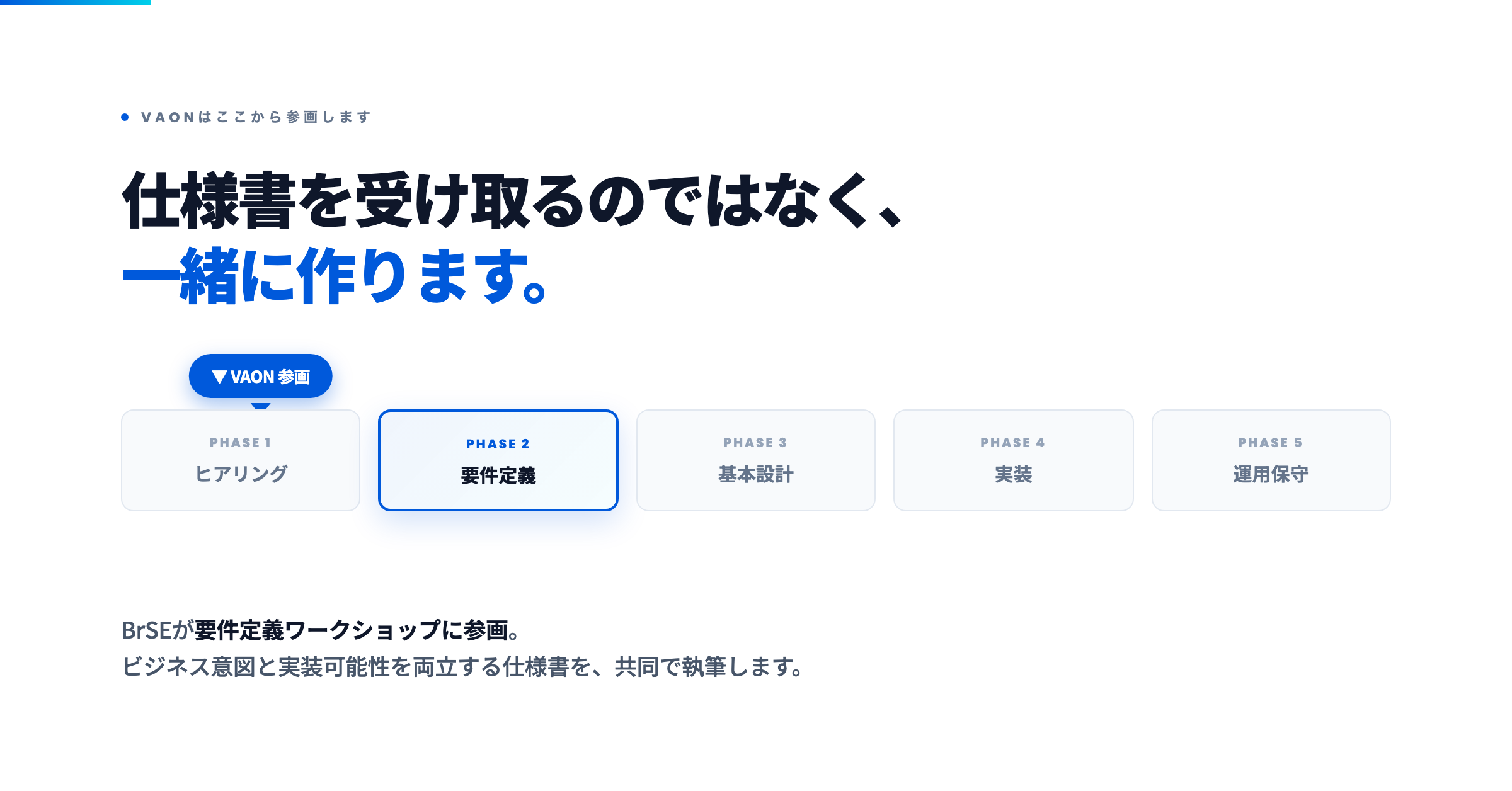
The way to change the outcome is not "be more careful next time." It is structural. The offshore vendor must participate in the requirements definition phase itself, not receive its output.
In our work with Japanese clients, VAON's senior engineer or BrSE (Bridge SE) joins the requirements workshops alongside the client's product and engineering teams. The conversation is conducted in Japanese — VAON's BrSEs hold JLPT N1, the fluency level required to co-author technical specifications with Japanese engineering teams, not just translate between them. The output is a specification co-authored by both sides: one that captures the business intent and one that respects implementation feasibility. Twenty to forty hours of upstream involvement, at the start.
The alternative — discovering the same gaps three months in — costs between one hundred and five hundred hours of rework. This is not a theoretical number. This is what we observe consistently in projects that arrive at VAON after an initial attempt elsewhere did not go as planned.
Mini Case: A Mid-Sized Tokyo Manufacturer
A mid-sized Tokyo-based manufacturing client (anonymized) approached VAON after terminating a six-month engagement with a prior offshore vendor. The prior vendor had delivered a functional internal logistics tracking system that the operations team refused to use — the workflow assumed a single warehouse, but the client operated several.
When VAON conducted the upstream workshop for the rebuild, the multi-warehouse requirement surfaced in the first hour. It had been mentioned in passing in the original kickoff but was not in the spec. The prior vendor, lacking either Japanese fluency or upstream participation, never knew to ask. The rebuild took eleven weeks and shipped on time. The client is now in their second engagement with VAON, this time on a customer-facing application.
Time and Cost: With Versus Without Upstream Participation
The pattern is consistent across project sizes:
1) Upstream participation: 20–40 hours of senior engineer time, distributed across two to four requirements workshops. This appears in the project as part of Phase 1 estimation.
2) Without upstream participation: 100–500 hours of engineering rework, plus the time spent in stakeholder meetings to revisit scope. Schedule slip is often 30–50%.
3) The cumulative effect, based on the project data we and our clients have tracked, is a consistently higher rate of projects that reach delivery on time and on scope — typically with materially fewer mid-project scope renegotiations.
For teams who have been through this before, this is not a sophisticated optimization. It is a simple structural choice made at the moment of vendor selection — not after.
・FAQ
Does upstream participation cost extra? Not at VAON. The hours are part of Phase 1 and are included in our standard estimation. Most clients see the upstream phase explicitly itemized so they understand what they are receiving.
Will switching vendors mid-project create more rework? Less than you might fear, if the new vendor takes the time to audit what exists before rebuilding. We typically run a two-week diagnostic before scoping the rebuild. This often surfaces salvageable components.
What about NDAs and IP from the previous engagement? The previous vendor's deliverables typically transfer to you under the prior SOW. The new vendor needs only the artifacts you own — source code, documentation, requirements. NDAs between you and us are signed before any artifact is shared.
Is upstream participation only useful for new projects? No. Even mid-engagement, restarting requirements alignment for the remaining scope can change the trajectory of the next phase. We have done this several times — what we call a "scope reset workshop."
・Closing
If your organization has been through this before, the question is not whether to try offshore again. The question is whether the next engagement is structured to include the offshore team at the moment when their voice matters most — requirements definition. That single choice, made before the first line of code is written, changes the shape of the entire project.
If you would like to talk through what an upstream-led engagement might look like for your specific situation, we are open to that conversation. No obligation, no pitch deck — just a working discussion.
Email: luan.dang@vaon.com.vn.