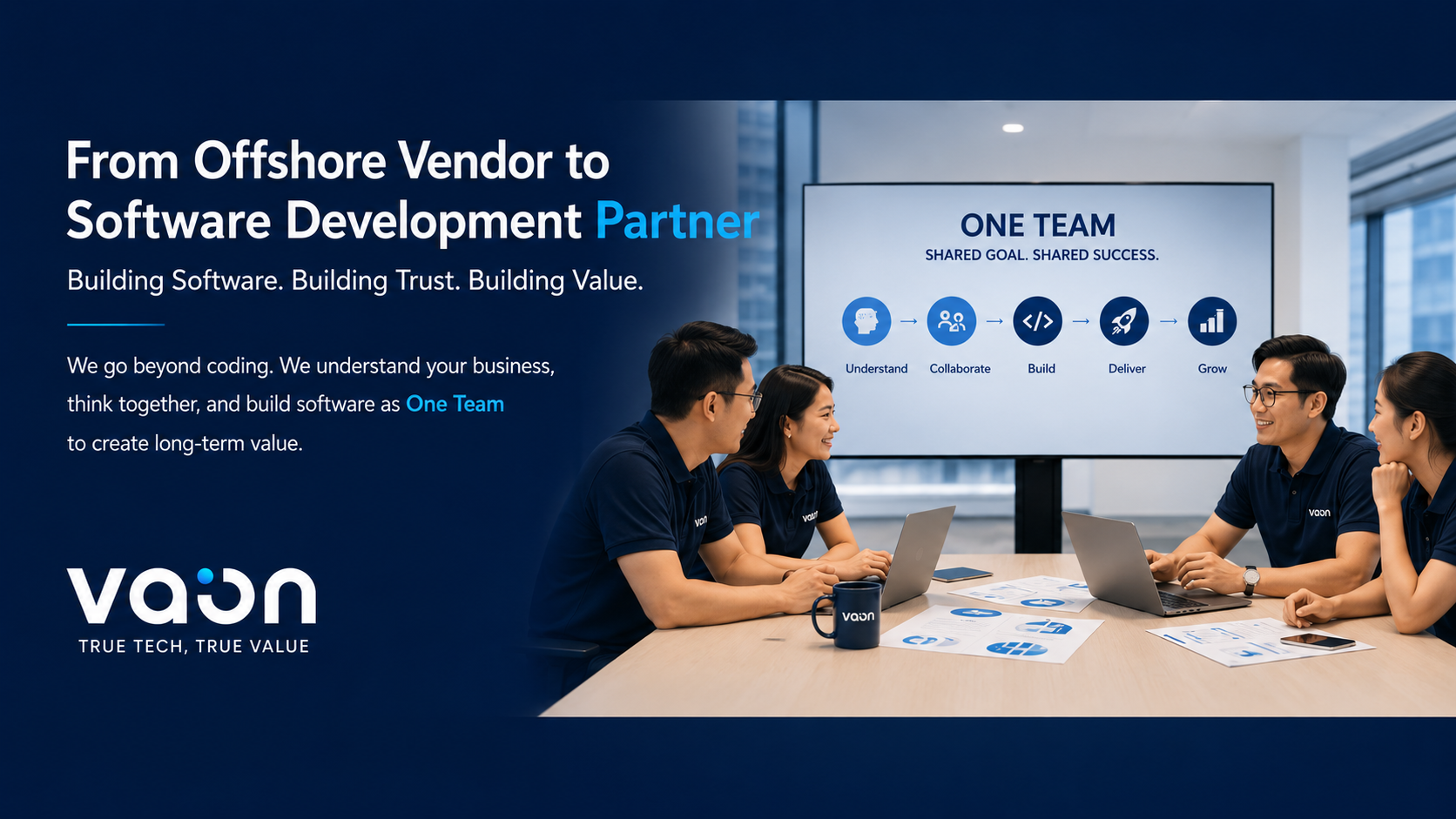
From Offshore Vendor to Software Development Partner: What Modern Companies Really Need
For many years, offshore development was mainly seen as a way to reduce development cost.
A company prepared requirements.
An offshore vendor received tasks.
Developers implemented the system.
The customer reviewed the output.
This model worked when software development was mostly about execution. But today, software has become much more closely connected to business strategy, customer experience, operations, and long-term growth.
Modern companies no longer need only offshore resources.
They need a software development partner.
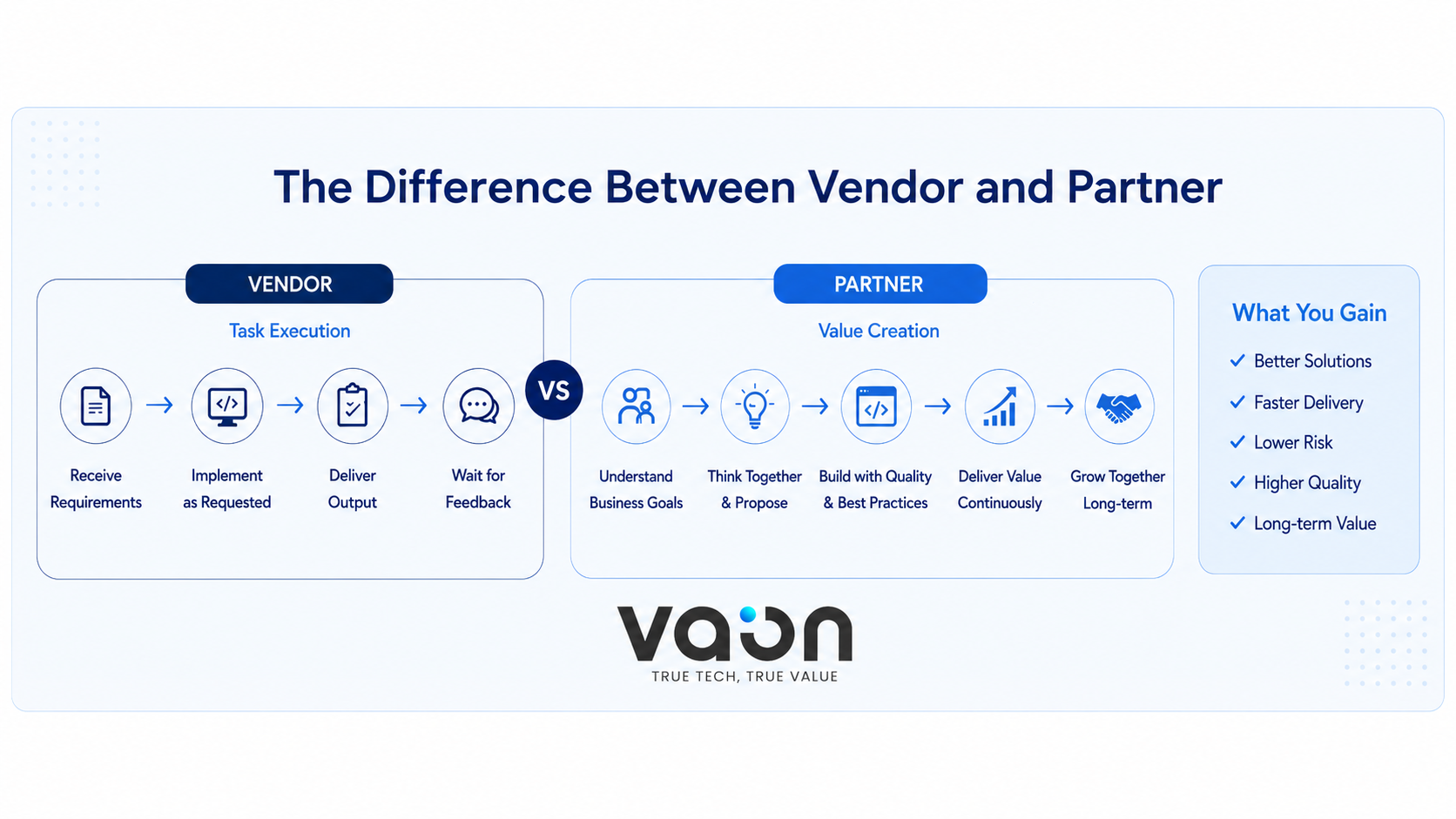
A vendor completes assigned tasks.
A partner understands why those tasks matter.
That difference changes the entire project.
Cost Reduction Is No Longer Enough
Cost is still an important reason companies consider offshore development. Lower development cost can help companies build faster, test ideas earlier, and allocate budget more efficiently.
However, cost reduction alone does not guarantee project success.
If requirements are misunderstood, the project becomes expensive.
If communication is slow, the project becomes delayed.
If the team only follows instructions without understanding the business, the product may fail to solve the real problem.
If technical decisions are made only for short-term delivery, maintenance cost can increase later.
In this situation, cheap development can become expensive development.
The real goal should not be simply to reduce cost.
The real goal should be to create better software with better efficiency.
That requires a partner mindset.
What Makes a Software Development Partner Different?
A software development partner does more than write code.
A good partner tries to understand the customer’s business model, users, operation flow, priorities, and risks. The partner does not only ask, “What should we build?” but also asks, “Why is this important?” and “Is there a better way to achieve the goal?”
This does not mean the development team replaces the customer’s business decision-making. The customer still owns the business vision. But a strong development partner can support better decisions by bringing technical knowledge, product thinking, and implementation experience.
For example, when a customer requests a new feature, a vendor may simply estimate and implement it.
A partner may ask:
Is this feature needed for the first release?
Can we solve the same problem with a simpler workflow?
Will this feature increase maintenance complexity?
What risk will appear after production release?
How will this affect users, operations, and future scalability?
These questions create value before coding begins.
The One-Team Model
At VAON, we believe that successful software development requires a One-Team model.
This means the customer and development team should not work as two separate sides. They should work as one team with shared goals, shared context, and shared responsibility for project success.
In a traditional vendor model, the customer writes requirements and the vendor implements them. Communication often becomes transactional. The customer gives instructions. The vendor gives delivery reports.
In a One-Team model, communication becomes collaborative.
Both sides discuss priorities.
Both sides identify risks.
Both sides clarify requirements.
Both sides think about the best path to delivery.
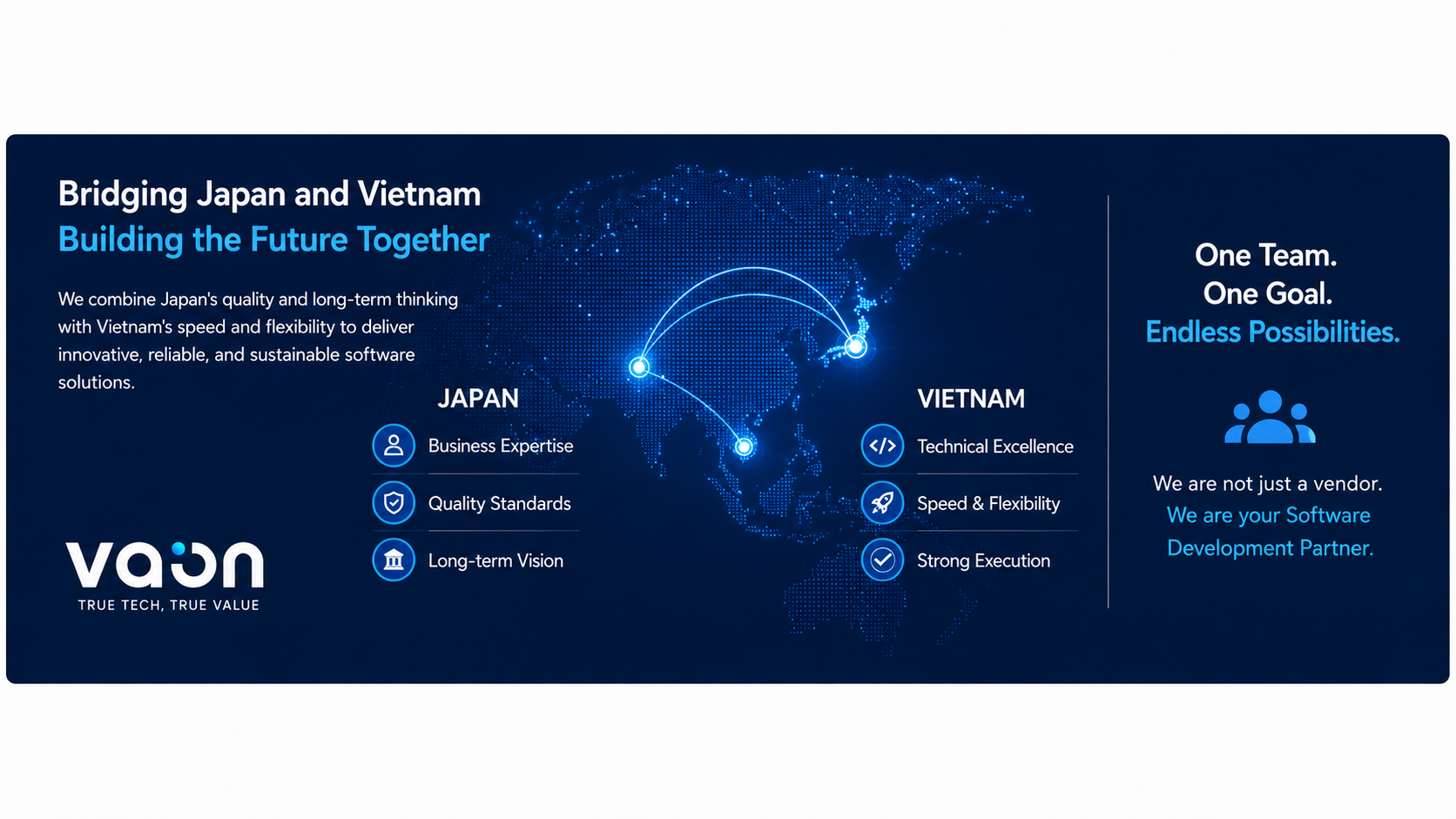
This model is especially important in Japan–Vietnam software development.
Japanese companies often bring strong business domain knowledge, quality expectations, and long-term thinking. Vietnamese development teams often bring speed, flexibility, and strong technical execution. When these strengths are connected through clear communication and shared ownership, offshore development becomes much more powerful.
Communication Is a Core Capability
In modern software development, communication is not a soft skill. It is a core delivery capability.
Many project issues are not caused by lack of programming skill. They are caused by unclear expectations, missing context, slow confirmation, or decisions that are not properly recorded.
A strong software development partner knows how to manage communication carefully.
Important discussions should be documented.
Questions should be tracked.
Decisions should be recorded.
Risks should be raised early.
Progress should be reported in a way that is understandable for both business and technical stakeholders.
This is particularly important when working across countries, languages, and cultures.
A good partner does not only translate words.
A good partner translates context.
Building for Long-Term Value
Software is not finished when the first version is released.
After release, users provide feedback. Business needs change. Operations reveal new issues. The system needs maintenance, improvement, security updates, and sometimes architectural redesign.
That is why companies should think carefully when choosing a development partner.
A short-term vendor may focus only on completing the current scope.
A long-term partner thinks about maintainability, scalability, operational efficiency, and future growth.
This does not mean every system needs to be over-engineered from the beginning. In fact, a good partner should avoid unnecessary complexity.
The key is balance.
Build fast enough to create value.
Build carefully enough to avoid future risk.
Build simply enough to maintain.
Build flexibly enough to improve later.
This balance requires both engineering judgment and business understanding.
From Task Execution to Value Creation
The role of offshore development is changing.
In the past, offshore teams were often expected to execute tasks at lower cost. Today, companies need teams that can contribute to value creation.
This means offshore teams need to understand product goals, user needs, business priorities, quality expectations, and operational constraints.
At the same time, customers also need to involve the development team earlier in the process.
The earlier the partner understands the business goal, the earlier they can identify risks, propose alternatives, and help reduce waste.
This is how software development becomes more than implementation.
It becomes a joint process of problem-solving.
Conclusion
Modern companies need more than offshore vendors.
They need partners who can understand business context, communicate clearly, manage risks, and build software with long-term value in mind.
Cost matters. Speed matters. Technical skill matters.
But they are not enough.
The real value of offshore development comes when the development team becomes part of the customer’s thinking process, not just the execution process.
At VAON, we aim to be that kind of partner.
A team that understands business and technology.
A team that works across Japan and Vietnam.
A team that builds not only software, but trust, clarity, and long-term value.
Because the future of offshore development is not just about outsourcing.
It is about building together as one team.