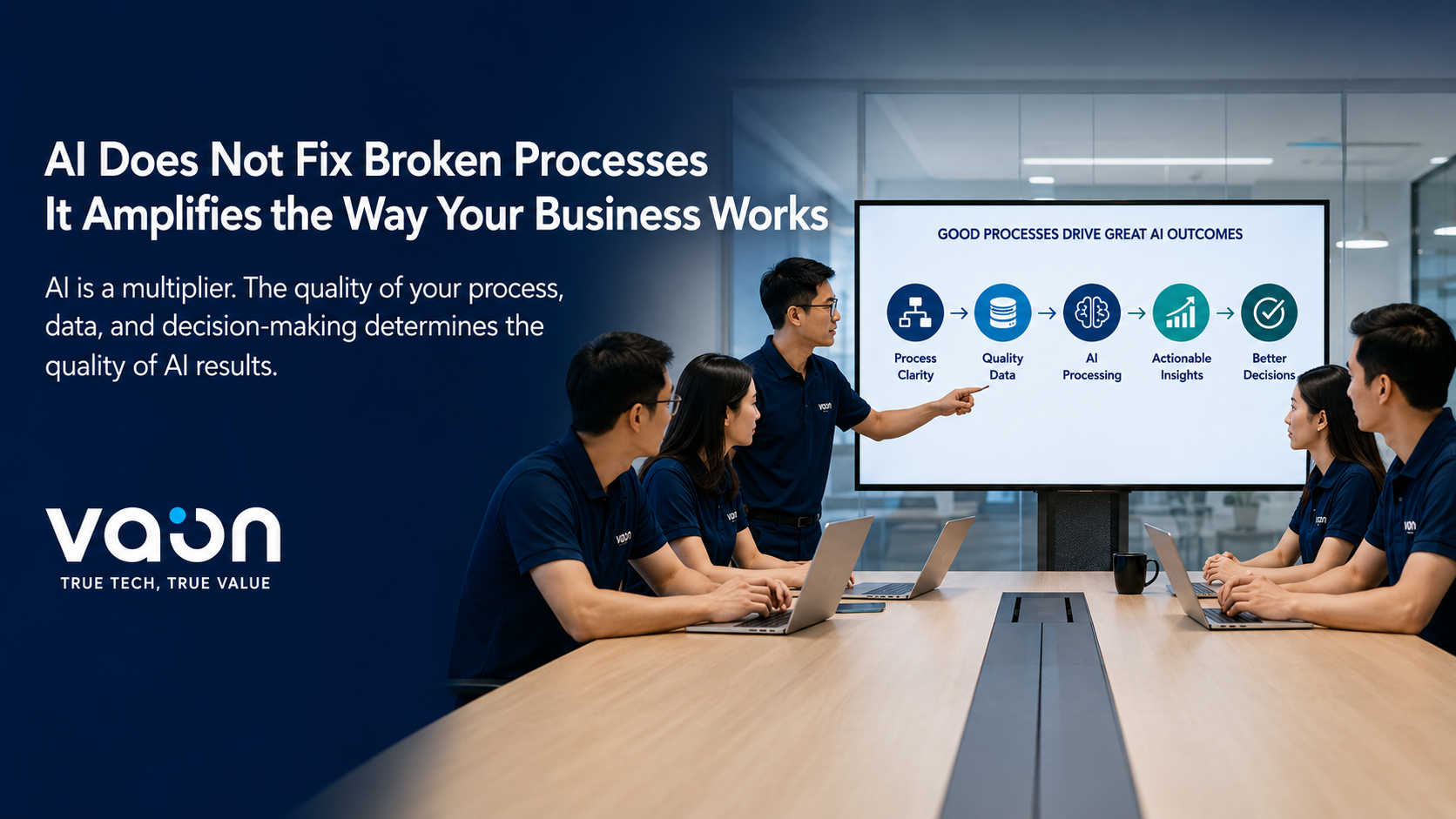
AI Does Not Fix Broken Processes — It Amplifies the Way Your Business Works
Artificial intelligence is becoming one of the most discussed themes in business transformation.
Companies are exploring AI chatbots, document automation, meeting summaries, OCR, customer support automation, internal knowledge search, and workflow optimization. The expectations are high, and for good reason. AI can reduce manual work, improve response speed, support decision-making, and help teams operate more efficiently.
But there is one important misunderstanding.
AI does not automatically fix broken business processes.
If a workflow is unclear, AI will not magically make it clear.
If data is scattered, AI will not automatically make it reliable.
If decisions are not recorded, AI cannot create organizational memory from nothing.
If teams do not share the same understanding, AI may even amplify the confusion.
AI is powerful, but it is not a replacement for operational discipline.
At VAON, we believe successful AI adoption begins before the AI implementation itself. It begins with understanding how the business actually works.
The Common Misunderstanding About AI Adoption
Many companies start AI projects with a technology-first mindset.
They ask:
Which AI model should we use?
Should we use ChatGPT, Gemini, Claude, or another model?
How much will the API cost?
Can we build an AI chatbot quickly?
Can AI replace manual operations?
These are valid questions, but they are not the first questions.
Before choosing tools, businesses need to ask more fundamental questions.
What problem are we trying to solve?
Where does the current process break down?
What information does the team need to make better decisions?
Which tasks are repetitive, rule-based, or knowledge-heavy?
Which decisions still require human judgment?
What data can AI safely access?
Without answering these questions, AI implementation can become a technical experiment rather than a business solution.
The result is often a system that looks impressive in a demo but does not create real operational value.
AI Works Best When the Process Is Already Visible
AI performs best when the business process is visible, structured, and explainable.
For example, if a company wants to build an AI chatbot for customer support, the first question should not be only “Which model should we use?”
The better questions are:
What types of questions do customers ask most often?
Where are the official answers stored?
Who approves the answers?
How should the chatbot respond when it is not confident?
When should the conversation be handed over to a human operator?
How will incorrect answers be reviewed and improved?
These questions are not purely technical. They are operational design questions.
The same applies to AI OCR, internal knowledge search, meeting summary tools, and workflow automation.
AI can process information quickly, but the business still needs to define what “correct” means.
Without that definition, AI output becomes difficult to evaluate.
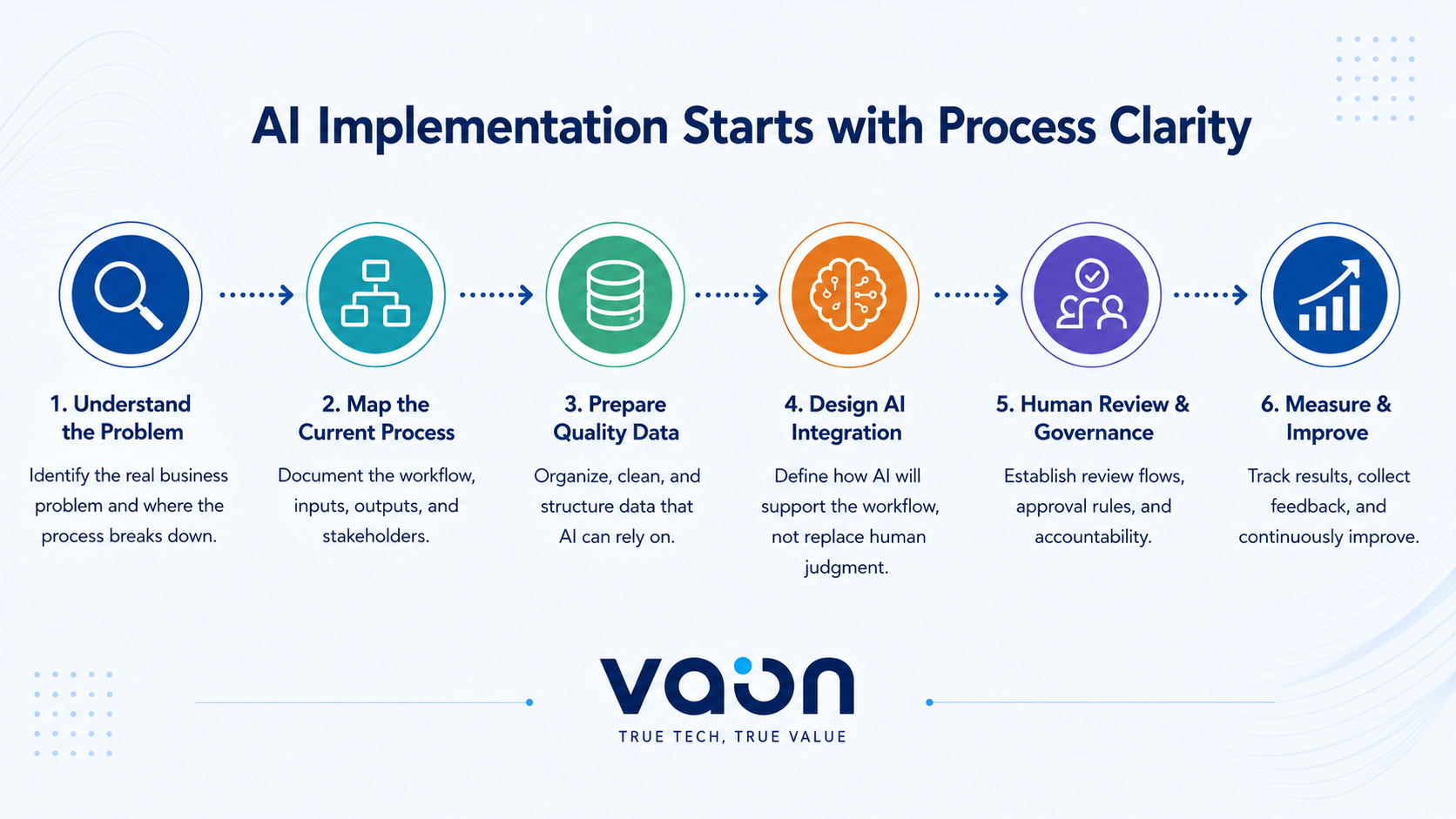
Broken Processes Create Broken AI Results
AI systems rely heavily on input quality.
If the source documents are outdated, AI may generate outdated answers.
If business rules are inconsistent, AI may produce inconsistent suggestions.
If team communication is fragmented, AI may summarize incomplete context.
If decision logs are missing, AI cannot understand why something was decided.
This is why AI projects often reveal existing organizational weaknesses.
The problem is not always the AI model.
The problem is the hidden complexity inside the business process.
For example, a company may want to automate approval workflows. But during analysis, the team discovers that approval rules are different depending on department, customer type, contract size, and manager preference. Some rules are written in documents. Some exist only in people’s memory.
In that situation, AI automation cannot succeed simply by connecting an API.
The process must first be clarified.
AI can help accelerate the workflow, but it cannot define the business rules alone.
Digital Transformation Is Not Only About Tools
Digital transformation is often misunderstood as tool introduction.
A company introduces a new system.
A team starts using cloud storage.
An AI chatbot is added to a website.
An automation script is connected to existing operations.
These actions may be part of digital transformation, but they are not the transformation itself.
True digital transformation changes how the organization works.
It improves how information flows.
It reduces duplicated work.
It makes decisions traceable.
It connects departments more effectively.
It helps people focus on higher-value work.
AI can support this transformation, but only when the business is willing to review and redesign its operations.
In other words, AI should not be treated as a shortcut that avoids process improvement.
It should be treated as a catalyst that makes process improvement more valuable.
From “AI Feature” to “AI-Enabled Operation”
One of the most important shifts in AI adoption is moving from an “AI feature” mindset to an “AI-enabled operation” mindset.
An AI feature is usually isolated.
For example:
An AI chatbot on a website.
An AI summary button in a meeting tool.
An AI OCR function in a document system.
An AI search box inside an internal portal.
These features can be useful. But if they are not connected to the actual workflow, their impact is limited.
AI-enabled operation goes further.
It asks how AI fits into the entire business flow.
Who uses the output?
When is the output generated?
How is it checked?
Where is it stored?
How does it support the next action?
How does the business learn from the result?
This is where AI creates real value.
The goal is not simply to add AI to a product.
The goal is to redesign the operation so that AI and people work together effectively.
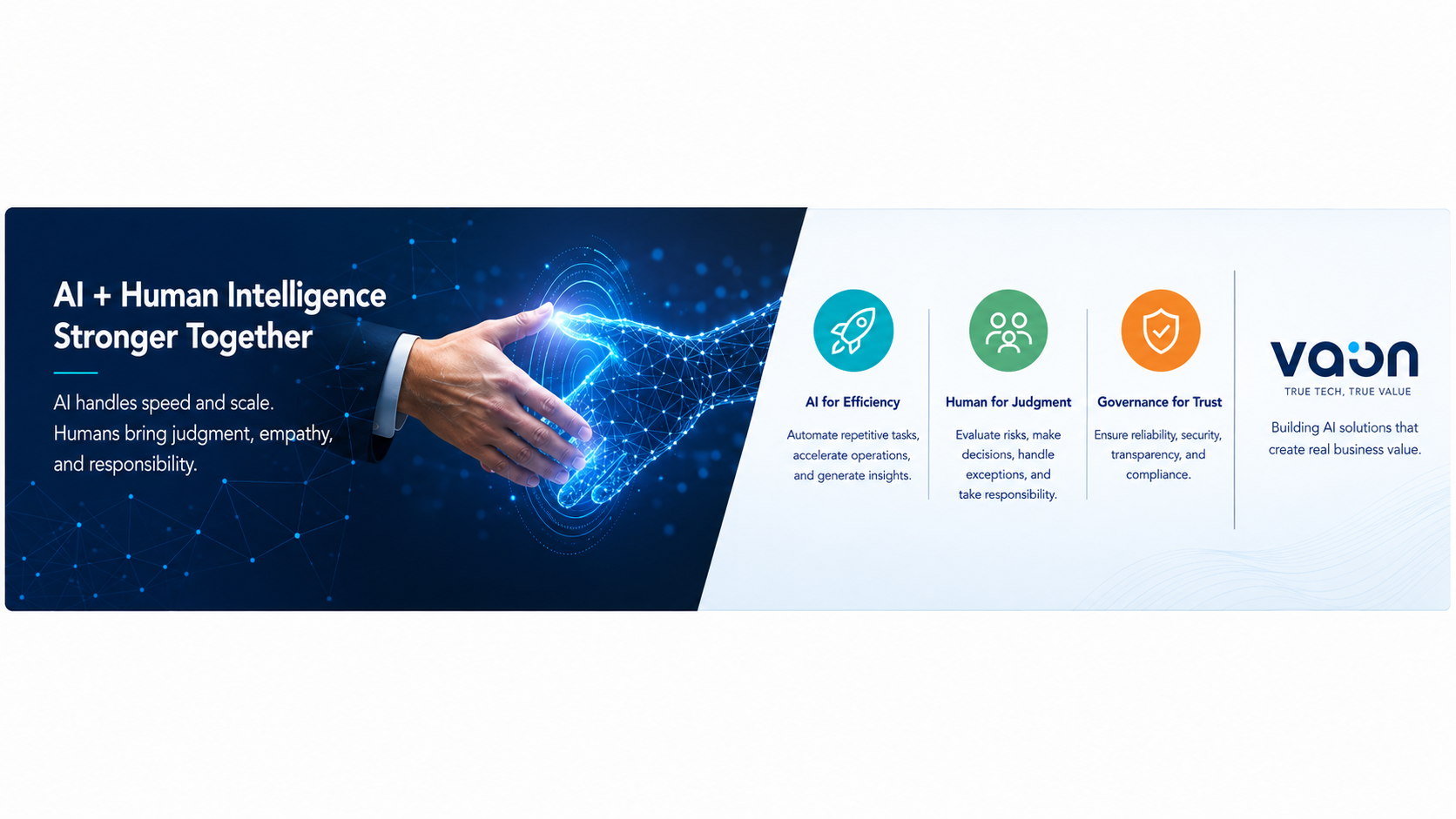
Human Judgment Still Matters
AI can support many business tasks, but it does not remove the need for human judgment.
This is especially true in areas such as customer communication, legal review, hiring, finance, project management, and product strategy.
AI can summarize information.
AI can classify documents.
AI can suggest responses.
AI can detect patterns.
AI can reduce repetitive work.
But humans still need to define the purpose, evaluate the risk, confirm the final decision, and take responsibility for the outcome.
A strong AI system should not be designed to replace human accountability.
It should be designed to support better human decisions.
This is why review flows, approval rules, audit logs, and escalation paths are important in AI projects.
Without them, AI may increase speed but reduce control.
Good AI implementation balances automation with governance.
How Companies Should Start
For companies considering AI adoption, the first step should not be to build a large system immediately.
A better starting point is to identify one high-impact workflow.
This workflow should have clear business value, frequent repetition, measurable results, and accessible data.
Then the team should analyze the current process carefully.
What happens today?
Who is involved?
What data is used?
Where do delays occur?
Which parts can be automated?
Which parts require human review?
How will success be measured?
After that, a small AI prototype can be built, tested, and improved.
This approach reduces risk.
It also helps the company learn how AI fits into its real operations.
AI adoption should be iterative. The first version does not need to be perfect. But it must be connected to a real business process.
The VAON Perspective
At VAON, we see AI implementation as a combination of technology, business understanding, and operational design.
A successful AI project requires more than model selection or API integration.
It requires understanding the customer’s business flow.
It requires clarifying requirements and decision rules.
It requires designing how AI output will be used by people.
It requires connecting systems, data, and workflows in a practical way.
This is where a One-Team approach becomes important.
AI projects often involve both uncertainty and discovery. The customer understands the business deeply. The development team understands the technology. When both sides work separately, the project becomes slow and risky.
But when both sides work as one team, AI can be applied more realistically and effectively.
The best AI solutions are not created by technology alone.
They are created by teams that understand both business and engineering.
Conclusion: AI Is a Multiplier, Not a Magic Fix
AI can bring significant value to modern businesses.
It can increase speed, reduce manual work, improve knowledge access, and support better decision-making.
But AI is not magic.
It does not automatically fix unclear processes, poor data management, weak communication, or undefined responsibilities.
Instead, AI amplifies the way a business already works.
If the process is unclear, AI may amplify confusion.
If the data is unreliable, AI may amplify mistakes.
If decision-making is fragmented, AI may amplify inconsistency.
But if the process is clear, the data is structured, and the team understands how AI should support the workflow, AI can become a powerful driver of transformation.
Before asking “How can we use AI?”, companies should first ask:
“How does our business really work, and where can AI create meaningful value?”
That is where successful AI transformation begins.