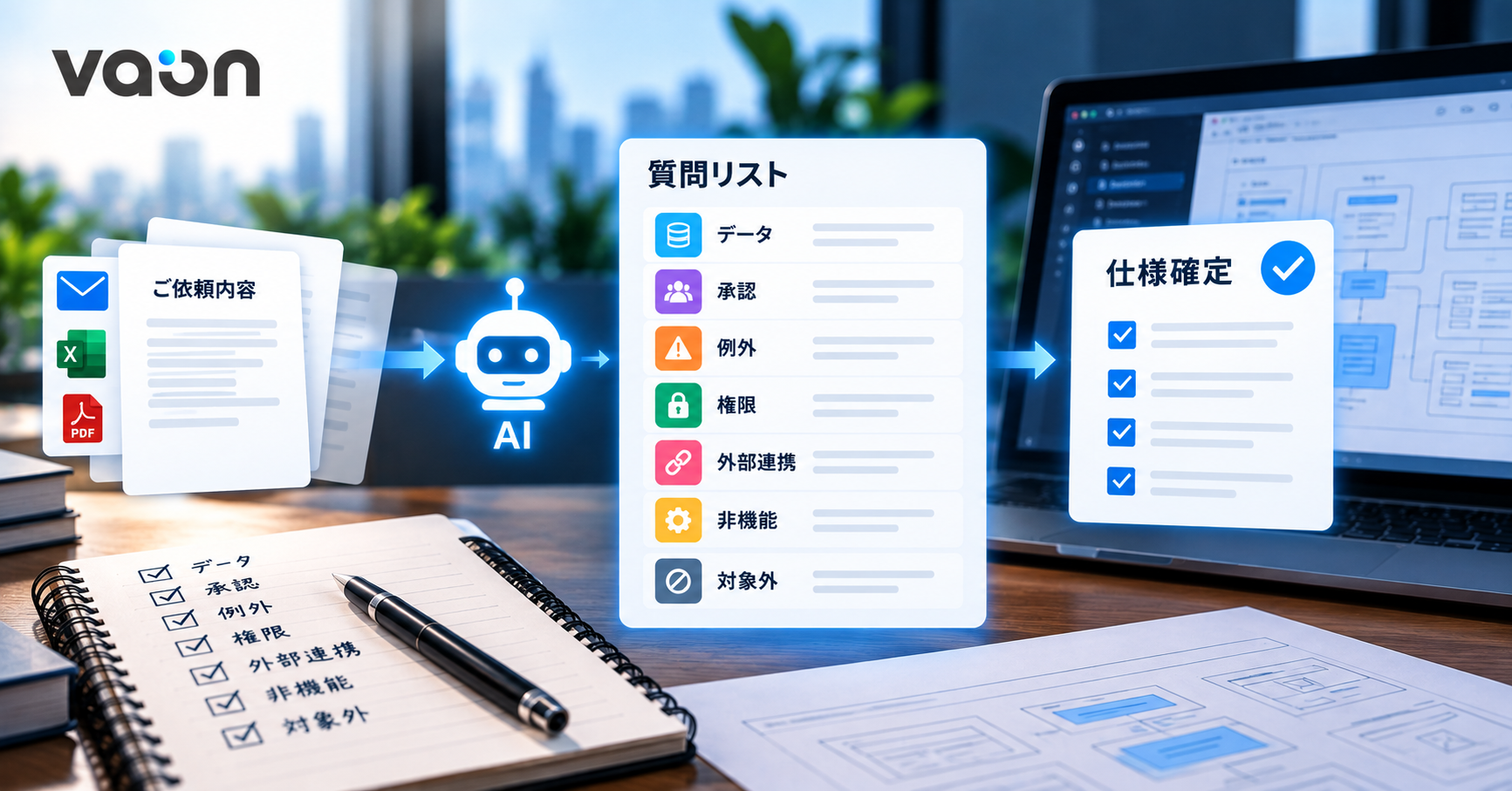
Summary: VAON has AI read a client's initial request and list every decision nobody has made yet. The list covers seven groups: data, approvals, exceptions, permissions, integrations, non-functional needs and out-of-scope items. An engineer filters the list and keeps only questions the client can answer. Until each one has an answer, the spec is not locked.
Contents
- Why ask the right questions before writing a spec?
- How does AI list questions from a client request?
- How does the engineer filter the question list?
- What does a 7-group question template look like?
- What has VAON learned from letting AI review documents?
- When does this approach not fit?
- FAQ
1. Why ask the right questions before writing a spec?
A list of requirements clarification questions shapes the quality of a spec more than the first spec draft does. A draft written over gaps fills them with guesses. Guesses read just like real decisions.
"Can we talk to you before we have a spec?" was one of the three questions clients asked VAON most in 2026. Yes, you can. The first thing VAON does is list what nobody has decided yet, not write a document.
In VAON's Claude Code development workflow, this is step 1: AI lists questions, an engineer picks the ones to ask you. Locking the spec is step 2. Time and cost for the whole requirements phase are covered in requirements definition: how long it takes and what it costs. This post is only about how to ask.
2. How does AI list questions from a client request?
AI produces useful requirements questions when it reads the request one fixed group at a time, not when it is asked "what's missing?". A general prompt returns a long, repetitive list.
The input is what you already sent: emails, Excel files, meeting notes. Engineers put documents into an AI tool only after you allow it. For each group, the AI returns three things per question:
- The question, written so a business user understands it.
- The passage in the request that raised it.
- What the development team would have to guess if nobody asks.
The third item is the most useful. It shows the cost of not asking.
3. How does the engineer filter the question list?
The engineer keeps only questions that someone on your side can answer and whose answer changes what gets built. The AI's list is always longer than the list you receive.
Questions that get dropped usually fall into one of these types:
- Technical choices the team can make itself, such as a library or a table structure.
- Questions your documents already answer, which the AI missed.
- Duplicates of another question.
- Questions where no answer would change anything.
Yes/no questions are rewritten as options. For example: "Order cancelled after shipping: (a) block it, (b) allow it and create a return receipt, or (c) something else?" You decide faster, and the answer is harder to misread.
Each question also names who should answer it. Send the whole list to one person and many answers come back as "probably the same as now".
4. What does a 7-group question template look like?
The 7-group question template below is one you can copy, both for briefing an AI and for checking a list yourself. The sample questions are illustrations, not taken from a real project.
| Group | Sample question | If nobody asks, the team assumes | Who answers on your side |
|---|---|---|---|
| Data | Where does customer data live today, are there duplicates, from which year do we migrate? | Clean data, migrate everything | Whoever runs the current system |
| Approvals | Above what amount does an order need approval? Who approves when that person is away? | One approval level, no deputy | Department head |
| Exceptions | How are partial cancellations and returns after invoicing handled? | Only the normal flow exists | Daily operations staff |
| Permissions | Besides "admin" and "staff", is there a view-only role? | Two roles | Manager, security owner |
| Integrations | Which accounting software exchanges data with the system, on a schedule or in real time? | Manual CSV export | IT lead |
| Non-functional | How many concurrent users, how long is data kept? | Default settings | IT lead, manager |
| Out of scope | Which reports or screens are definitely not in this phase? | Everything ever mentioned is in scope | Budget owner |
The last group is easy to forget, because it asks about what will not be built. Once out-of-scope is clear, each new request goes through a written change control process.
For the buyer's side of requirements work, Japan's IPA (Information-technology Promotion Agency) publishes the User's Guide to Requirements Definition, 2nd edition (Japanese), released in 2019.
5. What has VAON learned from letting AI review documents?
VAON has learned that AI is good at finding inconsistencies and blanks in documents, but cannot tell which business rule is correct. We saw this when we tested a large language model (LLM) reviewing basic design documents (基本設計書) on an internal project.
The AI caught places where two documents contradicted each other, missing error flows and edge cases, and inconsistent terms. It could not judge business rules, priorities, trade-offs or how operations really run. So VAON's rule is: AI reviews the first pass, a person reviews the business logic.
With Japanese clients there is one more reason for a question list. In Japan, the receiver of information is expected to put themselves in the sender's position and interpret fully. A question list turns what "should be understood" into written questions with a named person to answer. Answers sent by chat are logged by VAON in a feedback file or backlog and sent back to you for confirmation.
6. When does this approach not fit?
An AI-drafted question list does not replace an interview with the people who do the work. Four cases to be clear about:
- Unwritten rules. "Regular customers are exempt from this limit" is rarely in any document. Only interviews bring it out.
- No one on your side to answer. Good questions with no one to answer them still leave the spec guessing.
- You have not allowed documents into AI tools. The engineer builds the list by hand using the same 7 groups. Slower, same principle.
- Very small changes. Renaming a button does not need the 7-group table.
A very long list just moves the filtering to you, which means the filtering step was skipped.
7. FAQ
How is a question list different from a requirements document? A question list records what nobody has decided yet. A requirements document records what has been decided. VAON builds the question list first, sends each question to the right person on your side, then moves the answers into the requirements document. Anything still unanswered is marked as undecided, not filled with a guess.
I'm not technical. Can I answer these questions? Yes, and that is the point of the filtering step. The engineer removes technical questions the team can decide alone. What remains is about your business: who approves, what counts as an exception, where the data lives. When a question needs someone else in your company, the list says who to ask.
Will the AI read my internal documents? Only if you allow it. Before work starts, VAON agrees with you which data may be used, who may see it, and whether documents may go into AI tools. If you have not given permission, the engineer builds the question list by hand using the same groups. It takes longer; the principle is the same.
How long does the question list take? This step has no fixed duration of its own. On new projects, questions and answers happen inside VAON's Spec Lock Phase (仕様確定フェーズ). It usually takes 1 to 2 weeks, or 2 to 4 weeks for large projects. Speed depends mostly on how quickly people on your side can answer.
What if new questions come up after the spec is locked? They still get asked, but through change control. VAON writes a change request and gives you the price and schedule impact in writing. Work starts only after you approve it. No approval means no work and no invoice. A thorough question list at the start means fewer of these rounds later.
One thing you can do today: take the request you plan to send a development team and walk through the 7 groups above. Write one question for each. Where you cannot answer, write down who in your company can. The next step, seeing screens before the spec is locked, is in AI mockups: approve every screen before the spec is frozen.
If you want VAON to go through this list with your request, book a free 60-minute consultation. Our CEO joins, you need no documents, and there is no commitment.
Author: Dang Van Luan, Founder & CEO, VAON. Graduate of HEDSPI (Hanoi University of Science and Technology). Worked at FPT Software, then 5 years at Digital Plus (Tokyo) on a system with 10 million users. 8 years as COO of a 120-person IT outsourcing company, where he built the management system to ISO 9001 and ISO 27001. 15 years in the industry.