Why Data Is Always the Foundation of an Enterprise Chatbot
In recent years, as I have explored modern AI technologies more deeply, one truth has become increasingly clear to me: no matter how intelligent a model may be, data is still the factor that determines output quality. For any machine learning system to work well, it needs not only the right type of data, but also enough volume, enough diversity, and enough cleanliness to learn something truly valuable.
This is especially true for enterprise chatbots. If the input data is limited, lacks context, or does not reflect the way customers actually ask questions, the chatbot can easily become mechanical, respond with generic answers, or even misunderstand the user’s intent. On the other hand, when it is trained on the right data sources, a chatbot can become a virtual assistant that listens well, responds in context, and supports customers in a much more natural way.

What Is Chatbot Training Data?
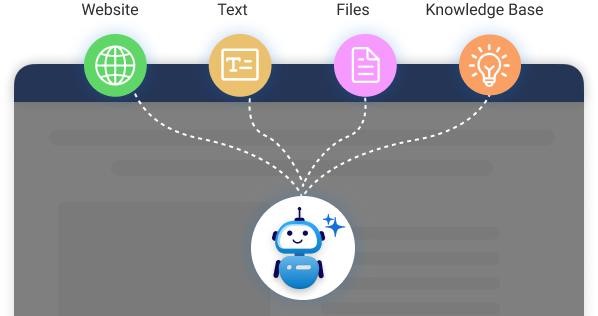
Simply put, chatbot training data is everything you provide to the system so it can learn how to understand language, recognize intent, and generate appropriate responses. This data can come from customer support emails, website content, chat logs, call recordings, product documentation, or any conversation history collected during day-to-day operations.
If we think of a chatbot as a new employee, then training data is the curriculum, practice exercises, and real-world scenarios that employee must study before working independently. That is why the quality of this “curriculum” directly affects how smart and reliable the chatbot becomes.

The Types of Data You Should Use
In practice, no single data type is enough to build a great chatbot; instead, businesses should combine multiple sources so the system can understand both language and operational context. User input data is one of the most valuable sources because it reflects how customers naturally express their needs in real life, even though it often contains a lot of noise and must be carefully preprocessed.
In addition, customer service logs, support emails, and previously resolved tickets often contain many real-world situations that help the chatbot learn how the business has answered similar cases in the past. If your system includes a voice bot, transcripts from phone calls can also be extremely useful, as long as the speech-to-text process is accurate enough not to distort the training data.
Social media data or open datasets can also be used as supporting sources, but they should play a secondary role rather than serve as the primary foundation, because they often lack brand voice and do not reflect the unique context of the business.

Why Internal Data Should Come First
If your goal is to build a truly useful enterprise chatbot, internal data is almost always the best place to start. Materials such as FAQs, knowledge bases, operating procedures, product content, customer support history, and call transcripts all reflect how your business actually works and how your customers actually ask questions.
The biggest advantage of this kind of data is that it carries real operational context, which gives the chatbot a better chance of answering in ways that match user expectations. In addition, because the data comes from your own internal processes, the business can maintain much better control over freshness, accuracy, and security.
Cleaning and Labeling Data
One of the most common mistakes in chatbot training is assuming that having a large amount of data is enough. In reality, raw data often contains typos, repeated sentences, redundant information, noise, and even irrelevant content, and if it is not processed properly, the chatbot will learn from those flaws as well.
That is why data cleaning must be taken seriously. This includes standardizing formats, removing duplicates, anonymizing sensitive information, and organizing data into a structure that is easier to use. For NLU-based chatbots, labeling intents, entities, and utterances is also essential, because this is how the model learns what the user wants and what they are talking about.
A simple example is when a user asks, “Where is the nearest ATM?” The system must not only recognize that this is a location-related question, but also understand that “ATM” is the service type and “nearest” is a distance constraint. Without proper labeling, the chatbot can easily respond out of context.

How to Collect Data Effectively
Whenever possible, businesses should begin with their own internal database, since this is usually the most relevant and valuable source for chatbot training. Data from CRM systems, ticketing platforms, support emails, product documents, transaction logs, and call transcripts all help the system learn much more closely from actual operations.
When expansion is needed, businesses can use web scraping or API integrations to collect additional data from legitimate sources such as public FAQs, help centers, or relevant third-party systems, as long as they continue to respect data usage policies. Open data is also worth considering, especially for early-stage startups, but it should be understood as a supporting layer rather than the main pillar of the system.

Conclusion
A strong enterprise chatbot is not built by a powerful AI model alone; it is created through the combination of the right model and the right data. If the data is clean enough, relevant enough, and rich enough in context, the chatbot will respond more naturally, more accurately, and far more usefully.
So instead of trying to “feed” the system with as much random data as possible, start with what your business already has, prioritize internal data, clean and label it carefully, and then expand gradually once the system is stable. That is the real way to build a chatbot that genuinely serves customers, rather than acting as nothing more than a mechanical answering tool.
