Project Context
Controlling who enters a restricted area (a warehouse, a production floor, a safety zone) mostly relies today on a security guard on shift or reviewing camera footage after an incident. Both methods catch the problem late: by the time it's noticed, the person is already inside. VAON built a PoC using existing cameras to detect a person entering a restricted zone and raise an alert the moment it happens, not on later review.
Challenges
Intrusions are caught after the fact, not at the moment they happen
Traditional surveillance cameras record continuously but don't alert on their own. An incident is only discovered when someone actively reviews the footage, usually after damage is done, not while it could still be prevented.
A restricted zone needs to be defined as coordinates, not a description
"No entry near the machinery" is an instruction for a person, not for a system. The restricted area has to become a specific geometric region on the camera frame, so the system knows precisely when someone has stepped inside it, not merely appeared somewhere in the frame.
Detection confidence shifts with distance and camera angle
A person nearby, facing away, in good light gives high detection confidence. The same person farther away, partially out of frame, sees confidence drop noticeably. An alert system needs to account for that shift rather than apply one fixed threshold at every distance.
VAON's Solution
Used a pretrained object-detection model that recognises people and vehicles, two common object classes, with no per-site training required.
Chose this over training a custom model per client: person/vehicle detection is a problem general-purpose models already solve well; custom training is only worth the cost for specialised problems (such as livestock counting, in VAON's other case study). Building a bespoke model here would add deployment time without adding value.
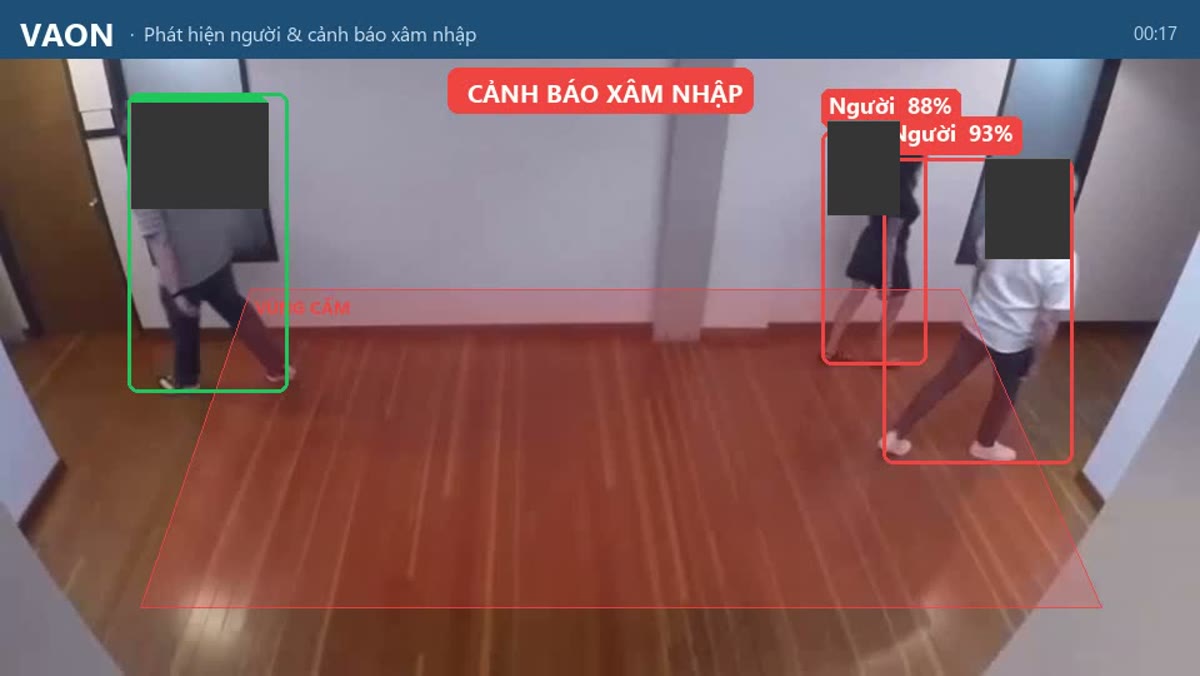
Defined the restricted zone as polygon coordinates on the frame, matching each detected person's centre point against it every frame. The moment they intersect, the system switches to an alert state immediately, shown clearly on screen.
Verified directly on demo footage: the system detects people at 88-93% confidence when nearby and well-lit, dropping to 55-57% when farther away and partially out of frame. These are real figures, not rounded to look better. The exact frame where someone crosses into the restricted zone shows the alert triggering in the same moment.
Designed to be handed off as an operating product, not just a proof: an hourly-searchable event dashboard, a logged snapshot at the moment of each alert, and instant Zalo/Telegram notification, matching how an operations team actually wants alerts (on their phone, not tied to a monitor).
Stated scope, honestly: every figure above is verified from the demo footage of the person-detection scenario. Vehicle detection shares the same architecture but is not captured in this clip; the hourly event dashboard and the Zalo/Telegram channel are a defined design awaiting their own demo; and confidence falls to 55-57% at longer range or in poor light, so camera placement needs care across the whole monitored area.
Value Delivered
88-93% person-detection confidence under good viewing conditions
For a person at close range in good light, the system reaches 88-93% detection confidence, consistent with the original feasibility estimate (~95%+ in good light or with IR). Figures recorded directly from the on-screen labels in the demo.
The alert triggers in the exact frame of intrusion
The moment a person crosses into the restricted zone, the interface changes state immediately: the detection box changes colour and an "INTRUSION ALERT" banner appears at once. This is a real-time alert, not a result of batch processing after recording.
No custom training, fast to deploy on existing cameras
Because it uses a general-purpose detection model, the system runs on an existing camera angle without collecting and labelling site-specific data first, which substantially cuts the time from kickoff to a visible result.
Technology Stack