Measured results
Project summary
| Solution | Built an automated Twilio voice flow that answers 100% of incoming calls, records them, and stores call history, so no call goes untracked. |
|---|---|
| Tech stack | Twilio Voice & SIP · Google Dialogflow · PostgreSQL · Google Cloud |
| Key results | Automation rate: 100% · Failed calls: 0 · Average handling time — session 1: 10.0sec |
Project Context
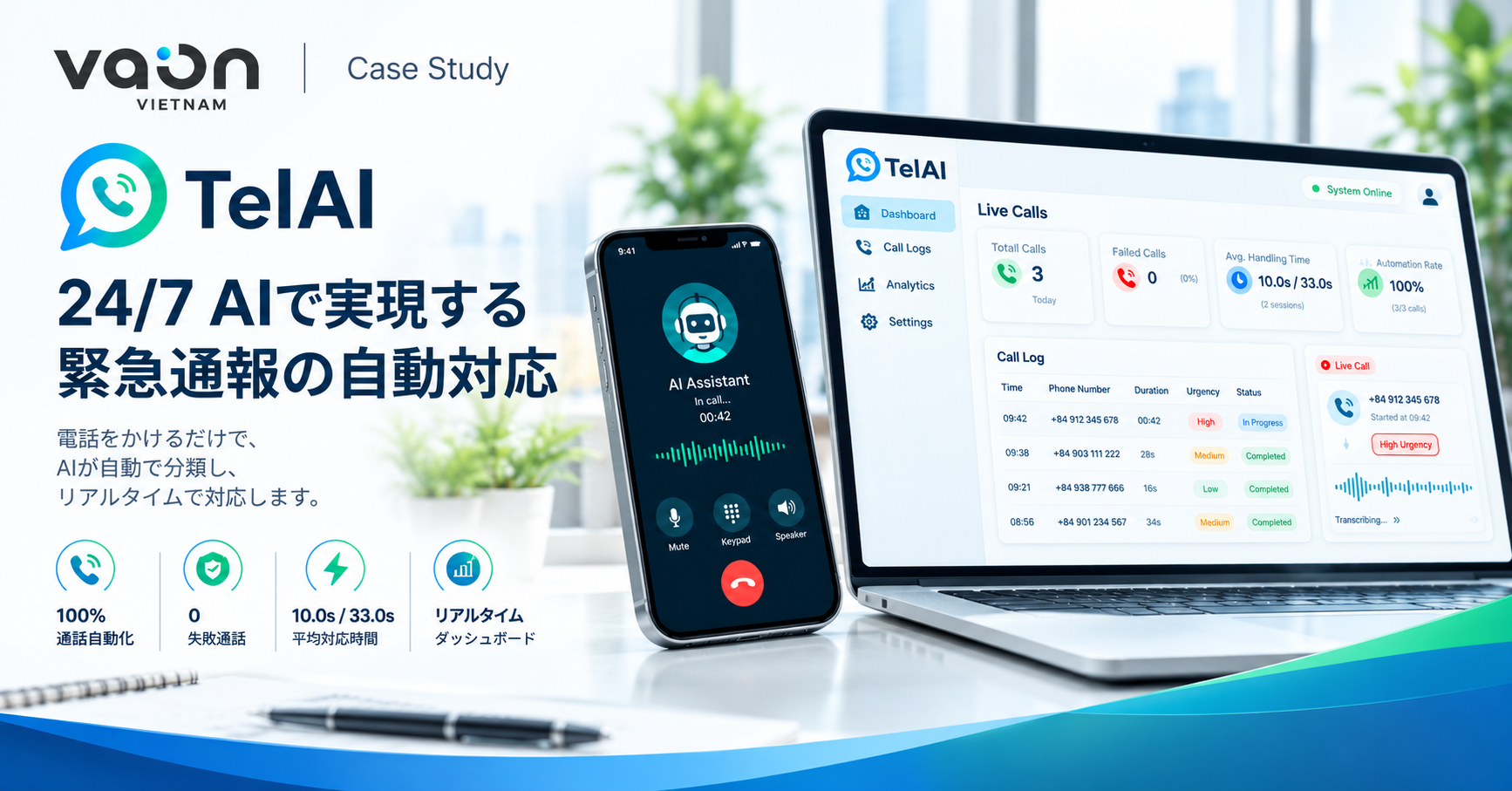
A 24/7 hotline that goes unanswered after hours loses the call entirely, with no record left to act on later. On-duty staff have to guess which call is urgent within seconds, with no shared criteria across shifts. VAON built the TelAI PoC: an AI answers the call, converses with the caller, classifies urgency during the call itself, and pushes it to a real-time dashboard. On the demo dataset: 100% automation rate, 0 failed calls, and average handling time of 10.0 seconds and 33.0 seconds across two separate measurement sessions, both reported rather than cherry-picked. A live test call dialed through Twilio Dev Phone appeared on the dashboard while still in progress. Illustrative scenario: a veterinary-clinic-style hotline, not a real client.
Challenges
Unanswered after-hours calls are lost entirely, with no record to act on later
A traditional hotline with no one on duty after hours simply misses the call. No recording, no caller number, nothing to call back or assess for urgency afterward.
On-duty staff must judge urgency in seconds, with no shared criteria across shifts
For every call, the person on duty has to decide if it's an emergency or can wait, based on gut feel. Criteria shift from person to person and shift to shift, leading to inconsistent handling.
No operational metrics exist for call volume, failure rate, or handling time
There's no way to know if a hotline is performing well without metrics. Daily call volume, failure rate, and average handling time all stay unknown, so nothing gets improved.
Urgent cases surface late, only when someone reopens the log or replays a recording
Without someone actively checking, an urgent call can sit unnoticed for hours. Late discovery means late response, exactly when response speed matters most.
VAON's Solution
Built an automated Twilio voice flow that answers 100% of incoming calls, records them, and stores call history, so no call goes untracked.
Classifies urgency during the call itself, tags it with a color or icon, and shows it live in the emergency-log panel so staff don't have to guess.
Computes daily operational stats, surfaced as 4 dashboard cards: today's calls, failed calls, average handling time, and automation rate.
Pushes call state to the UI via Server-Sent Events, so the log panel updates the instant a call is in progress, with no page reload needed.
Chose Dialogflow as the conversation and classification engine for this PoC instead of waiting on a GPT-model comparison. The PoC's goal is proving the end-to-end flow works (call in, classify, real-time dashboard), not benchmarking models. Dialogflow gives a stable flow and predictable latency, enough to measure. A GPT comparison is a separate, later step, out of this PoC's scope.
Value Delivered
100% automation rate on the demo dataset
The "automation rate" stat card read 100% in the same session as the day's 3 recorded calls. Every call in that session was handled fully by the AI, with no human intervention.
0 failed calls across both measurement sessions
The "failed calls" card read 0 in both captured sessions. No call was dropped or mishandled in the demo data available.
Average handling time of 10.0 and 33.0 seconds per call
The "average duration" card recorded two different figures across two separate sessions: 10.0 seconds and 33.0 seconds. Both are reported in full, reflecting real variation rather than the more flattering number.
Real-time update verified with an actual call
A split-screen capture shows a live Twilio Dev Phone call in progress next to the dashboard's call-status panel, which populates instantly with caller number, start time, and urgency tag.
Results & how we measured
| Metric | Before | After | Change | How we measured |
|---|---|---|---|---|
| Automation rate | — | 100% | — | Read directly from the "Automation rate" stat card on the demo dashboard, in the session with 3 recorded calls that day — no manual intervention needed for any call. |
| Failed calls | — | 0 | — | The "Failed calls" stat card read 0 in both captured measurement sessions on the demo dashboard — no call was dropped or mishandled. |
| Average handling time — session 1 | — | 10.0sec | — | The "Average duration" stat card on the demo dashboard, in the measurement session with 1 recorded call that day. |
| Average handling time — session 2 | — | 33.0sec | — | The "Average duration" stat card on the demo dashboard, in the measurement session with 3 recorded calls that day. |
Current limitations
-
1
Multilingual capability has no demo evidence. The design calls for the AI to greet callers in Japanese by default, auto-detect language from the first response, support Japanese, English, and Vietnamese, and fall back to Japanese if unsupported — but no recorded call shows an actual language switch. This is design scope, not a measured result.
-
2
A GPT-versus-Dialogflow model comparison was never run. It's noted in internal planning only, not executed, so there's no conclusion yet about which model performs better.
-
3
The 100% automation rate is based on a small demo sample (three calls in one day), not an SLA validated against real production traffic.
-
4
Scope is a hypothetical hotline persona, not a live production deployment. There's no data yet on peak-hour volume, concurrent calls, or noisy real-world audio.
Technology Stack


Related Case Studies
Facing a similar problem?
Book a 30-minute consultation with the VAON engineering team, or explore the services behind this case study.