Project Context
A Japanese food manufacturing and processing company of roughly 150 staff needed a website renewal serving two goals at once: presenting products to B2B partners, and building a recruitment image for younger candidates. The binding constraint was a CMS in service for over 20 years that could not be replaced within the project's scope. VAON worked in the development, testing and delivery role, over four months with a team of 14.
Challenges
A CMS over 20 years old, with code and presentation tightly coupled
The running CMS architecture does not separate presentation from content. Every interface change pulls manual source edits along with it. That cost repeats on every revision cycle, and it is why previous updates ran long.
The interface needed several rounds of adjustment during development
The design direction was settled progressively rather than fixed upfront. For a site serving both B2B partners and recruitment candidates, inconsistency between pages leaves an unprofessional impression on both audiences.
Requirements crossing the Japanese-Vietnamese language boundary
Differences in language and phrasing slow requirement transfer. In a four-month project, a detail misread in week one may only surface in week six, when the cost of correction is entirely different. The risk is not any individual's language level; it is whether the requirement was written down.
VAON's Solution
VAON chose to generate HTML compatible with the existing CMS rather than replace it. Replacing the CMS would solve the architectural problem properly but sat outside scope and budget, and would have forced the client to retrain their content operations team. Keeping the CMS and automating HTML generation delivered the result in four months without disturbing a running operation.
How we worked
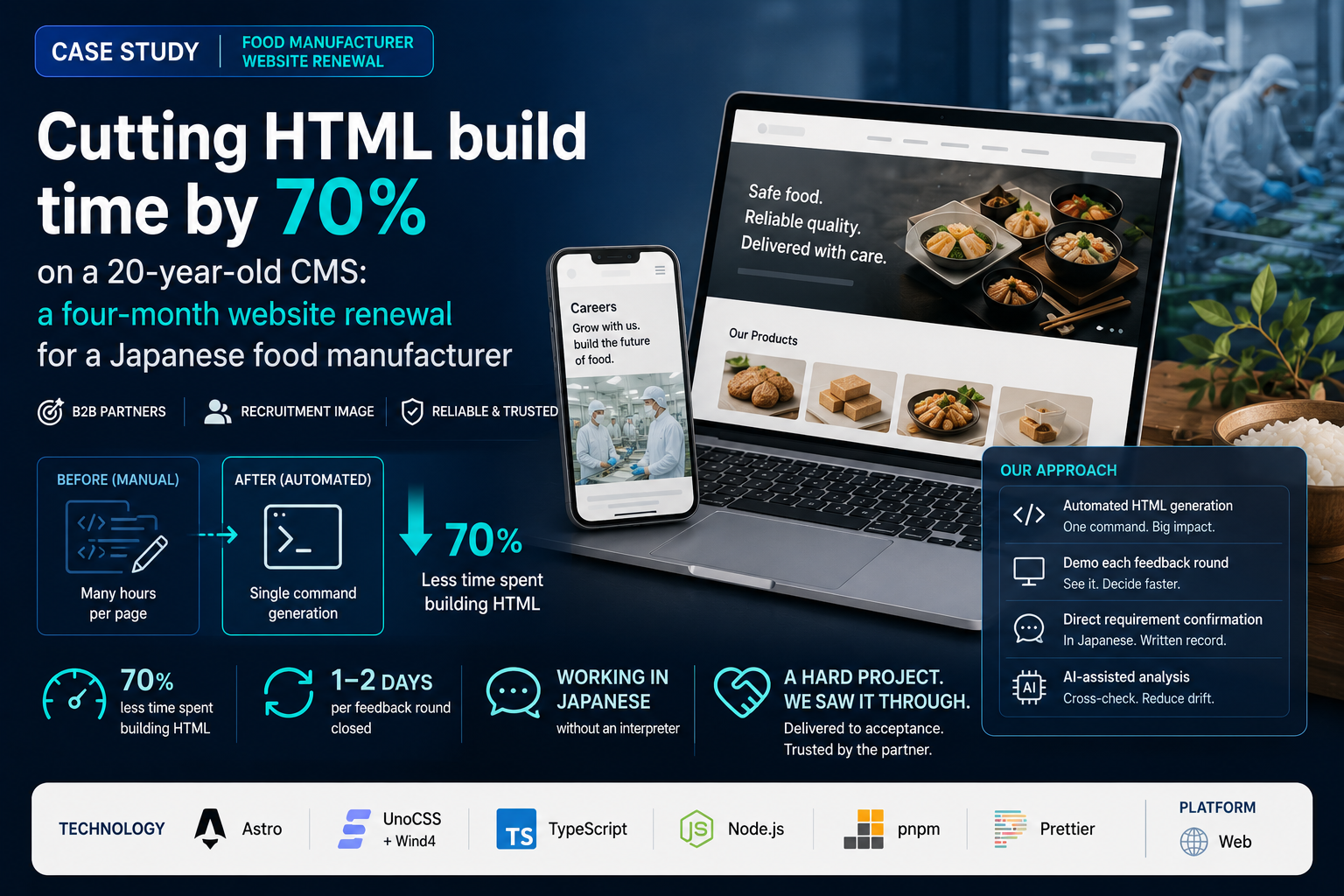
Built an automated step converting source into CMS-compatible HTML, run by a single command. This produced most of the project's efficiency gain.
Generated HTML compatible with the existing CMS instead of replacing the CMS, keeping the client's content operations untouched.
Built a demo for each feedback round instead of describing changes in writing. For interface changes, seeing it directly shortens the discussion more than describing it.
Confirmed business requirements directly in Japanese without an interpreter, and shared the written record of what was agreed. Writing it down is what makes a conclusion verifiable weeks later.
Used AI to help analyse and cross-check requirement content before handing it to the development team, reducing interpretation drift. AI here reviews and cross-checks; it does not replace the decision-maker.
Key Features
Product presentation pages aimed at B2B partners.
A recruitment section built to strengthen the company's image with younger candidates.
Value Delivered
70% less time spent building HTML, measured by comparing manual HTML authoring against single-command generation, across the same page volume in this project. Before automation, this was the single largest consumer of effort.
Each feedback round closed in 1-2 days, from receiving the partner's feedback to having a revised version ready for review. That pace holds because of the automated HTML step: most of the prior effort sat in rebuilding pages, not in deciding what to change.
Working in Japanese, without an interpreter: requirements were confirmed directly in Japanese and recorded in writing, so no intermediate translation round was introduced. Clarifying questions were handled within the working day rather than accumulating into a queue.
A hard project, carried through to acceptance: the project involved many adjustment rounds and schedule pressure; VAON stayed with it until acceptance was complete. On completion, the partner's project manager: "Truly, truly, this became a very hard piece of work, but thank you so much!!" (「本当に本当に、つらい仕事になりましたが、ありがとうございました!!」)