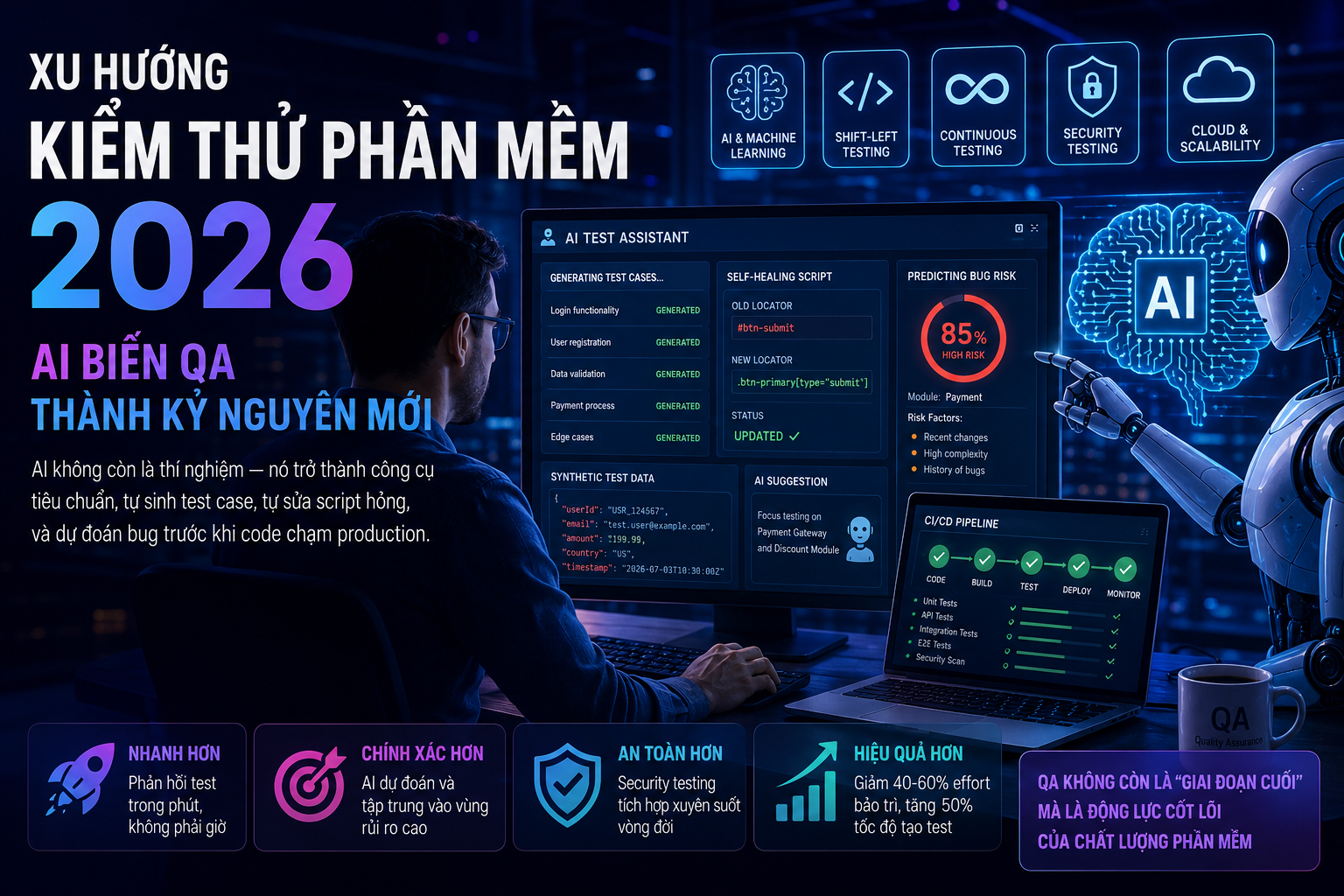
Software Testing Trends 2026 — AI Ushers QA Into a New Era
Answer-first block
2026 marks a real turning point for software testing: AI is no longer experimental — it has become a standard tool that auto-generates test cases, self-heals broken scripts, and predicts bugs before code hits production. QA teams that haven't adapted are putting themselves at a disadvantage.
The Trends Reshaping QA Right Now
According to a comprehensive report from Testomat.io (updated July 3, 2026) and multiple industry analyses, software testing in 2026 revolves around these key pillars:
AI & Machine Learning — From "Nice-to-Have" to Core Operations
AI in testing has moved past the marketing phase. Current tools analyze application behavior, historical test data, and real user patterns to generate genuinely valuable test scenarios — no more test cases that look like they were written by someone who's never used software.
Specifically, AI now delivers:
- Test case generation from requirements: From user stories, AI creates test suites including edge cases humans easily miss — not because testers are bad, but because no one can simultaneously consider 47 variable combinations while remembering to eat lunch.
- Self-healing scripts: The real game-changer. When devs change a CSS class or restructure the DOM, AI detects and updates locators automatically. Reduces maintenance effort by 40–60% — ending the "Monday morning 500 red tests because someone renamed a button" nightmare.
- Predictive analytics: AI analyzes patterns from test results, commit history, and production incidents to predict which code areas are most likely to harbor bugs. QA focuses there instead of testing everything equally.
- Synthetic test data: Generates realistic but fake test data, GDPR/HIPAA compliant, containing no real customer information. Setup in minutes instead of days.
Shift-Left & Shift-Right — Testing Is No Longer "The Final Phase"
Shift-left brings testing into requirements analysis. Shift-right extends testing into production. Sounds simple, but many organizations still treat testing as something that happens "after dev is done" — when everyone's exhausted and the deadline was yesterday.
The compelling numbers: bugs caught during development cost 6× less than in production, 100× less than live incidents. Shift-left isn't philosophy — it's math.
Core shift-left practices in 2026:
- Writing test cases during requirements analysis
- API testing begins before UI development
- Security testing integrated into code reviews
- BDD scenarios written with stakeholders, not after code is done
Continuous Testing in CI/CD — Testing Never Stops
Every commit triggers an automated test cascade:
- Immediate (on commit): Unit tests, static analysis, security scans
- Fast feedback (5–10 min): API tests, smoke tests, critical path
- Standard (15–30 min): Integration tests, functional tests
- Extended (30–60 min): E2E tests, cross-browser, performance
- Scheduled: Full regression, long-running performance tests
Results return in minutes, not hours. Teams still running sequential tests are creating their own bottleneck.
API Testing Overtakes UI Testing
With microservices architecture prevalent, API testing has become the backbone of modern test strategy:
- Faster than UI tests (seconds vs. minutes)
- More stable (doesn't break when the design team decides buttons should be rounded instead of square)
- Better business logic coverage, no UI dependency
- Easier to implement data-driven testing
- Better suited for shift-left since testing starts earlier
API testing is the "unsung hero" — less glamorous but delivering the highest ROI.
Security Testing — No Longer a Final Audit
In 2026, security testing integrates throughout the lifecycle:
- Design: Threat modeling, security architecture review
- Development: SAST (Static Application Security Testing), secure code review
- Build: Dependency vulnerability scanning, license compliance
- Testing: DAST (Dynamic Application Security Testing), penetration testing
- Deployment: Container security scanning, infrastructure validation
- Production: RASP, security monitoring
A data breach costs more than any investment in security testing. This isn't opinion — it's statistics.
Context: Why 2026 Is the Tipping Point
Two factors are creating unprecedented pressure on QA:
First — AI generates code faster than teams can verify it. 75% of new code at Google is now written by AI (per CEO Sundar Pichai). Code ships before anyone reviews it thoroughly. Testing volume surges while QA headcount stays flat.
Second — AI output is non-deterministic. The old QA model relies on hard assertions: input A → output B → pass. But when AI is embedded in products, output can differ each run. "Green build = safe to ship" no longer holds. New testing methods are needed for non-deterministic systems.
Combined: more code + harder-to-test code = QA must evolve or fall behind.
What This Means for QA Teams and Businesses
This is the most important section — what these trends mean in practice:
Testers without coding skills still have a place — but must pivot. Low-code/no-code automation (Playwright codegen, AI test generation, scriptless tools) lets testers focus on test design and edge-case thinking — things AI can't replace yet. But testers who only know manual clicking without upskilling will struggle to survive.
Exploratory testing remains irreplaceable. AI excels at pattern matching but lacks creativity. Human testers still discover bugs "no one thought of" — especially around UX, complex business logic, and scenarios no one wrote specs for.
ROI of AI testing tools is now clear. Self-healing reduces maintenance effort by 40–60%. AI test generation increases test creation speed by 50%. Predictive analytics focuses resources on high-risk areas. This is no longer "experimental" — it's competitive advantage.
Practical implementation roadmap:
- Weeks 1–2: Assess current state — what's tested, what's missing, where it hurts
- Weeks 3–8: Quick wins — integrate tests into CI/CD, add API tests for critical paths
- Months 3–6: Deploy AI test generation, comprehensive shift-left, integrated security testing
- Ongoing: Measure, optimize, train the team
Next Steps
Read the full analysis at Testomat.io — Software Testing Trends 2026 for detailed implementation guidance on each trend. If your team is reassessing its test strategy or evaluating AI testing tools, now is the right time to start — not because of FOMO, but because the gap between AI-equipped teams and those without is widening every day.
References
Testomat.io — Software Testing Trends 2026: The Ultimate QA Guide (Updated Jul 3, 2026)