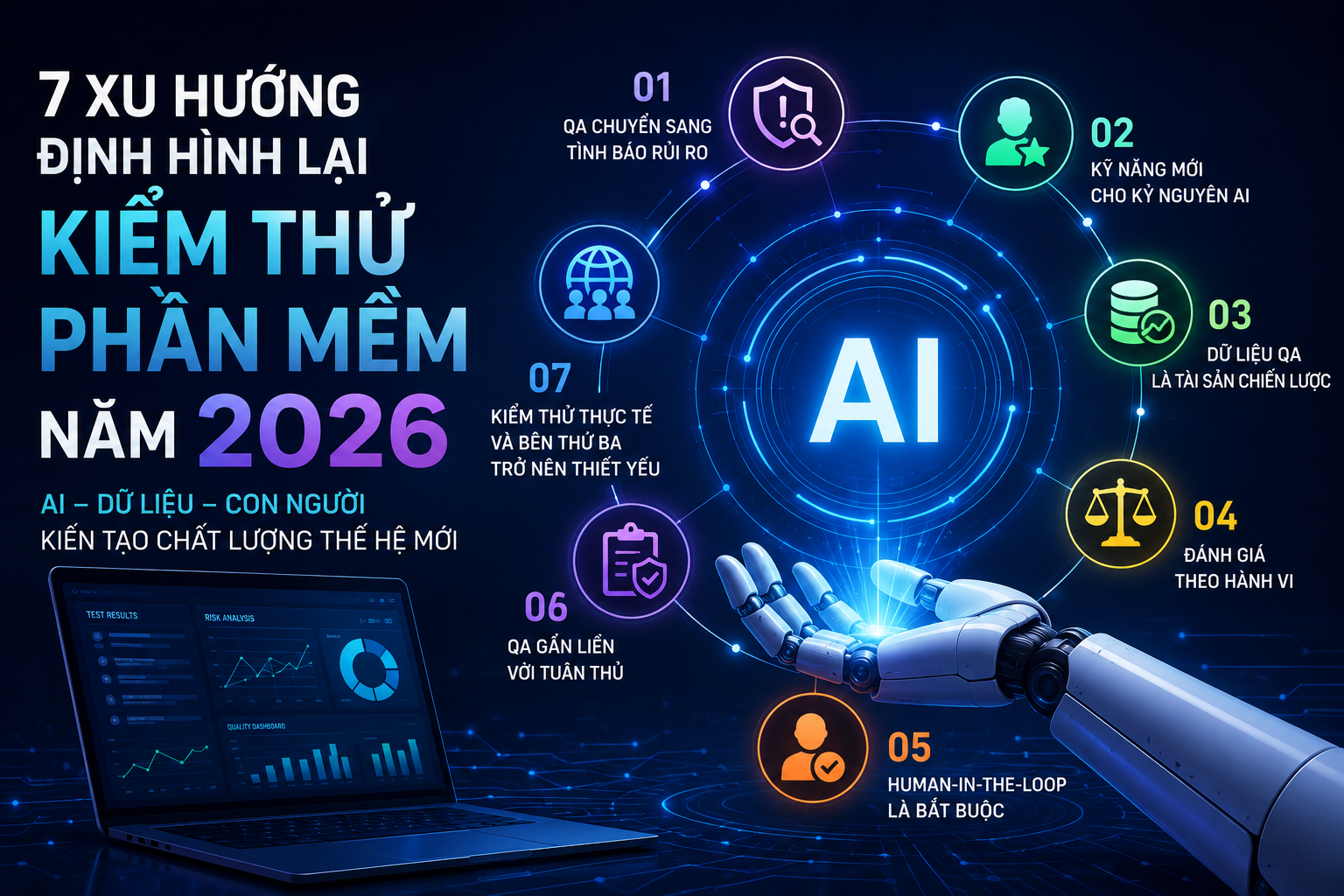
7 Trends Reshaping Software Testing in 2026
Testlio has published a report outlining 7 trends set to define software testing in 2026, showing that AI has embedded itself into nearly every layer of modern products — from payments and healthcare to logistics — and is pushing QA teams to shift from "running every test case" toward evaluating real-world behavioral risk. For any team running AI-powered products, this is a good moment to revisit your own quality assurance strategy.
What the report covers
The report opens with a simple observation: AI is moving into production at a much faster pace than it used to, and this is producing a new class of failure. Instead of a clear crash, products now show behavioral drift, bias, or inconsistent responses across devices and regions. The old QA model — built on fixed, deterministic outcomes — is no longer sufficient on its own.
The seven trends identified are:
- QA shifts from test-case execution to risk intelligence. As behavior depends more on personalization and context, chasing exhaustive coverage stops scaling. The central question moves from "did we test everything?" to "where does risk actually concentrate?" This isn't just theoretical — nearly half of organizations surveyed by the World Economic Forum now cite sophisticated, generative-AI-powered attacks as a top concern. These risks rarely show up as obvious functional bugs; they surface as subtle behavioral weaknesses, policy bypasses, or edge-case exploitation that traditional coverage-based testing struggles to catch.
- QA roles evolve, bringing new skill requirements. AI isn't eliminating QA — it's redefining the job. Routine checks get automated while people shift toward investigation, evaluation design, and oversight. A 2025–2026 global quality report ranks generative AI skills as the top priority for quality engineers, ahead of traditional automation expertise, while communication skills also rank in the top five — a sign that judgment and cross-team collaboration are becoming core competencies rather than "nice to haves." Roles such as AI output reviewer, LLM response auditor, and bias evaluator are increasingly being formalized.
- QA data becomes a strategic asset, not just a report. Leading teams are combining test results, recurring failure patterns, crowdtesting signals, production telemetry, and support tickets into a single view of product health. Most organizations already use real production data to inform testing, yet nearly half still struggle to turn those insights into action — a clear gap between visibility and impact. As that gap closes, QA moves from answering "what broke" to forecasting "what's likely to break next, and where."
- From checking correctness to evaluating behavior. With many AI systems, there's no single "correct" answer — an output can be factually accurate and still be misleading, unsafe, or contextually inappropriate. Data from a 2025 global AI index shows AI-related incidents rose sharply year over year, hitting a record high — most not from conventional crashes but from harmful or unsafe outputs. As a result, QA is shifting toward scored, comparative, human-rated evaluation rather than rigid pass/fail checks.
- Human-in-the-loop testing is no longer optional. Automation can flag anomalies, but it can't reliably judge intent or real-world harm. Most enterprises have already implemented human review processes to catch hallucinations, biased outputs, or unsafe guidance before they reach users, and knowledge workers now spend several hours a week fact-checking AI output. Mature teams don't treat this as ad hoc review — they run it with trained reviewers, calibrated scoring rubrics, and clear escalation paths.
- QA is now a compliance function. As AI enters regulated, high-impact domains, QA output becomes compliance evidence. Frameworks such as the EU AI Act and the NIST AI Risk Management Framework require traceability, human oversight, and documented evaluation — meaning QA has to produce audit-ready evidence: versioned results, replayable traces, and bias/safety evaluations. Governance maturity is still low, with only around a quarter of organizations running a fully operational AI governance program, which is why most are now racing to build and fund this capability.
- Third-party and real-world testing become essential. AI behaves differently across devices, networks, regions, languages, and user profiles — conditions that internal labs can't fully replicate. The global crowdsourced testing market is projected to grow at a strong double-digit rate through 2030, and studies show that adding external, real-world testing meaningfully shortens QA cycle time while improving post-release defect detection.
Why this is happening now
This shift isn't theoretical — it's driven by hard numbers. Enterprise AI adoption has surged over the past year or two, and most of that usage now sits inside real products serving real users — payments, health triage, content recommendations, support workflows, logistics — rather than isolated pilots. At the same time, most organizations still admit they lack the ethical and organizational guardrails to monitor AI features at scale. In short, the pace of AI deployment is outrunning the maturity of quality assurance processes — and that gap is exactly where risk quietly builds up.
It's worth noting that AI doesn't fail the way traditional software fails. Instead of an obvious bug that stops the system, a feature can "work" perfectly in staging and still misfire once it meets real-world context, a different user history, or a different device or region. That's why the old "green build equals safe to ship" mindset is losing its reliability.
What this means for your customers
If your product has any AI component — a chatbot, a recommendation engine, a scoring model, or any form of automated decision-making — the "green tests mean safe to ship" approach is no longer reliable enough on its own. Four things worth doing now:
- Rebuild your risk inventory around behavior, not just features — identify where AI is most likely to drift, show bias, or cause harm if it gets things wrong, especially in flows involving money, user safety, or regulated activity.
- Set up a structured human-in-the-loop review process, with calibrated scoring rubrics and clear escalation paths for high-impact AI decisions, instead of leaving review to individual judgment.
- Connect QA to real production data — track cohort-level drift, run canary releases with clear rollback triggers, and treat drift indicators as ongoing quality signals rather than something you only look at after an incident.
- Prepare traceable evidence packages — model version, prompt, retrieval context, test criteria, evaluation results — since this is becoming close to a requirement for enterprise customers and regulators asking for accountability, not just a "nice to have."
More broadly, organizations with strong QA governance and analytics are reporting noticeably better returns on their AI investments than those relying on shallow test metrics — because quiet behavioral failures tend to be far more costly than obvious technical bugs once they spread at scale.
Next step
For a deeper implementation-level breakdown of each trend, see Testomat.io — Software Testing Trends 2026. And if your team is already reconsidering its test strategy or evaluating AI testing tools, now is a reasonable time to start — not out of FOMO, but because the gap between teams that have brought AI into QA and those that haven't keeps widening.
Source: Testlio, "7 Trends Reshaping Software Testing in 2026" (testlio.com, Jan 22, 2026).