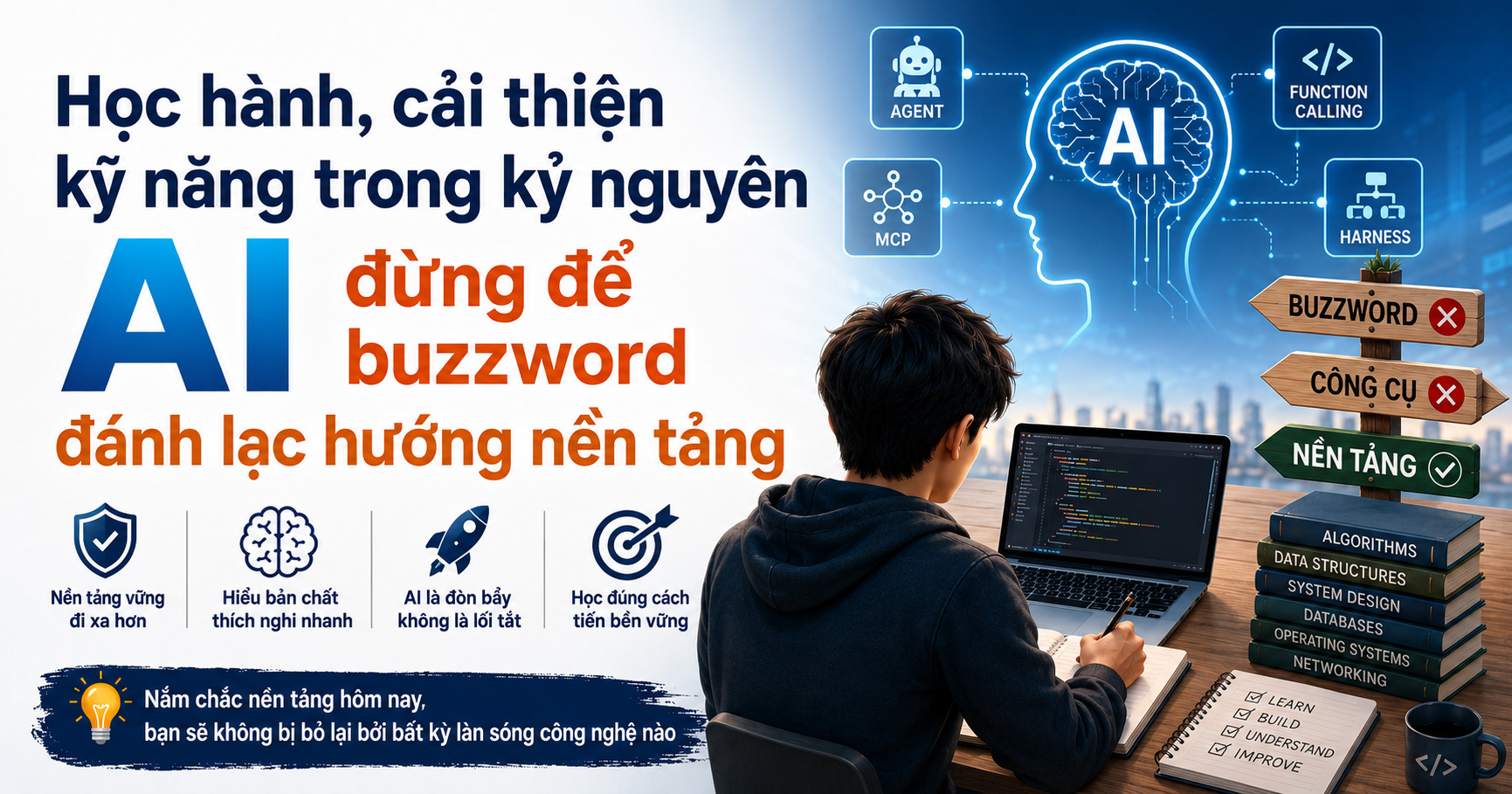
Learning and Leveling Up in the AI Era: Don't Let Buzzwords Distract You From the Fundamentals
Many in tech share the same worry: AI keeps minting new terms - agent, agent-skill, MCP, harness - so does learning old fundamentals (OS, threads, memory, databases) still make sense, or is that falling behind?
A Familiar Question in the AI Era
Not a rare worry - a new name to "know" appears every week, and skipping it feels like falling behind instantly.
But people who've lived through past tech waves - SOA, microservices, blockchain, now AI agents - find it familiar: most buzzwords are just marketing names for old concepts. Agent-skill is essentially function-calling - declaring and invoking a function. MCP standardizes how AI talks to external data/tools, much like an API or client-server setup. A harness resembles the runtime/orchestration layer backend engineers already know.
Solid fundamentals mean any new "tech abc" takes hours to grasp, not months. Real interviews still probe fundamentals - process scheduling, database indexing, memory management - not the trending buzzword.
Not Just a Gut Feeling: 2026 Industry Data
A 2026 academic study found that developers relying on AI assistance scored up to 17% lower on post-task conceptual understanding checks than a control group, with the widest gap in debugging skill. The AI-assisted group also hit fewer bugs while working (1 vs. 3) - which sounds good but actually reduced their learning from solving problems themselves. Task completion time showed no significant difference between groups - meaning AI didn't make things faster, it just meant less learning when it did everything.
A separate survey on junior developers found a similar pattern: those using AI finished tasks faster but scored 17% lower on knowledge tests than those working manually. Employers now also rate the ability to "catch and fix AI's mistakes" far higher than the ability to "handle typical edge cases" - a sign the market is shifting toward valuing critical, supervisory thinking about AI output, not just knowing how to operate the tools.
In short, using AI is not a shortcut to competence. Lasting value comes from understanding the underlying problem; tools - AI included - are just an interface that helps apply that understanding faster, not a replacement for understanding it deeply.
AI Is Still a Powerful Lever - Used Right
AI isn't worthless - quite the opposite. Used well, it:
- Lowers the barrier: explains any concept, at your level, anytime.
- Speeds up feedback: points you in the right direction in seconds instead of hours in docs.
- Frees time from repetitive work (boilerplate, tests) for the hard parts: system design, architecture.
- Broadens exposure: surfaces patterns or libraries hard to find alone.
The best approach combines both: fundamentals to understand and control AI's output, AI to speed up execution. AI amplifies those willing to learn - it doesn't replace learning. The order matters: fundamentals first, AI second.
So How Should You Learn AI-Era Skills?
Four things worth doing if you feel pressure to master every new AI tool:
- Prioritize fundamentals over tools - understanding data handling, memory, and function calls makes any AI framework easier to pick up.
- Treat new buzzwords as application exercises, not knowledge from scratch - ask what familiar problem they solve.
- Use AI as an accelerator, not a replacement - try 20 minutes on your own first, then let AI check or handle repetitive parts.
- Don't let FOMO dictate your path - no one keeps up with 100% of new tools, and no one needs to.
This reflection, backed by the industry data above, comes from a discussion worth thinking about - hopefully useful for your own learning journey.
Sources:
AI Impact on Skill Formation in Software Engineering (arXiv/EmergentMind)
daily.dev - How Junior Developers Should Adapt to AI in 2026