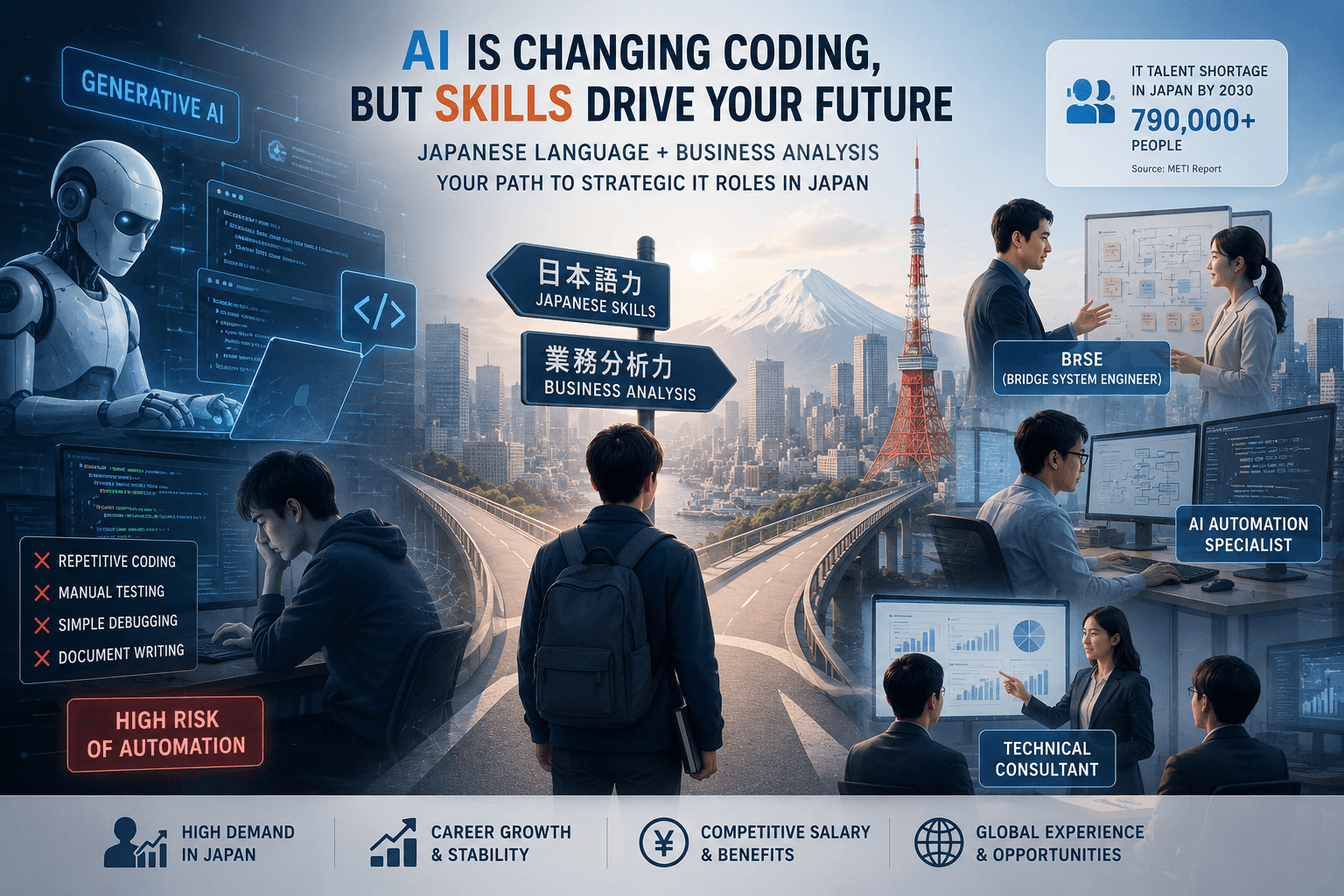
1. The AI Automation Wave: Why Pure Coders Face Attrition
The rapid evolution of Generative AI tools (such as GitHub Copilot, Claude, and ChatGPT) has restructured software development cost models.
Traditional entry-level engineering tasks—such as boilerplate coding, basic HTML/CSS generation, unit test creation, and syntax debugging—are now handled by AI at significantly higher speeds and lower operational costs.
According to software engineering studies published by the Information-technology Promotion Agency (IPA Japan), software development lifecycles are drastically reducing routine implementation phases. This shift creates two direct labor market outcomes:
- Tightening entry-level hiring bars: Technology companies are reducing headcount for junior developers who strictly write code from predefined tickets.
- Elevated competency requirements: Employers increasingly demand engineers capable of analyzing business domains, managing system risks, and directly communicating with stakeholders.
2. The Japanese Market Reality: IT Talent Shortage in the AI Era
While AI automates code generation, Japan faces an acute IT workforce deficit driven by population aging and accelerating field digitization (現場DX).
According to the IT Personnel Supply and Demand Survey Report by the Ministry of Economy, Trade and Industry (METI Japan), projected IT talent shortages by 2030 vary across three economic scenarios:
| Market Scenario | Projected IT Talent Shortage (by 2030) | Industry Context |
|---|---|---|
| Low Growth Scenario | 160,000 professionals | Slower adoption of AI and digital transformation initiatives. |
| Standard Scenario | 430,000 professionals | Steady DX adoption across mid-sized industrial enterprises. |
| High Growth Scenario | 790,000 professionals | Rapid expansion of AI Automation, Cloud Native, and IoT across Construction, FSM, and After-sales. |
The primary bottleneck for Japanese enterprises is not a lack of basic coders, but a shortage of engineers who understand domain-specific business rules and translate them into secure technology architectures.
3. IT Japanese & Business Mindset: The Bridge Out of Automation Traps
AI generates code efficiently, but it cannot navigate enterprise culture, business context, or unwritten specification rules (仕様書) in Japanese software projects.
Equipping developers with specialized IT Japanese and business domain knowledge elevates their position from task executors to strategic problem solvers:
- Decoding Business Requirement Specs (要件定義書): Japanese clients rarely frame requests in pure technical terms; they present business problems. Engineers fluent in IT Japanese analyze specification gaps and lock down precise requirements early.
- Risk Mitigation via Hourenso Culture (ホウレンソウ): AI assumes no liability during system outages. Engineers with IT Japanese fluency communicate risks transparently and propose structured remediation options.
- AI-Assisted Engineering Efficiency: Writing prompts directly in technical Japanese (日本語プロンプト) allows developers to summarize specifications, auto-generate test suites, and accelerate document research by 50%.
4. Value Comparison: Pure Technical Dev vs. IT Japanese & Business Dev
Integrating specialized language fluency with business domain analysis provides measurable career security and compensation growth:
| Evaluation Criteria | Pure Technical Developer (No Japanese Fluency) | IT Japanese + Business Mindset Engineer |
|---|---|---|
| AI Automation Risk | Very High. Core coding tasks are easily automated by Generative AI. | Low. AI functions as an assistant; the engineer retains decision-making authority. |
| Market Demand Position | High competition within low-margin outsourcing pools. | Strong demand for strategic roles: BrSE, Tech Lead, Solution Architect. |
| Problem-Solving Scope | Executes predefined tasks from explicit specification tickets. | Conducts direct stakeholder discovery, clarifies specification gaps, and designs solutions. |
| Job Security Level | Vulnerable to downsizing during project cost optimization cycles. | Resilient due to direct alignment with risk management and stakeholder communication. |
5. A 3-Stage 5-Year Career Transition Roadmap for Software Engineers
Developers looking to navigate AI disruption can adopt this 3-stage progression roadmap over 3 to 5 years:
[Stage 1: Junior Engineer (N3/N2)] ──► [Stage 2: Sub-BrSE / Senior Dev (N2/N1)] ──► [Stage 3: Full BrSE / Tech Lead / Consultant]
• Solid code quality + AI prompt • Detailed Spec analysis (詳細設計) • System Architecture & AI Consulting
• Master Katakana/Kanji IT terms • Risk reporting via 3-Option format • Risk Management & Technical Co-founder
Stage 1 (Years 1 - 2): Master Engineering Fundamentals & Basic IT Japanese
- Technical Skills: Clean code principles, database structures, Git workflows, CI/CD pipelines, and AI Copilot integration for personal productivity.
- Japanese Proficiency: N3/N2 level. Master essential IT Katakana and Kanji terminology (要件定義, 詳細設計, 障害, 成果物).
- Actions: Practice reading Japanese screen/database designs and draft daily status reports in Japanese.
Stage 2 (Years 2 - 4): Transition to Sub-BrSE / Domain Analysis Engineer
- Technical Skills: Database design, RESTful API architecture, and multi-tier application patterns.
- Communication Skills: Interact with Japanese PMs to resolve specification ambiguities. Report bugs using the structured 3-Option format (Symptom
 Root Cause
  3 Options A/B/C
  Recommendation).
 - Actions: Act as a technical bridge, translating specification logic for internal implementation teams.
Stage 3 (Year 5+): Become a Full BrSE / Solution Architect / Technical Consultant
- Technical Expertise: Consult on emerging technology integration (AI Automation, RAG, Cloud Native), security compliance, and performance optimization.
- Management Competency: Evaluate end-to-end project risks, manage infrastructure costs, and partner with Japanese enterprises as a Technical Co-founder.
6. When Is IT Japanese NOT Enough to Save Your Career?
Language skills provide a distinct advantage, but Japanese fluency cannot compensate for weaknesses in fundamental engineering competencies. This transition path will fail under the following conditions:
- Weak Technical Foundations: A BrSE or engineer with N1 Japanese who lacks database design or architectural knowledge cannot translate specifications accurately. Technical misinterpretations cause far greater damage than language barriers.
- Lack of Discipline and Risk Transparency: Japanese engineering cultures demand strict process compliance, data security, and deadline fidelity. Concealing bugs or misrepresenting progress immediately destroys professional credibility.
- Literal Translation Without Business Context: Software development requires domain understanding. Translating word-for-word without grasping business rules results in severe requirement mismatches (仕様の不整合).
7. References
- Ministry of Economy, Trade and Industry (METI Japan) – IT Personnel Supply and Demand Survey Report (IT人材の最新動向と将来推計に関する調査研究報告書). Projection report on Japanese IT workforce shortages through 2030.
- Information-technology Promotion Agency (IPA Japan) – DX White Paper (DX白書) & Software Engineering Center Guidelines. Industry benchmarks on digital transformation, quality assurance, and project risk management in Japan.
- Japanese Industrial Standards (JIS) – JIS X 25010 System and Software Quality Models. Standardized quality evaluation metrics for software acceptance in Japanese software engineering.