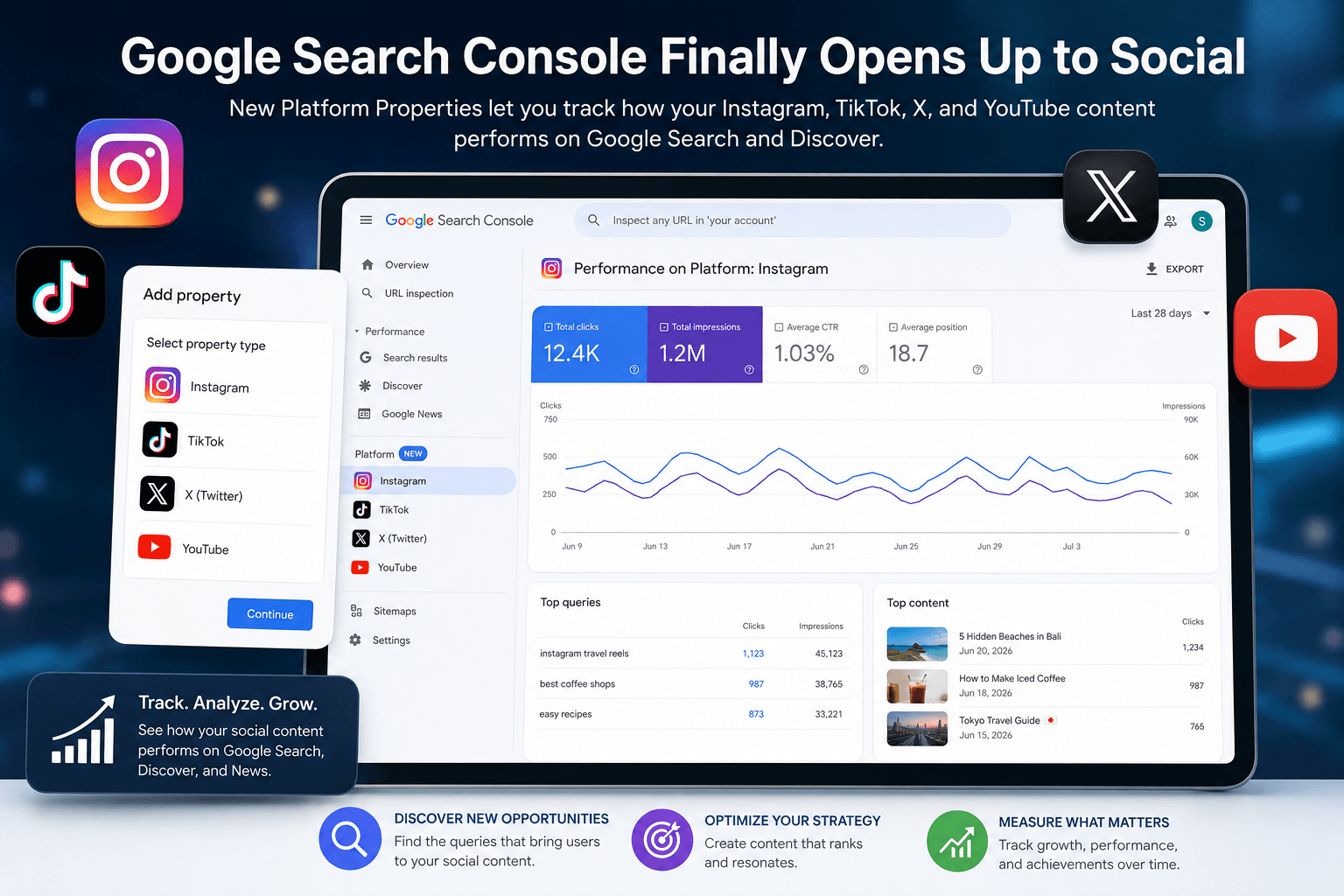
Google Search Console Finally Opens Up to Social: What Are Platform Properties and Why Should You Care Right Now?
For years, Google Search Console (GSC) was a tool reserved for website owners. You verified your domain, and Google showed you the queries, impressions, and clicks that led users to your pages. But what about the content you posted on Instagram, TikTok, X, or YouTube? That was a black box — you knew your posts were getting views, but you had no idea how they appeared or performed on Google Search.
That has just changed completely.
On July 7, 2026, Google announced Platform Properties — an entirely new property type in Search Console that lets you connect your social media accounts and see how they perform on Google Search and Discover. And as of July 29, 2026, the feature has been rolled out globally to every Search Console account.
From Experiment to Official Feature
The story began on December 8, 2025, when Google quietly started testing social channel data inside the Search Console Insights report. At that stage, everything was quite limited: only a small set of websites could participate, and Search Console automatically detected the social channels associated with a website — you couldn't add them manually.
The December 2025 experiment supported YouTube, Instagram, TikTok, and Facebook. In the official July 2026 release, Google dropped Facebook and added X (formerly Twitter) — a small detail that says a lot about where Google believes "social search" behavior is actually happening.
What Are Platform Properties?
In short: this is a new property type in Search Console, sitting alongside the familiar Domain and URL-prefix properties. But instead of being tied to a website, it's tied to your social media or video platform account.
Four platforms are supported at launch:
- TikTok
- X (Twitter)
- YouTube
The biggest breakthrough: this is the first property type in Search Console history that you can verify without owning a domain. That means creators who have built their entire brand on TikTok or YouTube — without ever having a website — can now use Search Console as a genuine measurement tool.
What Data Will You See?
Each Platform Property comes with three groups of reports:
1. Performance: Clicks, impressions, and most importantly — the search queries driving users to your posts. This is exactly the data that no native analytics tool from any social platform has ever been able to provide. The report supports filtering, sorting, and exporting, just like a regular website property.
2. Insights: Overall trends, your top-performing posts, and content that's trending up or down.
3. Achievements: Milestones reached over 28-day cycles — great for tracking growth momentum.
The data covers Google Search, Google Discover, and Google News — in other words, Google's entire content discovery ecosystem.
How to Set It Up
The process is very similar to adding a website property:
- Open Google Search Console
- Click the property selector in the top-left corner
- Select Add property
- Choose one of the four platforms: Instagram, TikTok, X, or YouTube
- Follow the on-screen verification steps to securely authorize the connection
- Wait for data to be collected
One important note: data is only collected from the moment you connect — there is no retroactive data. This is exactly why you should set it up today, even if you don't have a specific analysis plan yet. Every day you delay is a day of data lost.
Why Is This a Turning Point for SEO and Social Media Marketing?
First, the last measurement blind spot has finally been filled. Social content is taking up more and more space on search results pages — TikTok videos, Reels, and X posts appear directly in the SERPs. But because those posts live on domains you don't own, traditional Search Console could never report on them. Now it can.
Second, you can see the complete brand discovery journey. How many times do users search "your brand name + TikTok"? Is your social content outranking your own website for certain queries? These questions could only be guessed at before — now there are concrete numbers to answer them.
Third, the line between SEO and Social is blurring. Google officially bringing social data into its most important SEO tool is an admission that search behavior is no longer confined to Google's search box. Users search on social, in apps, in feeds. Content strategy now needs to be measured by your total digital footprint, not just the rankings of a single domain.
Fourth, creators without websites officially join the game. For individuals and small brands operating only on social, this is the first time they can access "Google-grade" search data — completely free.
Limitations to Keep in Mind
No new feature is perfect from day one:
- Only 4 platforms — Facebook, LinkedIn, Pinterest, Threads, and others are not yet supported.
- No historical data — everything starts from the day you connect.
- Reporting delays — like other GSC reports, data can lag by a few days.
- Data granularity remains to be seen — the feature is still new, and the SEO community is still evaluating the actual depth of the data.
What Should You Do Right Now?
- Connect all eligible social accounts to Search Console today to start accumulating data.
- After 2–4 weeks, review the query reports: look for keywords where your social content is showing but your website isn't (and vice versa).
- Compare performance across channels: if a topic performs well on TikTok via Google Search, consider developing corresponding content on your website — and vice versa.
- Add this data to your recurring reports for clients or internal teams: "visibility on Google" now includes social.
Conclusion
Platform Properties isn't just a new tab in the Search Console menu. It's a strategic signal from Google: search is now everywhere, and so is your brand. Whoever starts measuring early will understand their audience sooner than the competition.
The feature has been open globally since July 29, 2026. All you need to do now is open Search Console and hit "Add property."
Sources: Google Search Central Blog (July 7, 2026), Search Engine Land, Search Engine Roundtable, Search Engine Journal.