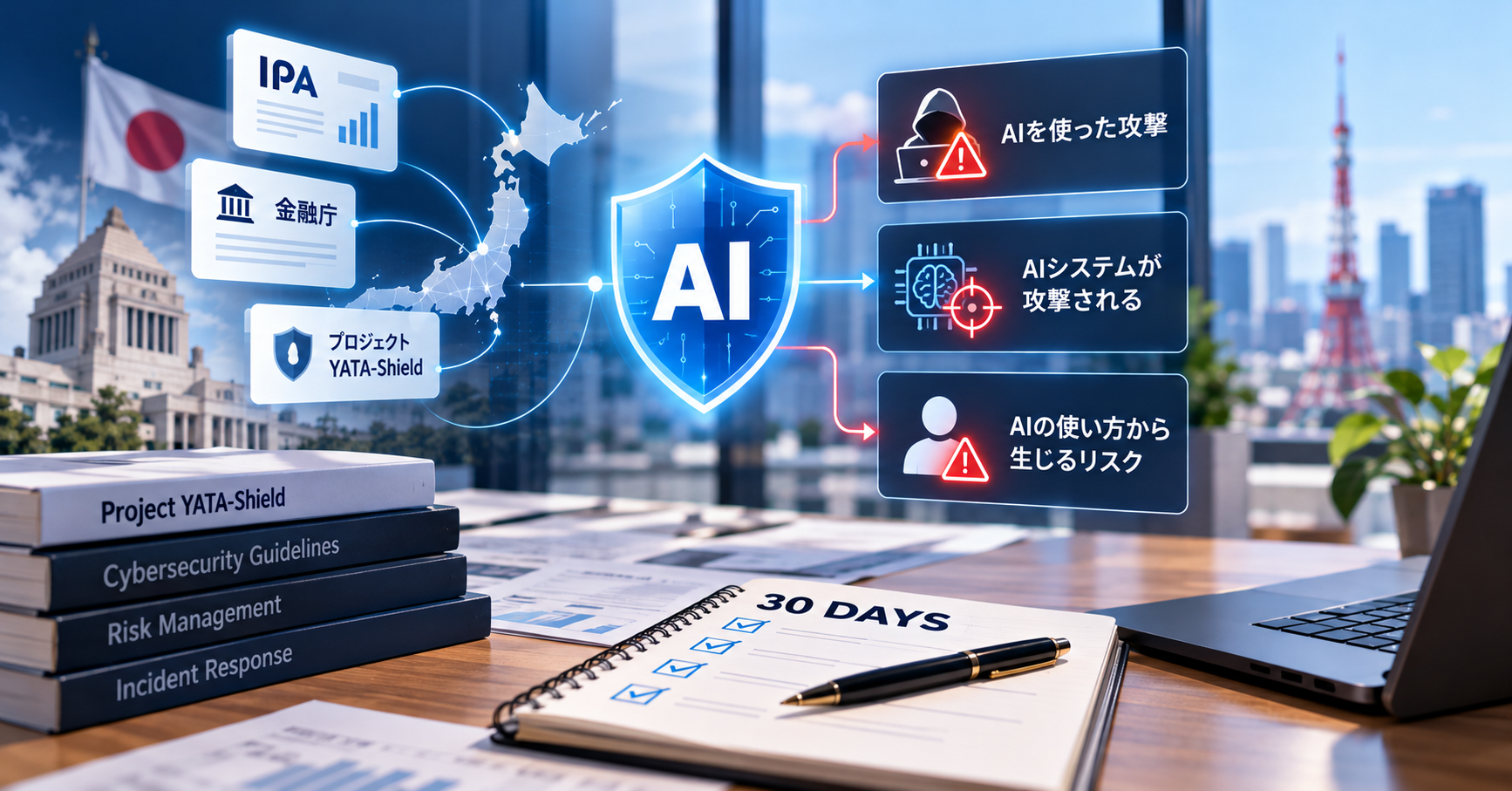
Summary: In 2026 the Japanese government issued the Project YATA-Shield package, a 9-item request to the financial sector and technical guidance on AI security. The common thread is doing the basics well, and faster. This article turns those documents into 16 tasks for 30 days and 10 questions for your software developer.
Part 6 of 6 in the series "AI-Driven Cyberattacks in Japan". The overall map is in part 1: concepts and 3 risk groups.
Contents
- What did the Japanese government issue in 2026?
- What do those documents ask of an ordinary company?
- What should you do in the first 30 days?
- Which questions should you send your software development and maintenance vendor?
- How does VAON answer those questions?
- When is this checklist not enough?
1. What did the Japanese government issue in 2026?
From January to October 2026, Japanese authorities issued or brought into force 6 documents that deal directly with cybersecurity risk from AI. The table below lists them in date order and shows who each one addresses.
| Date | Authority | Document | Addressed to | Nature |
|---|---|---|---|---|
| Jan 29, 2026 | IPA (Information-technology Promotion Agency, Japan; 独立行政法人情報処理推進機構) | 情報セキュリティ10大脅威 2026 (10 Major Security Threats 2026): 「AIの利用をめぐるサイバーリスク」 (cyber risks around the use of AI) ranked 3rd | All organizations | Awareness material |
| Mar 27, 2026 | Ministry of Internal Affairs and Communications (総務省) | AIのセキュリティ確保のための技術的対策に係るガイドライン (guideline on technical measures for AI security) | See the original document | Guideline |
| Mar 27, 2026 | IPA | 中小企業の情報セキュリティ対策ガイドライン (information security guideline for SMEs), version 4.0 | Small and medium-sized enterprises | Guideline |
| May 18, 2026 | National Cybersecurity Office (国家サイバー統括室) with 13 other agencies | Project YATA-Shield | Critical infrastructure, government bodies, software vendors | Policy package |
| May 22, 2026 | Financial Services Agency (金融庁), Bank of Japan (日本銀行) | Request for 9 short-term items | Financial institutions | Request from the regulator |
| Oct 1, 2026 | Government | サイバー対処能力強化法 (Cyber Response Capability Strengthening Act): incident reporting obligation | Designated critical infrastructure operators | Law |
The direct background to the two May documents is the arrival of frontier AI (the most advanced AI models). The Project YATA-Shield package names Claude Mythos Preview, which Anthropic announced on April 7, 2026. It also points to the fast-growing ability of this class of models to find and fix vulnerabilities.
The Japanese government looks at both sides of AI. Project YATA-Shield states that high-performance AI helps find and fix vulnerabilities faster. It also states that, if abused, the same AI makes attacks faster and larger in scale. The package therefore places the use of AI for defense among the measures to accelerate.
2. What do those documents ask of an ordinary company?
For a company outside finance and critical infrastructure, the 2026 documents create no new legal obligation. They show what regulators treat as the baseline, and what your large customers are now being asked to do.
Three messages repeat across the documents:
- Basic measures remain the core. The Financial Services Agency (FSA) cites an assessment by the UK AI Security Institute. It says it cannot yet be said that frontier AI can attack well-defended systems. From that, the FSA concludes that carrying out basic measures faster and more reliably still matters. IPA also writes that conventional measures are effective in most cases.
- Speed is what has to change. Project YATA-Shield says AI can speed up both finding and abusing vulnerabilities. The FSA's items on adding patching staff and making patching risk-based follow from the same premise.
- This is a management matter. The first of the FSA's 9 items is to treat the response to frontier AI as a management issue, with the CIO and CISO directly involved.
The indirect effect deserves more attention than the direct one. The FSA's fifth item asks financial institutions to review their maintenance contracts with vendors. Is patching covered by the contract? Are roles clearly divided? Can the vendor act at night and on holidays? The FSA also notes that the risk extends to third-party software and open source. If your company supplies software or services to customers in this group, those questions will reach you.
IPA points small companies in the same direction. Version 4.0 of its guideline for small and medium-sized enterprises adds "backup" to the set of basic rules, making 6 rules. The same version also brings in the thinking behind a scheme for evaluating supply chain security measures. The Ministry of Economy, Trade and Industry (経済産業省) and the National Cybersecurity Office are developing that scheme.
3. What should you do in the first 30 days?
In the first 30 days, a company should complete the 16 tasks below, split over 4 weeks. The FSA expects its short-term items for the financial sector to proceed within about 1 month, so this article uses the same time frame. VAON compiled the list from documents of the FSA, IPA and the National Police Agency (警察庁). It is not an official document.
Week 1: decide and take stock
- Management names one accountable person and a reporting deadline.
- List the systems whose outage would seriously affect the business.
- Mark which systems are exposed to the internet.
- Ask employees which AI services they use, with no penalty attached.
Week 2: money and accounts (details in part 2)
- Require verification through a second channel for every payment request and every change of payee account.
- Require two approvers for amounts above a set threshold.
- Turn on multi-factor authentication for administrator accounts, email and remote connections.
- Tell staff about fake-CEO fraud (ニセ社長詐欺) and about requests to set up a group on a social messaging app.
Week 3: systems and vendors (details in part 3)
- For each priority system, confirm who applies patches and how quickly.
- Reread the maintenance contract: patching, response time, out-of-hours work.
- Ask the vendor for the list of libraries and outbound connections of each system.
- Test a restore from backup, and confirm the backup is separated from the main system.
Week 4: your own AI (details in part 4 and part 5)
- List the chatbots and AI agents in operation: which data each one reads and what it can do unattended.
- Choose the approved AI services and check their settings for using data in training.
- Write input rules by specific type of data.
- Set the incident contact rule: who to tell, how quickly, through which channel.
After 30 days, the company is not much safer in technical terms. But it knows what it has, who is accountable, and which areas nobody is looking after. That is the condition for every later investment to land in the right place.
4. Which questions should you send your software development and maintenance vendor?
A company should send its software development and maintenance vendor the 10 questions below and ask for answers in writing. The FSA's fifth item is the basis for the first group. The second group rests on Project YATA-Shield, which calls on software vendors to address vulnerabilities early under the secure by design (セキュア・バイ・デザイン) principle.
| # | Question | What a good answer contains |
|---|---|---|
| Patching and maintenance | ||
| 1 | Is vulnerability patching covered by the maintenance contract? | Yes or no, with the clause |
| 2 | For a critical vulnerability, what is your response time? Do you act at night and on holidays? | A specific figure, not "as fast as possible" |
| 3 | If several customers need patches at the same time, how do you prioritize? | The priority rule, with staffing limits stated |
| Knowing what the system contains | ||
| 4 | Which libraries does the system use, and in which versions? | A list, updated with each release |
| 5 | Which external services does the system connect to, and why? | A list with reasons |
| 6 | Who reviewed and tested it, and can we see the records? | Records for each change |
| Use of AI in development | ||
| 7 | Which AI tools does the team use, on company or personal accounts? | Tool names, account type |
| 8 | Are our source code and data entered into AI tools? | Yes or no, with the training setting |
| If the system includes AI | ||
| 9 | Are document permissions enforced at the retrieval step, or only in the prompt? | A description of the architecture |
| 10 | Which actions may the AI take by itself, without human approval? | A list of actions |
An honest "no" is worth more than a vague "yes". A vendor that says plainly it does not work out of hours tells you what you must cover another way. A vendor that answers every question with "we guarantee it" has answered none of them.
5. How does VAON answer those questions?
VAON can answer part of these questions with facts it already has. The rest is agreed project by project. The table below shows both kinds, including what VAON does not yet have.
| Topic | VAON's answer (as of October 2026) |
|---|---|
| Review and test records (question 6) | Kept for every project, and the customer can view them |
| Reporting rhythm | Every project has a weekly report |
| Outbound connections (question 5) | Done for an on-premise invoice and contract system that VAON developed itself: a source code scan found 6 environment variables, all for SMTP (measured Aug 24, 2026) |
| Permissions in AI systems (question 9) | ONEBOT has role-based access control |
| Patching, response time, out-of-hours work (questions 1 to 3) | Agreed contract by contract. The figures should be written into the contract |
| ISO 27001 certification | Not certified yet |
| 24-hour monitoring, incident response, penetration testing | VAON does not offer these |
| Size | 15 regular employees. A project that needs several dozen people for a short period may exceed VAON's capacity |
VAON includes the "not yet" and "not offered" rows because customers need them to make their own assessment. A 15-person developer cannot replace a dedicated security team. What VAON takes responsibility for is delivering software with inspection records, and telling you exactly what the system contains.
6. When is this checklist not enough?
The 30-day checklist is not enough in 4 cases, and in those cases a company needs a specialist firm.
- Your sector has its own rules. Financial institutions must follow the FSA's original document, not this compilation. Designated critical infrastructure operators have had an incident reporting obligation since October 1, 2026.
- There are signs of a breach. Contact an incident response firm and the police. Do not handle it alone.
- You need continuous monitoring. A checklist does not create someone on watch at night.
- You need a legal opinion. This article is not legal advice. Obligations under law and contract need confirmation by a lawyer.
The checklist will also age. IPA writes that the situation may change within a few months. Review this checklist every 6 months.
Want to review a running system against these 10 questions? VAON works with you to list libraries, outbound connections and inspection records, then points out what to prioritize. Book a free consultation
Posts in this series
- AI-driven cyberattacks in Japan: concepts, 3 risk groups and what to do first
- AI phishing and deepfakes: why the defense has to be a process
- AI-written malware and faster vulnerability exploitation
- Prompt injection and attacks on RAG systems and AI agents
- Shadow AI and AI-generated code: risks from the way you use AI
- A 30-day checklist and the questions to send your vendor (this post)
References (checked Oct 10, 2026)
- National Cybersecurity Office (国家サイバー統括室) and 13 agencies, AI性能の高度化を踏まえたサイバーセキュリティ対策の強化について ~Project YATA-Shield~ (May 18, 2026): https://www.cyber.go.jp/pdf/press/20260518_AI_CS_Package.pdf
- Financial Services Agency (金融庁), Bank of Japan (日本銀行), 「フロンティアAIによる脅威変化を踏まえた金融機関等の短期的な対応」に係る要請について (May 22, 2026): https://www.fsa.go.jp/news/r7/sonota/20260522-5/20260522.html
- Ministry of Internal Affairs and Communications (総務省), 「AIのセキュリティ確保のための技術的対策に係るガイドライン」の公表 (Mar 27, 2026): https://www.soumu.go.jp/menu_news/s-news/01cyber01_02000001_00282.html
- IPA, 中小企業の情報セキュリティ対策ガイドライン 第4.0版: https://www.ipa.go.jp/security/guide/sme/about.html
- サイバー対処能力強化法等の施行について (document published on the Cabinet Office (内閣府) website): https://www.cao.go.jp/cybersecurity/pdf/sekousetsumei.pdf