Where do agencies and SIers get stuck on AI chatbot requests?
Agencies and SIers rarely get stuck on whether they can build an AI chatbot. They get stuck on who will be responsible for it. A basic RAG system (Retrieval-Augmented Generation: the system finds the relevant passages in your documents and the AI writes an answer from them) can be prototyped from open components.
The hard part comes after the prototype. Getting accuracy to a level people can rely on at work. Answering the client's security review. Agreeing on who fixes what when something breaks. All three end up in your contract with the client.
So this is a business model question more than a technical one. You can build and own the product, refer clients to another vendor, or sell another vendor's product under your name.
How do building, reselling, and OEM differ?
Building, reselling, and OEM differ in whose name the end client sees, and in who is responsible for outages and improvements.
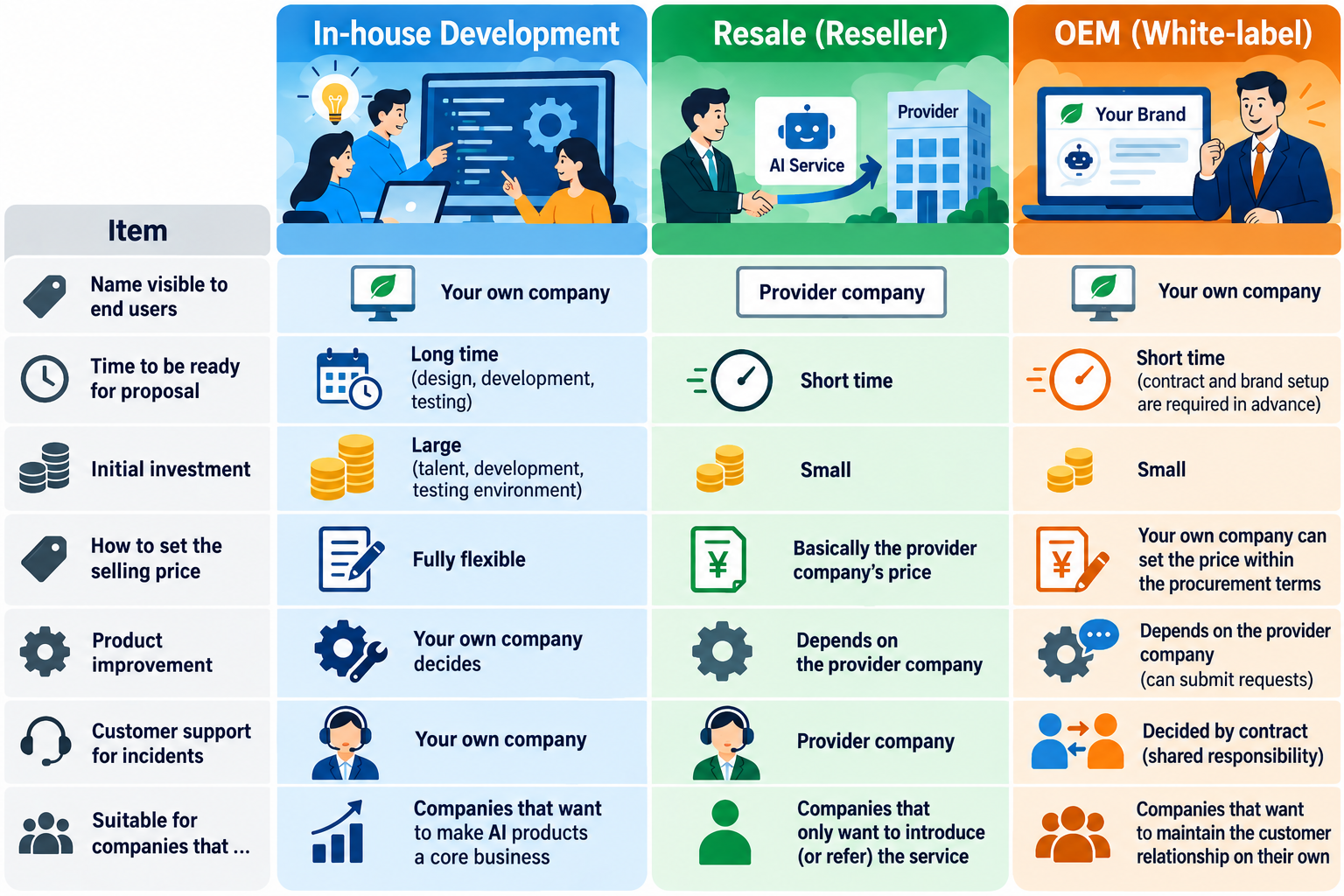
None of these is right for everyone. The same company may choose differently depending on the deal size and the client's industry.
When does building your own make sense?
Building your own AI chatbot makes sense when you plan to grow it as your product for several years and can keep investing during that time. It also makes sense if you want to compete on features for one industry, such as its specific forms or vocabulary.
Starting a build for a single client is where teams tend to struggle. To reuse the system for a second client, you have to rework how data is separated, how permissions work, and how updates are rolled out. You also need to decide early who keeps up with language model updates and who answers the phone when the system fails at midnight.
When is reselling enough, and when is it not?
Reselling is enough when the AI chatbot is a side service next to your main business and you do not plan to be involved much after go-live. It takes little effort and no development budget.
Reselling stops being enough when you want to keep the client relationship. In a referral model, the end client usually signs with the vendor directly, so renewals and expansion requests may stop going through you. Competitors can sell the same product too, which tends to turn every pitch into a price comparison.
Six things to ask a vendor before choosing OEM
With OEM, the end client sees you as the provider. Every weak spot of the vendor becomes something you have to explain. Before signing, ask about these six points.
1. Where data is stored, and whether it is used for training. Which country are the servers in? Will the vendor confirm in writing that end-client data is not used to train AI models?
2. The chain of data processing. In OEM, the end client entrusts personal data to you, and you entrust it to the vendor. Japan's Act on the Protection of Personal Information (APPI) requires the entrusting party to supervise the party it entrusts. Check that the vendor gives you documents you can use to explain its safeguards to the end client.
3. SLA scope and the incident path. What uptime is committed? Is planned maintenance included? When the end client reports a problem to you, how do you hand it to the vendor?
4. How far rebranding goes. Logo, colors, domain, admin panel labels, sender of notification emails. Is there anywhere the end client would still see the vendor's name?
5. Security review answers. How much of the end client's security questionnaire will the vendor answer?
6. Data at contract end. How is data deleted, and do you get confirmation? What export formats are available?
Points 1 and 5 are the same questions a company asks when it adopts a SaaS AI chatbot directly. They are covered in AI Chatbot Security for Enterprises: 5 Questions to Answer Before Approval. What OEM adds is points 2, 3, and 4: the terms between you and the vendor.
What ONEBOT OEM can and cannot do
VAON's ONEBOT is a SaaS AI chatbot for corporate customer support. It answers with RAG from PDF, Excel, Word, and website content, and runs on LINE and web chat. Through the ONEBOT partner program, agencies and SIers sell ONEBOT as their own service, while VAON builds, runs, and monitors the platform. Some partners already offer ONEBOT under their own brand. Their case studies are being prepared for publication, so on a call we share what we are allowed to.
Here is how ONEBOT answers the points in section 5 today:
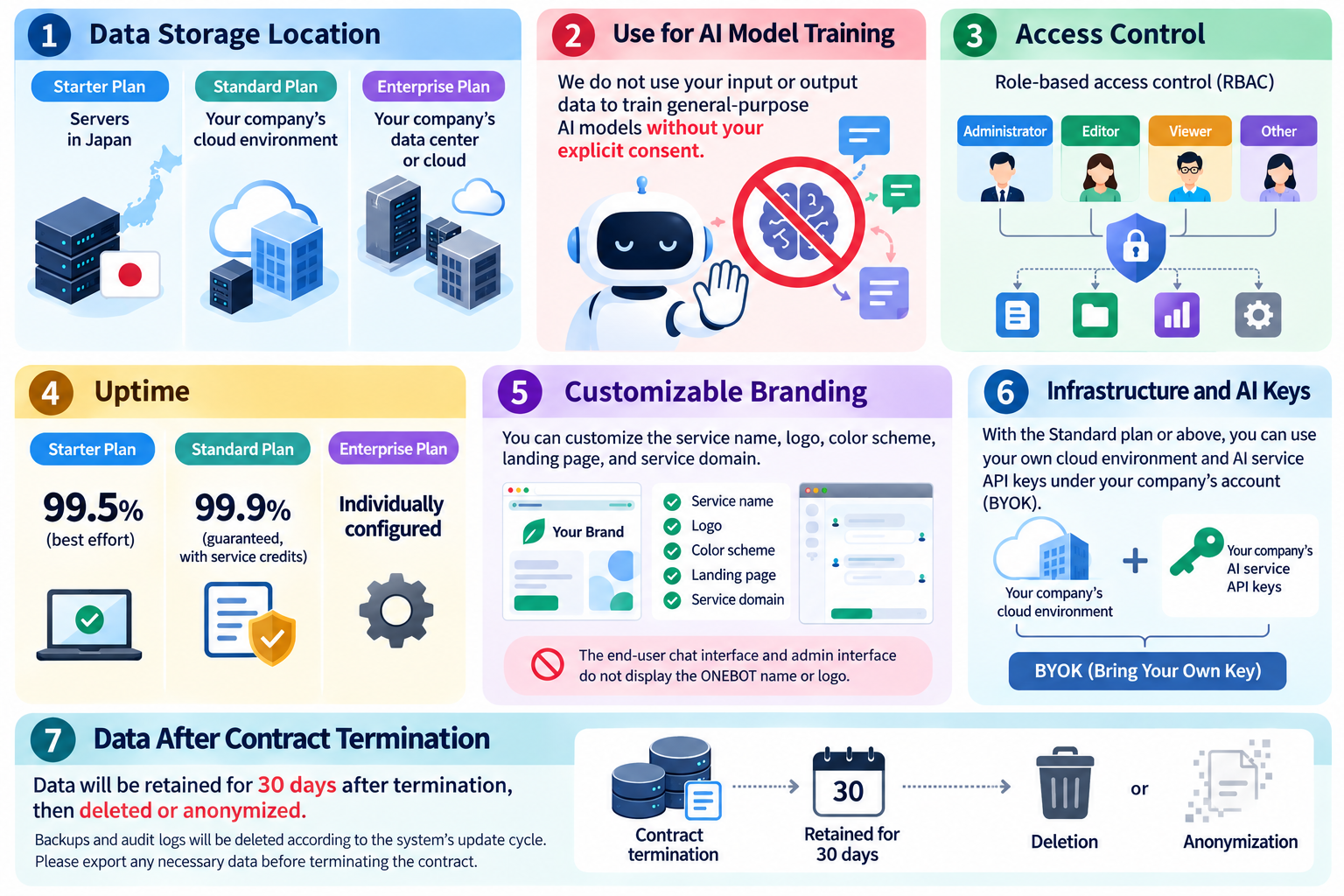
There are also things ONEBOT OEM cannot do.
ONEBOT does not fit end clients who cannot let any data reach the internet. ONEBOT calls an external AI service over the internet when it writes answers. If internal rules or contracts forbid data from leaving the network, VAON builds an on-premise RAG system as a custom development project. The difference is explained in On-Premise RAG Chatbots: When You Need One and What It Costs You.
The product does not make you APPI compliant on its own. Which data goes in, who can see it, and how long it is kept are decisions for the end client and you.
How does an OEM partnership start?
A ONEBOT OEM partnership can go from first call to selling in about two weeks at the fastest.
1. First call (online). We ask about the end clients you have in mind, their size, and the channels they want (LINE, web chat), and decide together whether ONEBOT is enough or custom development fits better. You can try the real screens and answers in a demo environment.
2. Terms and contract (week 1). Plan, partner price, roles during incidents, and the data processing agreement.
3. Brand setup and build (week 1). VAON sets up the display under your brand and builds the environment. On the Standard plan with a cloud account in your name, the build takes about one extra week.
4. Training and acceptance (week 2). Your staff learn operation and support, and we check the system together. We also hand over materials for your proposals.
5. Start selling. For deals with many technical questions, VAON engineers join meetings with the end client. Starting with a PoC helps the client decide: we measure answer accuracy using their real documents and 50 to 100 questions with answers prepared by their business staff.
Once live, you handle sales, contracts, billing, and first-line support for end clients. VAON handles infrastructure build, operation, and monitoring, plus technical investigation and recovery.