Measured results
Project summary
| Client | EVOS |
|---|---|
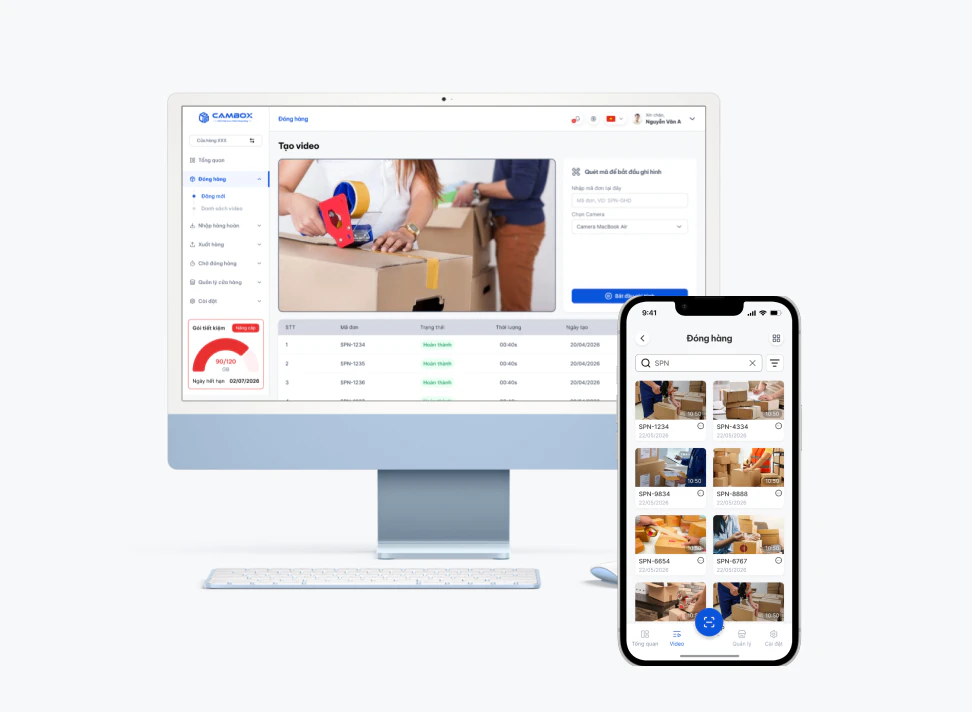
| Problem | VAON built CamBox with EVOS from the first line of code: a mobile and web SaaS that records each packing video against its waybill, burns in order code, server time and address, and issues a public verification link. AI-assisted engineering helped take it from empty repository to official release on the App Store and Google Play in about eleven weeks. |
| Solution | How we worked: we started with the dispute, not the camera. Before writing code, we used AI research agents to collect marketplace complaint rules, competitor pricing and feature sets, then turned them into a shared domain glossary and acceptance criteria that engineers and EVOS both signed off. Every feature then went through a written plan, AI-assisted implementation, AI and human code review, automated tests and a pull request before merge. Where AI helped, and where people stayed in charge - Understanding the domain faster. Research agents summarised marketplace dispute rules, carrier waybill formats and six competitors' pricing and features. Engineers and EVOS reviewed the summaries and turned them into a domain glossary used in code and UI. - Shortening delivery. Each feature started from a written plan with acceptance criteria. AI drafted code and tests inside project rules (AGENTS.md), so engineers spent their time on decisions, edge cases and review. Over 200 plans and 57 engineering journals record those decisions. - Raising quality. An AI reviewer checked every change before human review; CI ran unit and integration tests against PostgreSQL and Redis on every pull request. Crash recovery for interrupted videos came from QA findings, not from a demo. - A better mobile experience. Competitor apps were tested screen by screen. The gap we chose to win was team operation on the phone (roles, staff, labels, notifications), which the leading competitor's app did not offer at the time of comparison (5 August 2026). - AI inside the product, where it is useful. Serial-number photos are read with Gemini OCR, with a review queue for anything uncertain. |
| Engagement model | Product partnership: VAON builds and runs the product; EVOS is Product Owner, sales and support |
| Timeline | 3 months · from 05/2026 |
| Team | CTO / Tech lead (VAON), Mobile app engineer (VAON), Full-stack engineer (VAON), QA engineer (VAON), Product Owner (EVOS), Sales & customer support, final acceptance (EVOS) |
| Key results | Time to official release (iOS and Android): ~11 weeks (76 days) · Commits in first 6 weeks (web): 607 · Pull requests merged: 459 |
Project Context
Vietnamese online sellers lose money every week to disputes: buyers who claim an empty box, a wrong item or a missing part, and returns that come back swapped. Marketplaces ask for video proof, but a phone clip on a staff member's device rarely proves which order it shows or when it was recorded. EVOS, a sales partner close to these sellers, wanted a product for warehouses with a packing team, not just a recording app. VAON joined before any code existed: we mapped how disputes are actually filed on each marketplace, defined what "evidence" should mean, then designed, built and now operate CamBox on web, iOS and Android.
Challenges
A packing video is only evidence if it is tied to one order and one moment
A clip without the waybill code and a trustworthy timestamp can be dismissed as recorded later or for another parcel. Times taken from the phone clock can be changed by the user.
Warehouses pack hundreds of orders a day and cannot afford extra seconds
Holding a phone, pressing record and waiting for an upload adds friction to every order. Staff push back, and recording gets skipped on exactly the busy days when disputes happen.
The owner needs to manage a team, not a single phone
Existing tools focus on one person recording. Owners with 3–10 packers need staff accounts, roles, labels and per-person reports to know who packed which disputed order.
A fast-moving market with established competitors
Dohana, Cam Check, ASCAM/E-CAM and others were already selling. A new product had to reach the app stores quickly, with quality high enough that a first dispute would not be lost to a bug.
VAON's Solution
How we worked: we started with the dispute, not the camera. Before writing code, we used AI research agents to collect marketplace complaint rules, competitor pricing and feature sets, then turned them into a shared domain glossary and acceptance criteria that engineers and EVOS both signed off. Every feature then went through a written plan, AI-assisted implementation, AI and human code review, automated tests and a pull request before merge. Where AI helped, and where people stayed in charge - Understanding the domain faster. Research agents summarised marketplace dispute rules, carrier waybill formats and six competitors' pricing and features. Engineers and EVOS reviewed the summaries and turned them into a domain glossary used in code and UI. - Shortening delivery. Each feature started from a written plan with acceptance criteria. AI drafted code and tests inside project rules (AGENTS.md), so engineers spent their time on decisions, edge cases and review. Over 200 plans and 57 engineering journals record those decisions. - Raising quality. An AI reviewer checked every change before human review; CI ran unit and integration tests against PostgreSQL and Redis on every pull request. Crash recovery for interrupted videos came from QA findings, not from a demo. - A better mobile experience. Competitor apps were tested screen by screen. The gap we chose to win was team operation on the phone (roles, staff, labels, notifications), which the leading competitor's app did not offer at the time of comparison (5 August 2026). - AI inside the product, where it is useful. Serial-number photos are read with Gemini OCR, with a review queue for anything uncertain.
Evidence you can verify: one order, one video, one public link
Scan the waybill first; the server reserves that code so one order maps to one video and duplicates are blocked.
A background worker burns order code, server time (ICT), ward/province address and a QR code into the video.
SHA-256 fingerprints of the original and the exported file, plus a public /verify/{token} page anyone can open.
For the packing floor: fast capture that survives a busy shift
On-device barcode scanning (Code128/39/93, EAN, QR, DataMatrix) and automatic carrier detection for 6 carriers.
Upload queue in the background with direct multipart upload to storage, so staff move to the next order immediately.
Crash recovery: a video interrupted by an app crash is checked and recovered instead of silently lost.
Two editions: CamBox Mobile (phone, free to start, for shops under ~50 orders/day) and CamBox Pro (web + EVOS camera kit recording two angles, for 50–300 orders/day).
For the owner: a team operating system, not a recording app
5 roles × 16 permissions enforced on the server, staff invites, account locking, all available inside the mobile app.
TikTok Shop integration: when a buyer requests cancellation, scanning that order shows a red banner with a beep.
Serial/label photos read by Gemini OCR, video labels and per-staff reports for dispute follow-up.
Key Features
Scan → claim → record (≤5 min) → background upload on iOS and Android; recording also works in the browser on a PC webcam.
Evidence watermark (order code, server time, address and QR, rendered by an ffmpeg worker) and a public verification page /verify/{token} with SHA-256 fingerprints.
Search by waybill code or by scanning the barcode, filters by carrier, label, staff, status and date.
Team management with roles, labels, notifications (in-app, push, email) and staff reports, plus TikTok Shop connection with cancellation alerts at scan time and after packing.
Free plan (7-day retention) and paid plans from 129,000 VND/month with 25–40 days retention, online payment (VNPay), automatic cleanup when a plan's retention ends.
Full HD and 2K recording; Pro camera kits (1080p or 2K) with a wide-angle camera, a waybill camera and two stands.
Value Delivered
About eleven weeks from the first commit (27/05/2026) to the official release on the App Store and Google Play (11/08/2026); the web app and the evidence pipeline were built in parallel.
Evidence a third party can check: open the QR or link and see order, time and fingerprint without logging in.
Built for warehouses with a team: roles, staff reports and labels work on the phone, not only on a desktop.
Quality kept while moving fast: 459 web and 103 Flutter test files run in CI, 459 PRs merged after review.
Results & how we measured
| Metric | Before | After | Change | How we measured |
|---|---|---|---|---|
| Time to official release (iOS and Android) | — | ~11 weeks (76 days) | — | First commit 27/05/2026 (mobile repo) to official release on the App Store and Google Play, 11/08/2026 (release date provided by the VAON team) Measured 2026-08-11 |
| Commits in first 6 weeks (web) | — | 607 | — | git log on the web monorepo, 01/06–15/07/2026 |
| Pull requests merged | — | 459 | — | 334 (web, to 19/10/2026) + 125 (mobile, to 30/09/2026), from PR numbers |
| Automated test files | — | 562 | — | 459 (web: unit + integration) + 103 (Flutter), counted in repo |
| Written engineering plans | — | 200+ | — | Plan folders in both repos (~177 web, ~26 mobile) |
| Carriers auto-detected | — | 6 | — | SPX, GHN, GHTK, Viettel Post, J&T, VNPost in the carrier contract (code) |
| Official release date (App Store and Google Play) | — | 11/08/2026 | — | Release date provided by the VAON team; App Store and Google Play Console release history to be attached as evidence Measured 2026-08-11 |
Current limitations
-
1
Business impact (fewer lost disputes, refunds saved) has not been measured yet. Sales started in November 2026; we will add numbers once there is enough data.
-
2
Evidence is self-attested (SHA-256 fingerprints and server time). There is no digital signature or third-party timestamp (RFC 3161) yet.
-
3
The watermark shows ward/province address, not raw GPS coordinates, by privacy design.
-
4
Marketplace sync covers TikTok Shop only. Shopee and Lazada are not integrated.
-
5
No native Windows app. On a PC, staff record through the web app in a browser.
-
6
Videos are kept for a period set by the plan, then deleted automatically. CamBox is not long-term archival storage.
-
7
AI speeds up research, planning, coding and review, but every change is reviewed by an engineer and must pass tests before merge. Elapsed time also depended on team size and prior experience, so the gain is not attributed to AI alone.
Related Case Studies


Facing a similar problem?
Book a 30-minute consultation with the VAON engineering team, or explore the services behind this case study.