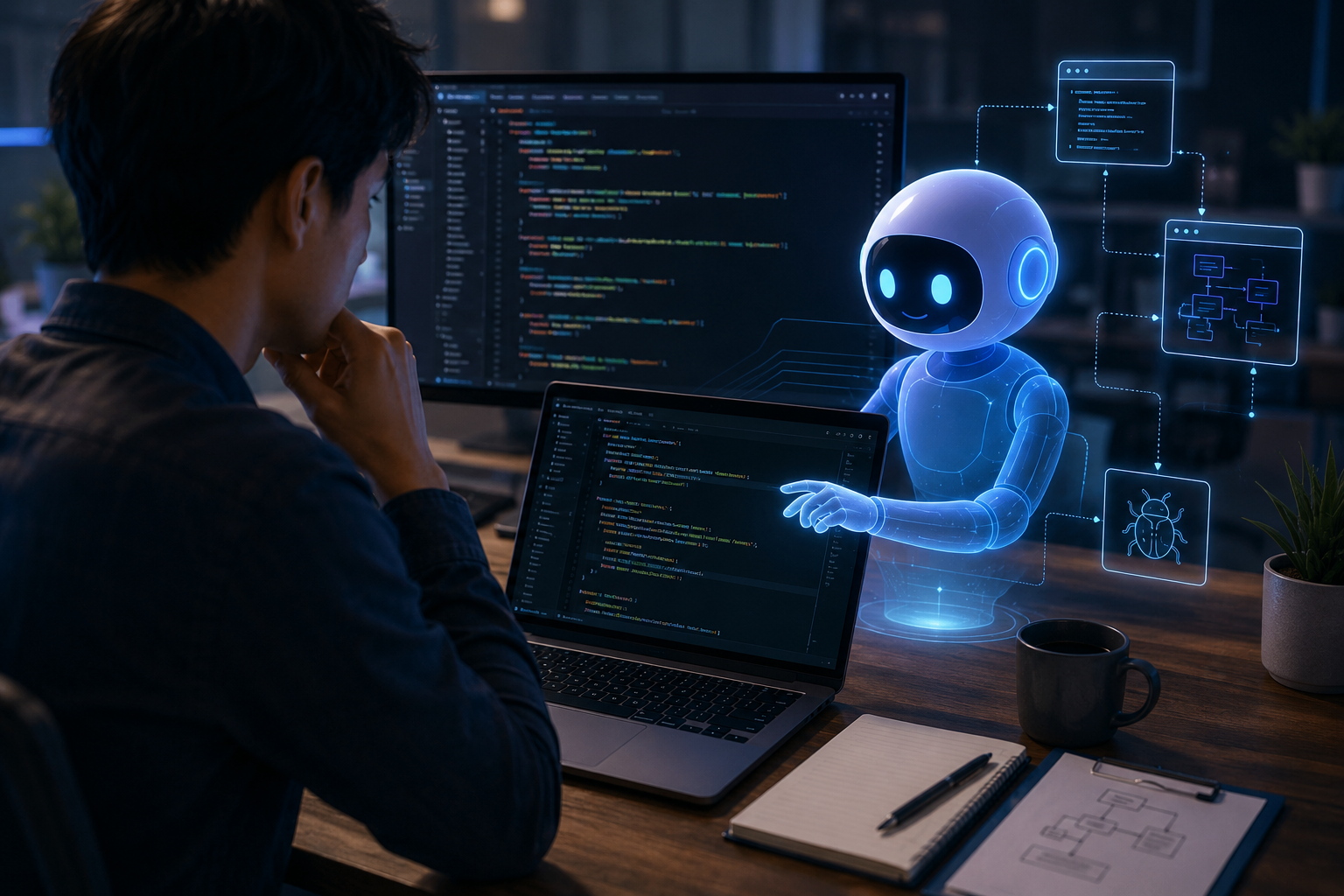
Answer-first: Vibe coding allows users to describe software requirements in natural language and have AI generate or modify the code. This can significantly accelerate development, but it also creates a new quality challenge: AI-generated code still needs independent verification for functionality, security, edge cases, and regressions before it reaches production.
What Is Vibe Coding?
Vibe coding is a software development approach in which users describe what they want to build in natural language while AI handles much of the implementation and debugging work.
The workflow typically follows a simple loop: describe the requirement, let AI generate the code, run the result, observe its behavior, and provide further instructions until the desired outcome is reached.
The term “Vibe Coding” was coined by Andrej Karpathy in February 2025. Since then, AI coding tools such as Cursor, Replit, GitHub Copilot, and Google AI Studio have helped make this approach increasingly accessible.
The biggest attraction is speed. Features that traditionally required significant manual implementation can potentially be produced within minutes. AI also lowers the technical barrier, allowing users to focus more on product intent and less on programming syntax.
But there is an important distinction between working software and verified software.
As code generation becomes faster, development teams face a new question: Who is verifying the code that AI produces?
Why Does AI-Generated Code Require Different Testing?
AI coding tools are generally optimized to make the requested functionality work quickly. As a result, the happy path described in the prompt may work well while less obvious scenarios remain untested.
Testomat.io identifies several common risk patterns in AI-generated code, including edge-case gaps, security vulnerabilities, silent regressions, non-deterministic output, and scalability blind spots.
For example, a registration form may work correctly with a standard email address but fail when users enter Unicode characters or less common formats. Similarly, a new feature may unintentionally change existing behavior if the team does not maintain an effective regression suite.
A practical QA strategy for vibe-coded applications therefore needs several layers:
- Security scanning: identify security issues before code is merged.
- Unit and integration testing: verify individual components and how they work together.
- Risk-based regression testing: protect high-value and high-risk workflows.
- Exploratory and edge-case testing: investigate scenarios that the original prompt may not have covered.
- Human review: ensure customer-facing code and behavior are reviewed before release.
AI can also generate test cases and automation scripts. However, generated tests should not automatically be treated as correct. Human review remains important to ensure that assertions and expected results actually reflect business requirements.
What Does Vibe Coding Mean for Customers?
For businesses, the clearest benefit of vibe coding is faster software delivery.
Teams can build prototypes and new features more quickly, making it easier to experiment with ideas and respond to changing market needs.
But development speed only creates business value when quality keeps pace.
If a feature takes minutes to generate but contains an undetected defect, the cost may appear later through production fixes, regressions, disrupted business workflows, or a poor customer experience.
This is why the role of QA is evolving alongside AI-assisted development.
QA teams need to answer more than “Which test cases have been executed?”
They increasingly need to answer:
What is actually covered? What remains untested? And what risks are still present before release?
Martin Fowler also distinguishes Vibe Coding from “Agentic Programming.” In the stricter definition of vibe coding, users may largely ignore the generated code, whereas agentic programming involves humans reviewing and remaining responsible for the code produced by AI. This distinction becomes particularly important when software is used in real-world environments with meaningful business consequences.
GitHub has also reported significant growth in AI-assisted code reviews, illustrating how review processes are evolving alongside AI-accelerated software development.
For businesses, the key question is therefore not simply whether to adopt vibe coding. It is how to accelerate development without accelerating risk at the same time.
AI can help teams build software faster. QA provides the independent verification needed to determine whether that software is reliable enough to reach users.
References
- Testomat.io — Vibe Coding: How to Test AI-Generated Code Before It Reaches Production.
- Martin Fowler — Vibe Coding.
- Martin Fowler — Agentic Programming.
- GitHub Blog — 60 million Copilot code reviews and counting.
- GitHub Blog — Agent pull requests are everywhere. Here's how to review them.