Generative AI and Autonomous Agents in Enterprise Operations
Summary
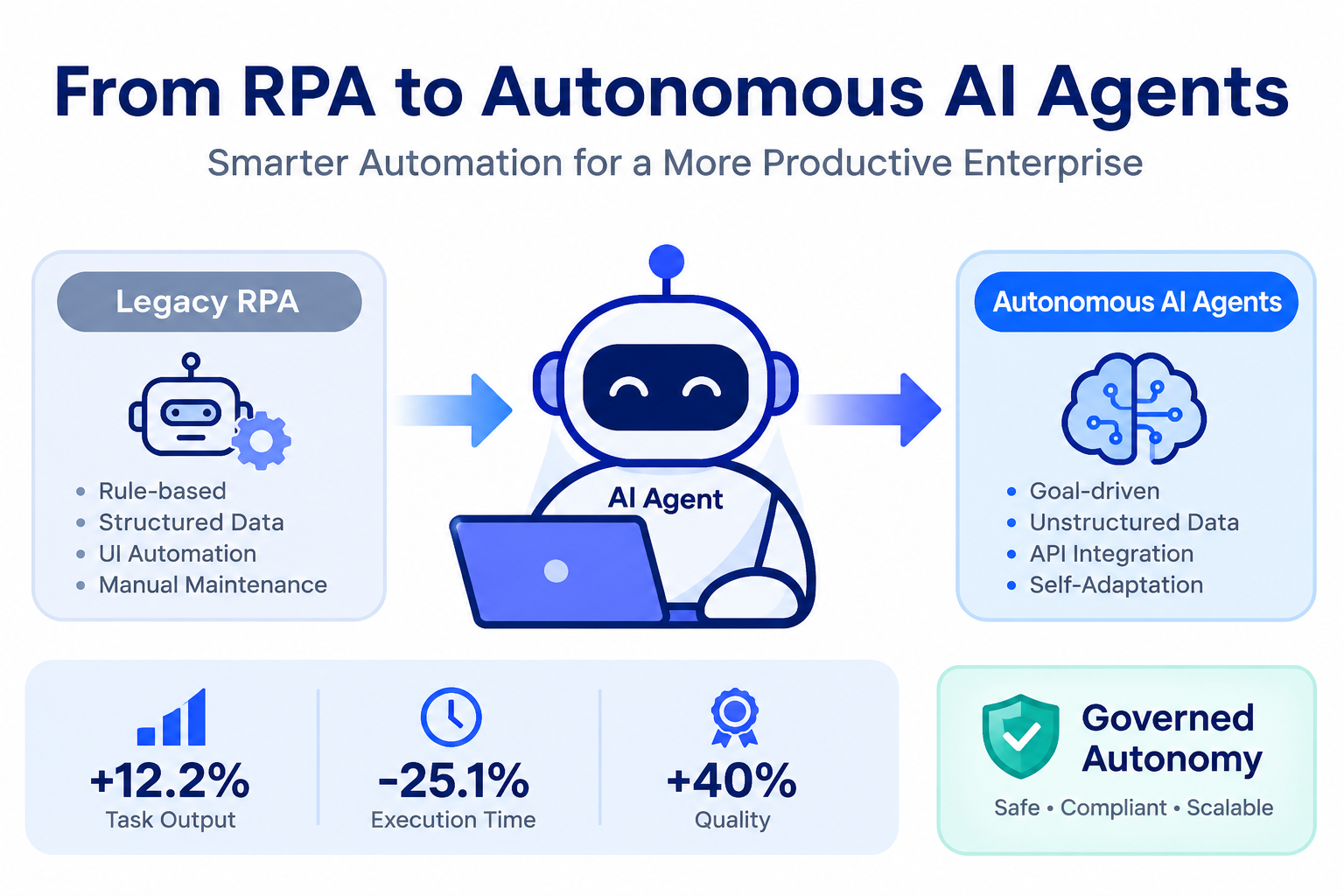
Generative AI and autonomous agents are fundamentally transforming enterprise operations across finance, supply chain, and contract management. Empirical findings from Harvard Business School and BCG confirm that AI enhances task completion by 12.2% and accelerates execution by 25.1%. However, navigating the "Jagged Technological Frontier" requires governed autonomy frameworks to mitigate critical failure modes.
Table of Contents
- The Shift from Legacy RPA to Autonomous Agentic AI
- Four Core Enterprise Automation Pillars
- Empirical Evidence from Harvard & BCG: Productivity and the Jagged Frontier
- Human-AI Interaction Archetypes: Centaur vs. Cyborg
- Implementation Challenges & Governed Autonomy Framework
- When Enterprises Should NOT Fully Automate with AI
- Frequently Asked Questions (FAQ)
- References
1. The Shift from Legacy RPA to Autonomous Agentic AI
Enterprise automation is moving beyond deterministic Robotic Process Automation (RPA) into the era of autonomous Agentic AI. While legacy RPA relies on static, rule-based execution on structured data, Agentic AI leverages Large Language Models (LLMs), computer vision, and function calling to interpret unstructured context, formulate multi-step plans, and orchestrate actions across disparate systems.
Comparison: Traditional RPA vs. Autonomous Agentic AI
Data Ingestion
Traditional RPA:
Restricted to structured formats (Excel, SQL tables, static forms).
Autonomous Agentic AI:
Processes complex unstructured data (free-form PDFs, contracts, emails, site photos).
Decision-Making
Traditional RPA:
Fixed if-then logic; halts execution when encountering edge cases.
Autonomous Agentic AI:
Goal-driven dynamic reasoning; adapts autonomously to workflow variations.
System Integration
Traditional RPA:
UI macro emulation (clicking and typing simulation).
Autonomous Agentic AI:
Direct API execution, vector search retrieval, and core ERP/CRM mutations.
Maintenance Burden
Traditional RPA:
High; requires manual code updates upon minor UI modifications.
Autonomous Agentic AI:
Low; autonomously adapts via human feedback loops and semantic understanding.
2. Four Core Enterprise Automation Pillars
2.1. Finance, Accounting & Risk Control
According to Gartner surveys, 58% to 59% of corporate finance leaders have actively deployed AI within enterprise operations. Primary use cases include corporate knowledge discovery (49%), accounts payable automation (37%), and transaction anomaly detection (34%).
- Automated 3-Way Invoice Matching: Intelligent OCR paired with LLMs extracts line items from supplier invoices, cross-referencing Purchase Orders (PO) and Goods Receipt Notes (GRN). Validated records automatically clear to the General Ledger and trigger payment gateways within minutes.
- Predictive Cash Flow & Credit Scoring: Machine learning models analyze historical debtor behaviors and macro trends to project cash flow positions and tier default probabilities in real time.
- Continuous 100% Audit Coverage: AI audits entire transaction datasets, identifying structuring behaviors, duplicate claims, and synthetic invoices while logging tamper-evident audit trails for AML/KYC compliance.
2.2. Supply Chain, Warehousing & Logistics
Research by McKinsey and Gartner highlights that integrating AI across supply chain operations reduces overall operational costs by 12% to 20% while curbing supply disruption losses by up to 40%.
Supply Chain Functions and AI Automation
Demand Forecasting
AI Automation Approach:
Multi-horizon time-series models ingesting POS, weather, and market indicators.
Quantitative Impact:
20%–50% forecast error reduction; 25%–30% inventory carrying cost decrease.
Procurement Automation
AI Automation Approach:
Dynamic reorder point tracking and autonomous PO generation.
Quantitative Impact:
Automates up to 90% of routine purchasing; eliminates hours of manual effort weekly.
Fleet Dispatch & Routing
AI Automation Approach:
Dynamic real-time routing based on load factors, traffic, and delivery windows.
Quantitative Impact:
10% fuel cost reduction; 40% higher package throughput per driver hour.
Predictive Maintenance
AI Automation Approach:
IoT vibration and thermal anomaly tracking across facility machinery.
Quantitative Impact:
32% decrease in catastrophic machine breakdowns; 30% reduction in fleet downtime.
2.3. Legal Operations & Contract Lifecycle Management (CLM)
Legal departments are transitioning from manual reviews to automated contract intelligence platforms:
- Self-service Contract Drafting: Business units generate standard agreements from approved templates via platforms like Ironclad AI and Juro.
- Playbook-aligned Redlining: Legal AI engines (e.g., CoCounsel, Lexis+ AI) cross-examine third-party terms against corporate legal playbooks, highlighting deviations in indemnity and confidentiality clauses.
- Automated Pre-signature Negotiation: Autonomous redlining of low-risk agreements (such as bilateral NDAs) through platforms like Luminance Autopilot.
- Post-execution Obligation Tracking: Automated extraction of renewal milestones, service level agreements (SLAs), and indemnification triggers via systems like DocuSign Iris.
2.4. Customer Operations, HR & Enterprise Architecture
- End-to-End Customer Resolution: Autonomous AI agents interface with Customer Data Platforms (CDPs) and enterprise APIs to execute refunds, reschedule bookings, and resolve tickets without human intervention.
- HR Talent Acquisition: Automated resume parsing, skill-matrix scoring, interactive technical assessments, and personalized onboarding orchestrations.
- Enterprise IT Architecture: Continuous application portfolio rationalization using Gartner's TIME framework (Tolerate, Invest, Migrate, Eliminate) and automated TOGAF compliance mapping.
3. Empirical Evidence from Harvard & BCG: Productivity and the Jagged Frontier
In a field experiment conducted by Harvard Business School and Boston Consulting Group (BCG) involving 758 strategy consultants, researchers measured the empirical impact of generative AI on complex knowledge work.
The Jagged Technological Frontier
Inside the Frontier (High AI Efficacy)
- Creative ideation & market scoping
- Structured drafting & synthesis
- Text classification & data extraction
Result:
- +12.2% Task Volume
- -25.1% Execution Time
- +40% Quality Score
Outside the Frontier (Subtle Traps)
- Deep quantitative reconciliation
- Multi-step recursive reasoning
- Complex domain-specific nuances
Result:
- Incorrect response rate increased by 19 points
- -23% net performance
Key Empirical Findings
- Task Output Volume: Consultants using AI completed 12.2% more tasks on average.
- Speed of Execution: Task completion speed increased by 25.1%.
- Output Quality: Work quality scores evaluated by independent experts were 40% higher compared to the control group.
- Skill-Level Equalization: Bottom-tier performers experienced a 43% performance boost, compared to a 17% increase for top-tier performers.
The Reality of the Jagged Technological Frontier
AI capability does not expand along a smooth boundary. For tasks situated inside the frontier, AI drives massive productivity gains. However, for tasks located outside the frontier (such as subtle mathematical cross-checks), consultants relying uncritically on AI were 19 percentage points more likely to produce erroneous solutions, leading to a 23% net decline in performance.
4. Human-AI Interaction Archetypes: Centaur vs. Cyborg
The Harvard-BCG study identified two distinct collaboration models utilized by top-performing knowledge workers:
- The Centaur Model (Clear Division of Labor): Professionals strategically divide workflows into distinct tasks—delegating routine data gathering and drafting entirely to AI while reserving strategic evaluation, nuance calibration, and final sign-offs strictly for humans.
- The Cyborg Model (Deep Task-Level Integration): Professionals weave their cognition with the AI system at a micro-task level, engaging in rapid, iterative prompt-feedback loops to refine ideas, text, and code continuously.
5. Implementation Challenges & Governed Autonomy Framework
Deploying AI agents at enterprise scale demands a structured "Governed Autonomy" framework across three core pillars:
- Enterprise Data Readiness: Unifying fragmented data silos from ERP, CRM, and HRIS into cleaned, vectorized data architectures to eliminate hallucinations.
- Risk-Based Tiering & Guardrails: Authorizing 100% autonomous execution for high-frequency, low-risk tasks while mandating Human-in-the-Loop (HITL) checkpoints for transactions exceeding defined monetary or compliance thresholds.
- Immutable Audit Logging: Recording structured, time-stamped execution traces for every agentic API call to ensure complete compliance traceability and regulatory alignment.
6. When Enterprises Should NOT Fully Automate with AI
Autonomous AI deployment is counterproductive under the following conditions:
- Unstandardized, Fragmented Data Estates: Ingesting corrupted data into autonomous pipelines only accelerates the generation of flawed enterprise decisions.
- Ill-defined Business Logic: If human experts cannot establish objective decision trees, AI cannot reliably infer corporate policy.
- High-Stakes Legal and Strategic Determinations: Material litigation strategies, executive restructuring, and critical client negotiations require definitive human accountability.
7. References
- Dell'Acqua, F., McFowland, E., Mollick, E. R., Lifshitz-Assaf, H., Kellogg, K., Rajendran, S., Krayer, L., Candelon, F., & Lakhani, K. R. (2023).
Navigating the Jagged Technological Frontier: Field Experimental Evidence of the Effects of AI on Knowledge Worker Productivity and Quality. Harvard Business School Working Paper No. 24-013. - Gartner Research (2024–2026).
AI in Finance and Enterprise Architecture: Autonomous Intelligence and TIME Framework Adoption in Modern Operations. - McKinsey & Company (2024).
The Economic Potential of Generative AI: The Next Productivity Frontier in Supply Chain and Business Operations. - Boston Consulting Group (BCG) Henderson Institute (2023).
How People Can Create—and Destroy—Value with Generative AI: Centaur and Cyborg Collaboration Models.