The New Era of QA: From Manual Tester to AI Orchestrator
Summary: Between 2026 and 2030, AI takes over most test case generation. The QA engineer's role shifts from manual execution to AI orchestration: designing context, auditing AI output, and analysing business risk. Machines own the speed. People still own the judgement.
Contents
- Why 2026 is a turning point for software testing
- The "all green" problem: if AI passes everything, who checks AI?
- How an AI Orchestrator differs from a traditional QA engineer
- The three core capabilities of an AI Orchestrator
- Which skills should QA engineers invest in?
- When you should NOT fully automate with AI
- Frequently asked questions
1. Why 2026 is a turning point for software testing
Software testing is among the first disciplines reshaped by generative AI, because much of the work is repetitive and describable in natural language: generating sample data, writing test cases, maintaining automation scripts.
The Malaysian Software Testing Board's report AI in Software Testing (2026–2030) (February 2026) notes that early adopters report test creation up to 9× faster: a figure published by tooling vendor Virtuoso QA and cited in the report. The same report carries a more consequential forecast for practitioners: roughly 70% of current QA roles will disappear, while those who remain become substantially more impactful.
Read those two numbers together. More speed does not mean more quality; it means more output. When a team can produce 5,000 test cases in an afternoon instead of 500 in a fortnight, the hard question is no longer "how do we write enough test cases?" It becomes "which test cases are actually worth running, and who is accountable when the suite reports green but the product still breaks in production?"
That is why the QA role has to change, not because AI is better than people, but because the work people used to do has moved to the machine, and what remains is markedly harder.
2. The "all green" problem: if AI passes everything, who checks AI?
"All green" describes a suite in which every test passes while the system still carries serious defects in production. It is the signature risk of AI-generated testing, and it is more dangerous than an ordinary defect because it arrives with a false sense of safety.
The cause lies in how the tool works. AI generates test cases probabilistically from the documents it is given. If a requirements document omits a business constraint, the model does not flag the gap: it produces a complete, internally consistent suite for the documentation it read. That suite passes, because it is testing exactly what it defined for itself.
Three classes of risk AI routinely misses:
| Risk class | Concrete example | Why AI misses it |
|---|---|---|
| Regulatory compliance | Construction progress acceptance must reconcile with on-site inspection records under local regulation | The constraint lives in legal text outside the project docs |
| Implicit business logic | Orders already dispatched cannot have their price edited: a rule that exists only in the operations team's heads | It was never written down for a model to read |
| Real-world edge cases | Users tap "submit" twice because connectivity is poor on a construction site | It arises from usage conditions, not from the specification |
All three share one property: the necessary information is not in the documents. No model can infer what has never been recorded. The only people who close that gap are those who understand both the domain and the end user.
3. How an AI Orchestrator differs from a traditional QA engineer
An AI Orchestrator is a QA engineer whose focus has moved from personally authoring and running tests to designing context for AI, coordinating automated tooling, and auditing what that tooling produces.
| Dimension | Traditional QA engineer | AI Orchestrator |
|---|---|---|
| Focus of work | Writing scripts, running manual tests | Designing context, orchestrating agent systems |
| Primary tools | Excel, TestRail, Jira, Selenium | Prompt engineering, AI frameworks, context models |
| Productivity ceiling | Individual speed and stamina | Quality of the context supplied to AI |
| Core value | Catching UI and syntax defects | Catching logic risk, compounding domain knowledge |
| Deliverable | A test suite | A test suite plus a reusable context library |
The last row matters most. A traditional QA engineer delivers the result of one project. An AI Orchestrator additionally delivers an asset the next project inherits: codified business rules, system constraints, and standardised context templates. That is where real productivity gaps between teams open up, not in who adopted the newest AI tool.
4. The three core capabilities of an AI Orchestrator
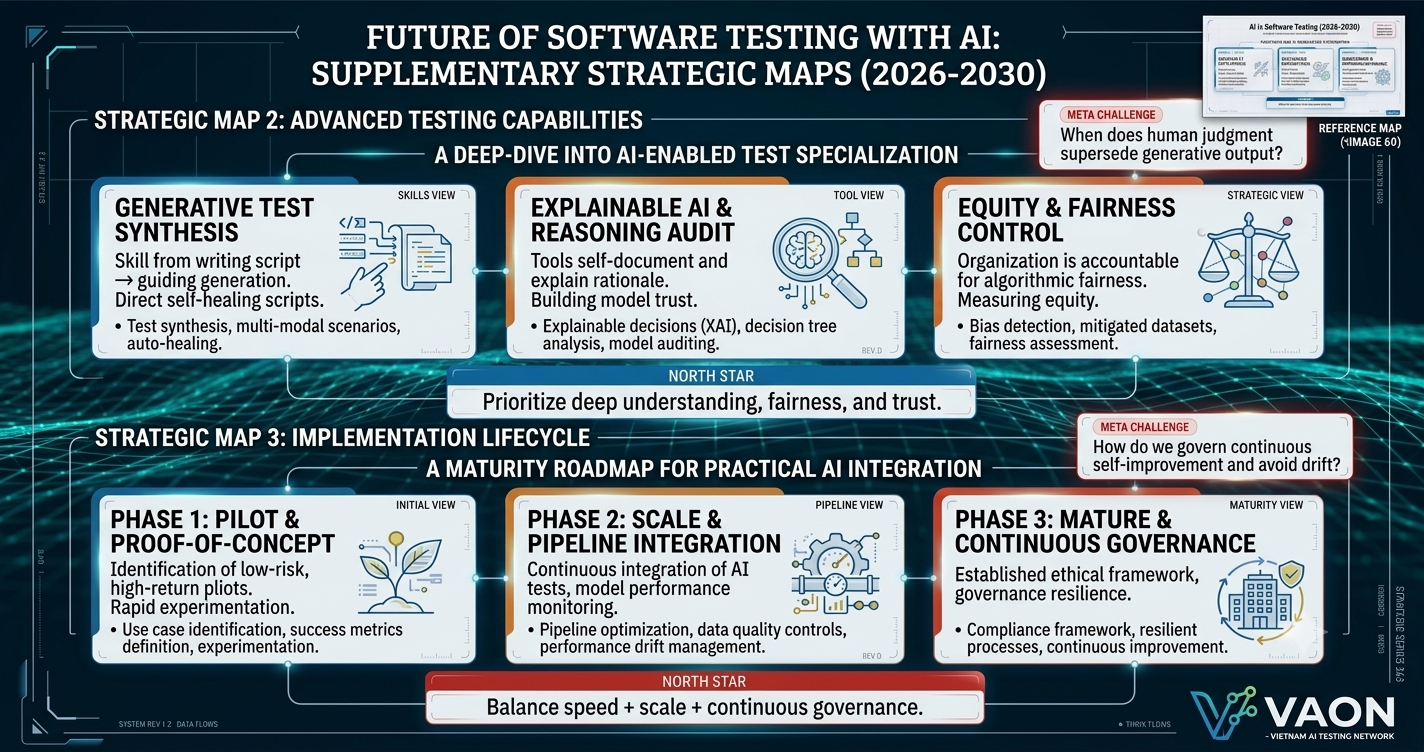
Knowing how to use generative AI tools is not enough to qualify. The role demands three distinct capabilities:
- Context engineering. Supplying input data, business rules, and system constraints precise enough for AI to generate tests with real-world value. Output quality is capped by context quality: this is the decisive capability.
- AI auditing. Acting as the final control layer, systematically challenging automated reports. The point is not to re-read every test case, but to design checks that reveal when the model is confidently wrong.
- Risk-based analysis. Concentrating human effort on the most complex parts of the system, where the cost of failure is highest, rather than spreading attention evenly across scope.
These are ordered by dependency: with poor context, auditing is merely damage control, and risk analysis is meaningless if the inputs were skewed from the start.
5. Which skills should QA engineers invest in?
What distinguishes a modern QA engineer is no longer typing speed or fluency in a test framework's syntax. The four levels below increase in difficulty, and in how hard they are to replace with AI.
| Level | Capability | What it looks like |
|---|---|---|
| 1 | Asking the right questions | Challenging assumptions in both the requirements and the AI's output |
| 2 | Spotting blind spots | Anticipating scenarios the model skips for lack of real user experience |
| 3 | Pairing human judgement with machine speed | AI sweeps broadly; a person makes the release call |
| 4 | Compounding organisational knowledge | Turning project experience into a standardised, reusable context library |
Level 4 is the hardest to copy and creates the most durable business value, because it converts individual experience into an organisational asset.
6. When you should NOT fully automate with AI
Not every context justifies pushing AI deep into the QA workflow. Three cases where people should stay in the lead:
- Deep user experience testing. AI can verify that a flow executes correctly, but it cannot register a user's frustration, confusion, or fatigue.
- Systems with continuously shifting business logic. While requirements still change daily, AI will keep generating context-drifted test cases. Cleanup costs exceed the speed benefit.
- Safety-critical systems. Healthcare, aviation, core financial systems, domains where legal accountability must rest with a named human, not a tool.
One more: if a team lacks a stable QA process manually, adding AI only accelerates the disorder. Standardise the process first, automate second.
7. Frequently asked questions
What should a QA engineer start learning to stay relevant over the next three years? Shift focus from test-framework syntax to three areas: designing context for AI, auditing generative output, and deepening domain knowledge. The third is the hardest to replace, because it accumulates over time, is specific to an industry, and cannot be downloaded from documentation.
Does AI reduce QA headcount on a project? It changes the mix more than it cuts across the board. Roles limited to data entry or manual test execution shrink, while demand rises for senior QA engineers who can orchestrate and control AI. The MSTB 2026 report projects that around 70% of current QA roles will disappear in their present form.
How do we keep project data safe when feeding documents to AI for test generation? Use on-premise models or enterprise AI services with contractual commitments not to train shared models on customer data. Pair that with a document classification process that states explicitly which materials may go to external tools and which may not.
Does adopting AI in QA mean replacing our existing tooling? No. Jira, TestRail, and Selenium keep their roles in storage and execution. The change sits in the layer above: how test cases are generated and maintained. The lowest-risk rollout is to run in parallel on one narrowly scoped module, measure, then expand.
Which metrics show whether AI is actually helping the QA process? Not the number of test cases generated: that rises easily and says nothing about quality. Measure instead: defect escape rate to production, lead time from requirement to a runnable suite, and the share of generated test cases humans discard on review. The last one is a direct read on the quality of the context being supplied.
Conclusion and next step
Moving from manual testing to AI orchestration is not a threat to the QA profession; it is an upgrade to what the profession demands. Machines absorb the volume. People retain judgement, domain knowledge, and release accountability. Teams that separate the two early move faster, not because their tools are better, but because they apply those tools in the right places.
If you are weighing how to bring AI into your testing workflow, the sensible first step is an assessment: where the QA process stands today, what can be automated now, and what needs standardising first. VAON offers a free QA process and system architecture audit, drawing on our delivery experience in system development and DX consulting for Japanese enterprises.
Reference
- Asrul Han. AI in Software Testing (2026–2030): The Next Five Years of Quality Engineering. Malaysian Software Testing Board, 11 February 2026. https://mstb.org/ai-in-software-testing-2026-2030-the-next-five-years-of-quality-engineering/