Why is modernizing a 20-year-old CMS considered so risky?
The question VAON's engineering team hears most often when taking over an aging CMS is whether the whole system can be modernized without a single minute of downtime. For established enterprises, media groups, or organizations with millions of content pages, that question is not hypothetical.
After 20 years in production, a CMS typically accumulates tangled code, dependencies on outdated plugins, lost documentation, and patches layered by generations of developers. Maintenance cost climbs every year, and so does security exposure.
The problem compounds when you want to adopt a modern frontend like Next.js or React to improve speed and security, but the monolithic backend behind it blocks that move. This is the classic technical-debt loop: you want to upgrade, but the old foundation will not let you.
The traditional approach is a "Big Bang" rebuild, replacing everything at once. It typically takes 1-2 years, costs well into six or seven figures in consulting and engineering time, and carries real risk of outages, data loss, or an SEO ranking drop on cutover day.
How did VAON modernize a million-page CMS in 4 months?
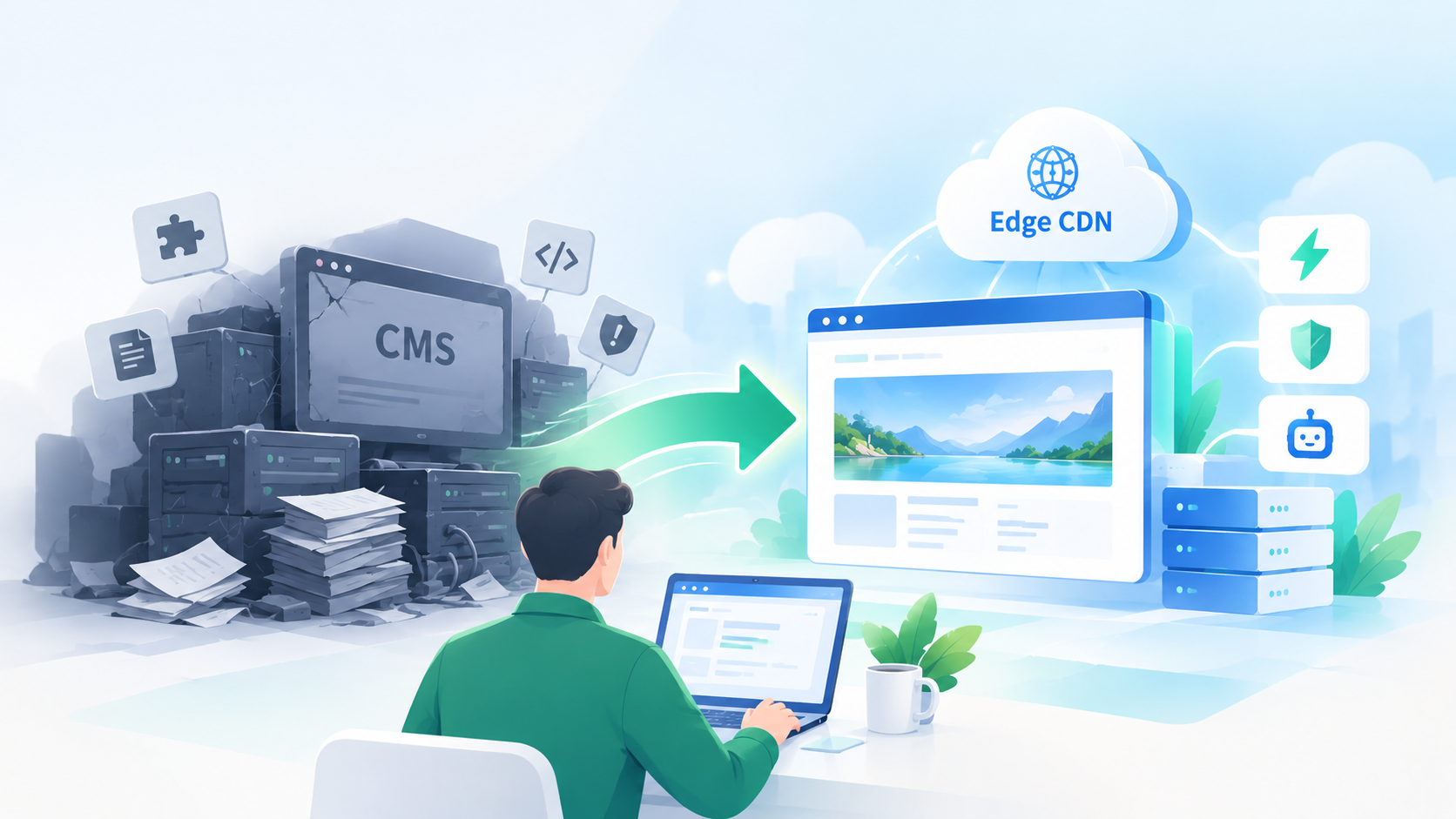
VAON did not dismantle the legacy database directly. Instead, the team designed a hybrid transition architecture: keep 100% of the existing editorial workflow intact, while automatically generating static HTML pages in the background and serving them through an Edge CDN.
This approach separates two things that are usually conflated: changing how editors work, and changing how end users receive content. VAON changed only the second, which cut operational risk significantly from day one.
The entire modernization was completed in 4 months, with no downtime for end users at any point during the transition.
Four architectural decisions behind zero downtime
The four design decisions below are the core reason the project reached zero downtime, not incidental technical detail.
1. **Phased migration via the Strangler Fig pattern.** Instead of cutting over the entire system at once, VAON routed traffic page group by page group, starting with the highest-traffic pages, to the new static infrastructure through an Edge Proxy layer. Pages not yet migrated kept running on the legacy CMS.
2. **Automated SSG pipeline.** When an editor publishes content in the legacy CMS as usual, a webhook triggers static HTML compilation within milliseconds. Database load at read time drops close to zero, so the site absorbs traffic spikes without scaling servers.
3. **Direct sync into OneBot, VAON's own RAG-based customer-service chatbot.** The newly compiled static HTML and structured metadata are pushed automatically into OneBot's RAG ingestion pipeline. The moment new content is published, OneBot updates its knowledge and can answer customer questions from the latest version, with no manual sync step.
4. **Portable, multi-infrastructure deployment.** The static HTML output is not tied to a specific cloud provider. It can run on AWS, Google Cloud, or on-premise infrastructure, including a Tokyo data center, depending on data-residency requirements.
Measured outcomes after project completion
The figures below come from a million-page CMS modernization project VAON delivered, completed in 2026. These are results from this specific project, not an industry average.
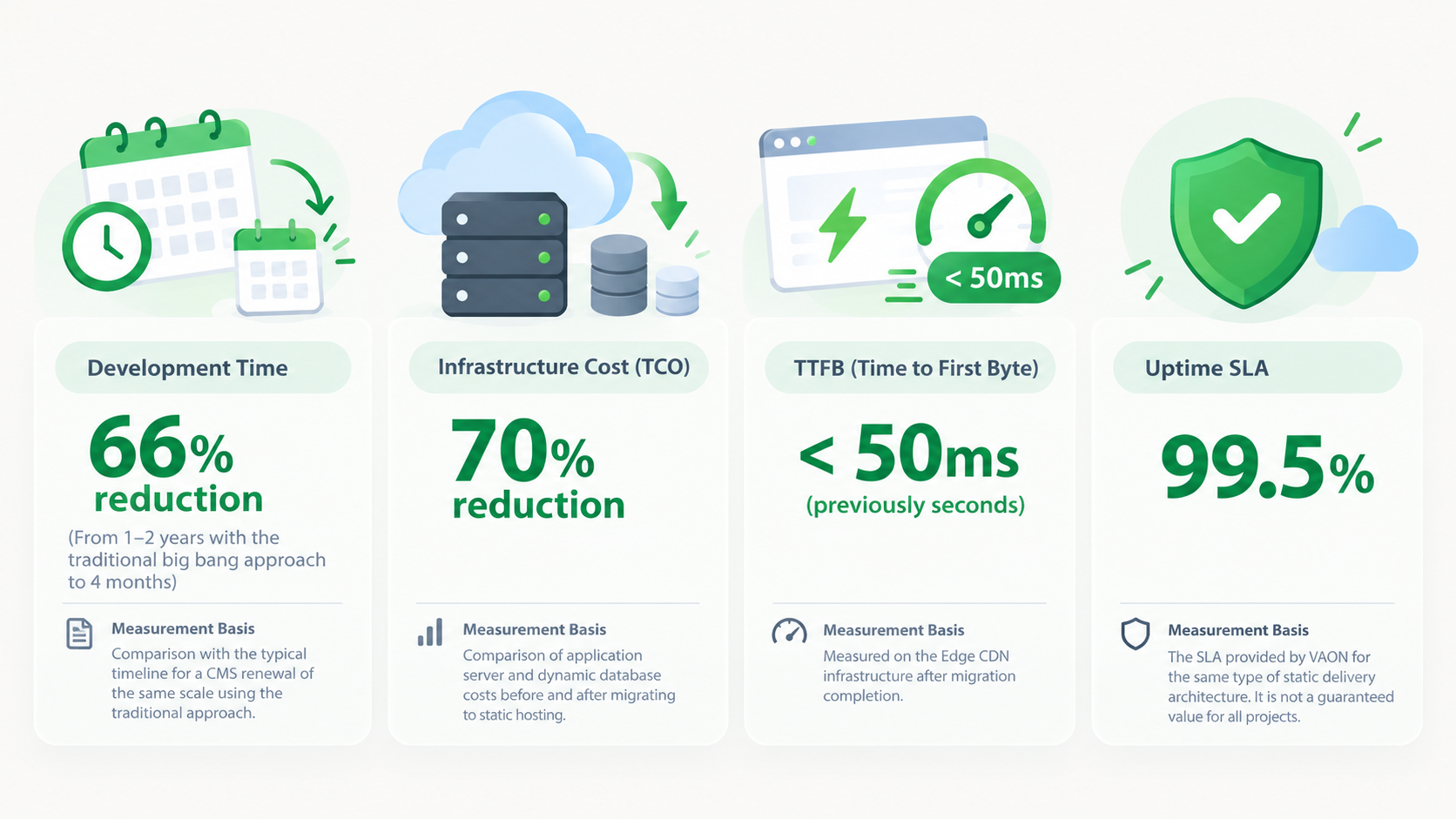
The 66% and 70% figures reflect this project's specific scale and complexity. Section 6 explains where these numbers do and do not generalize.
How does this architecture support APPI and GDPR alignment?
A static HTML architecture does not automatically mean "full compliance" with APPI (Japan's Act on the Protection of Personal Information) or GDPR. What it does is reduce the risk surface tied to personal data.
Specifically, static pages do not need real-time queries against user databases to render, so far less personal data flows through the public-facing distribution layer. Data still lives and is processed in the source system, which can sit in a Tokyo data center or on-premise depending on residency requirements, and the sync pipelines connecting the CMS, the static layer, and OneBot are all encrypted.
These are architectural characteristics that support compliance efforts, not a blanket legal compliance claim. Every organization still needs its own legal review for the specific data types and markets its system serves.
When is this architecture not the right fit?
A static HTML architecture works best for content-heavy, mostly-read sites where most pages can be pre-rendered: news sites, corporate sites, documentation, product catalogs.
It is a weaker fit in three cases:
1. Systems with deeply personalized, per-user dashboards where content rarely repeats between sessions.
2. Real-time transactional flows, such as payments or bookings that need instant inventory checks.
3. Systems where most traffic requires live server-side computation per request, rather than serving pre-rendered content.
The 4-month timeline and the improvement percentages in section 4 are also tied to this specific project's scale and complexity. A smaller CMS could finish faster; a system with deeper internal business integrations could take longer.
Wrap-up and next steps
A 20-year-old CMS is no longer a reason to keep absorbing high infrastructure cost and growing security risk. A Strangler Fig migration paired with an automated SSG pipeline enables step-by-step modernization with controlled risk, instead of betting the whole system on one cutover.
For CTOs and IT Directors seeking a legacy CMS modernization roadmap without operational disruption, VAON offers a complimentary audit to assess your current system architecture. This approach is backed by our extensive experience in system development and digital transformation consulting.
Additionally, VAON partners with Agencies and System Integrators (SIers) who wish to offer CMS modernization services to their clients but lack the in-house technical resources. Through our OEM partnership model, we provide end-to-end implementation support, including the integration of RAG-based AI chatbots like OneBot. Contact the VAON team to discuss this strategic collaboration in detail.
Official Website: https://vaon.com.vn/en