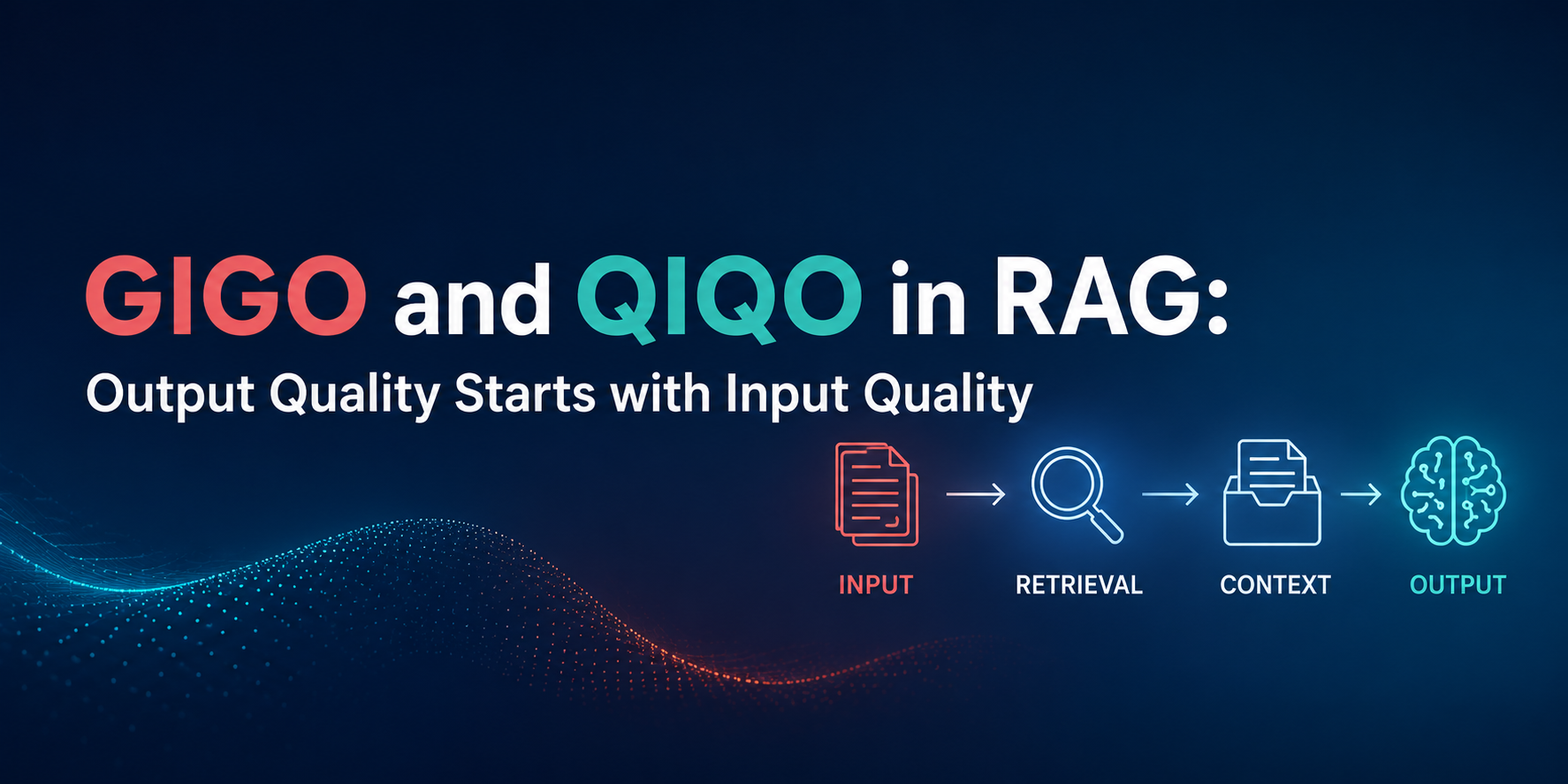
GIGO and QIQO in RAG: Output Quality Starts with Input Quality
Quick Summary
RAG cannot automatically turn a messy document collection into accurate answers.
GIGO — Garbage In, Garbage Out: poor data, vague queries, or irrelevant retrieved documents increase the risk of poor answers.
QIQO — Quality In, Quality Out: high-quality data, effective retrieval, and focused context improve the likelihood of accurate responses.
However, QIQO is not a guarantee. Even when the correct documents are provided, a model may still misunderstand, omit, or generate claims that are not supported by the sources.
1. RAG Is Not a Garbage Filter
A typical RAG pipeline can be summarized in three steps:
Question → document retrieval → answer generation
This architecture allows a language model to use external knowledge instead of relying entirely on information stored in its parameters. The foundational work by Lewis et al. showed that retrieval-augmented models can produce more specific and factually grounded outputs than models relying only on parametric memory [1].
However, RAG only places retrieved documents into the model’s context. It does not automatically verify whether:
- the documents are accurate;
- the information is still valid;
- the retrieved passages actually answer the question;
- the sources contradict one another.
As a result, when the system retrieves incorrect information, the LLM may present that information in a fluent and highly convincing way.
That is GIGO in RAG.
2. “Garbage” Can Enter at Every Layer
Poor-Quality Knowledge Bases
If a knowledge base contains outdated, duplicated, contradictory, or poorly sourced documents, the retriever has no reliable foundation for choosing the right evidence.
For example:
A new refund policy is already in effect, but the knowledge base still contains the previous version without any effective dates.
The retriever may find the right topic but return the wrong version.
The problem does not begin with the language model. It begins with the data the model is allowed to access.
Chunking Can Remove Critical Context
A correct document can still become a poor input when it is split incorrectly.
Suppose a policy statement appears in one chunk while an important exception appears in another. The system may retrieve only half of the rule.
In this case, the LLM is not necessarily inventing information. It is generating an answer from incomplete context.
Therefore, data quality in RAG includes more than factual accuracy. It also includes:
- document structure;
- metadata;
- chunk size and boundaries;
- relationships between sections.
RAG research commonly treats indexing, retrieval, and context augmentation as interconnected components that must be optimized together [2].
Poor Queries Produce Poor Retrieval
A retriever searches based on what the user says, not necessarily what the user means.
Consider the question:
“What is the leave policy?”
The user might be asking about annual leave, sick leave, unpaid leave, parental leave, or a policy in a specific country.
When a query is vague, incomplete, or contains typing errors, retrieval quality can decline significantly.
This is why query rewriting, clarification, and query classification can be just as important as selecting an embedding model.
Relevant Documents May Still Lack the Answer
High similarity does not always mean high usefulness.
A document may contain many of the same words as the query while still failing to provide the required evidence.
For example:
The retriever finds a document about the refund process, but the user is asking how long it takes for the money to reach their account.
The topic is correct. The answer is still missing.
A document should not be considered useful simply because it is semantically similar. It should be considered useful only when it helps the model answer the actual question.
3. More Context Is Not Always Better
A common response to weak retrieval is to increase top_k and provide more documents to the model.
However, a longer context can introduce more noise.
The Lost in the Middle study showed that a model’s ability to use information can depend heavily on where that information appears in the context. Important evidence placed in the middle of a long input may be used less effectively than information placed near the beginning or end [3].
RAGAS therefore treats context relevance as a key evaluation dimension. The retrieved context should be focused and contain as little unnecessary information as possible [4].
The goal is not:
Retrieve as many documents as possible.
The goal is:
Retrieve enough evidence to answer the question, with minimal duplication and noise.
4. QIQO Does Not Mean Good Input Guarantees Good Output
QIQO should be understood as a design principle:
The more reliable the input, the higher the probability of producing a reliable output.
It is not a deterministic formula.
Even when the correct documents are retrieved, a model may still:
- misinterpret the evidence;
- overlook an important condition;
- merge unrelated statements;
- generate unsupported claims.
In other words:
Quality In enables Quality Out, but generation still needs to be controlled.
A reliable RAG system should evaluate several dimensions separately:
- Context precision: Are the retrieved passages actually useful?
- Context recall: Has the system retrieved all necessary evidence?
- Faithfulness: Is the answer supported by the retrieved context?
- Answer relevance: Does the answer directly address the question?
Frameworks such as RAGAS separate retrieval quality from generation quality for exactly this reason [4].
5. GIGO in RAG Is Not Completely Linear
Not all noisy documents cause the same level of damage.
A document that looks highly relevant but does not contain the answer may be more harmful than a completely unrelated document. Highly similar but misleading evidence can push the model toward an incorrect conclusion.
This means that “garbage” in RAG cannot be defined by similarity score alone.
The real question is:
Does this document help the model produce a correct and well-supported answer?
If the answer is no, the document is not useful context, regardless of how similar it appears.
6. Moving from GIGO to QIQO in Production
A reliable RAG pipeline should include quality controls at multiple stages.
Before Retrieval
- remove outdated and duplicated documents;
- store source, version, and update date;
- chunk documents according to their structure;
- normalize or rewrite queries when necessary.
After Retrieval
- use a reranker;
- remove passages that contain no supporting evidence;
- eliminate duplicated content;
- detect conflicting sources;
- allow the system to refuse when evidence is insufficient.
After Generation
- verify individual claims against the context;
- require citations for important statements;
- measure faithfulness and answer relevance;
- involve human reviewers in high-risk use cases.
Approaches such as Corrective RAG add a retrieval evaluator that detects weak evidence and triggers corrective actions. Self-RAG allows the model to decide when retrieval is needed and to evaluate its own evidence and responses.
The important lesson is that retrieval should not be treated as a single search step. It should be treated as a controlled evidence pipeline.
Conclusion
In RAG, answer quality does not begin with the final prompt. It begins with the knowledge base, metadata, chunking strategy, query, and retrieved evidence.
GIGO reminds us that an LLM cannot rescue a weak data pipeline.
QIQO reminds us that improving output starts with improving every input that reaches the model.
A practical formula is:
Clean corpus + clear query + sufficient evidence + low-noise context + faithfulness checks = more reliable RAG
Switching to a larger model will not always solve the problem.
Sometimes, the first thing that needs to be fixed is simply the information the model is allowed to read.
References
[1] Patrick Lewis et al. Retrieval-Augmented Generation for Knowledge-Intensive NLP Tasks. NeurIPS 2020. arXiv:2005.11401.
[2] Yunfan Gao et al. Retrieval-Augmented Generation for Large Language Models: A Survey. 2023. arXiv:2312.10997.
[3] Nelson F. Liu et al. Lost in the Middle: How Language Models Use Long Contexts. 2023. arXiv:2307.03172.
[4] Shahul Es et al. RAGAS: Automated Evaluation of Retrieval-Augmented Generation. 2023. arXiv:2309.15217.