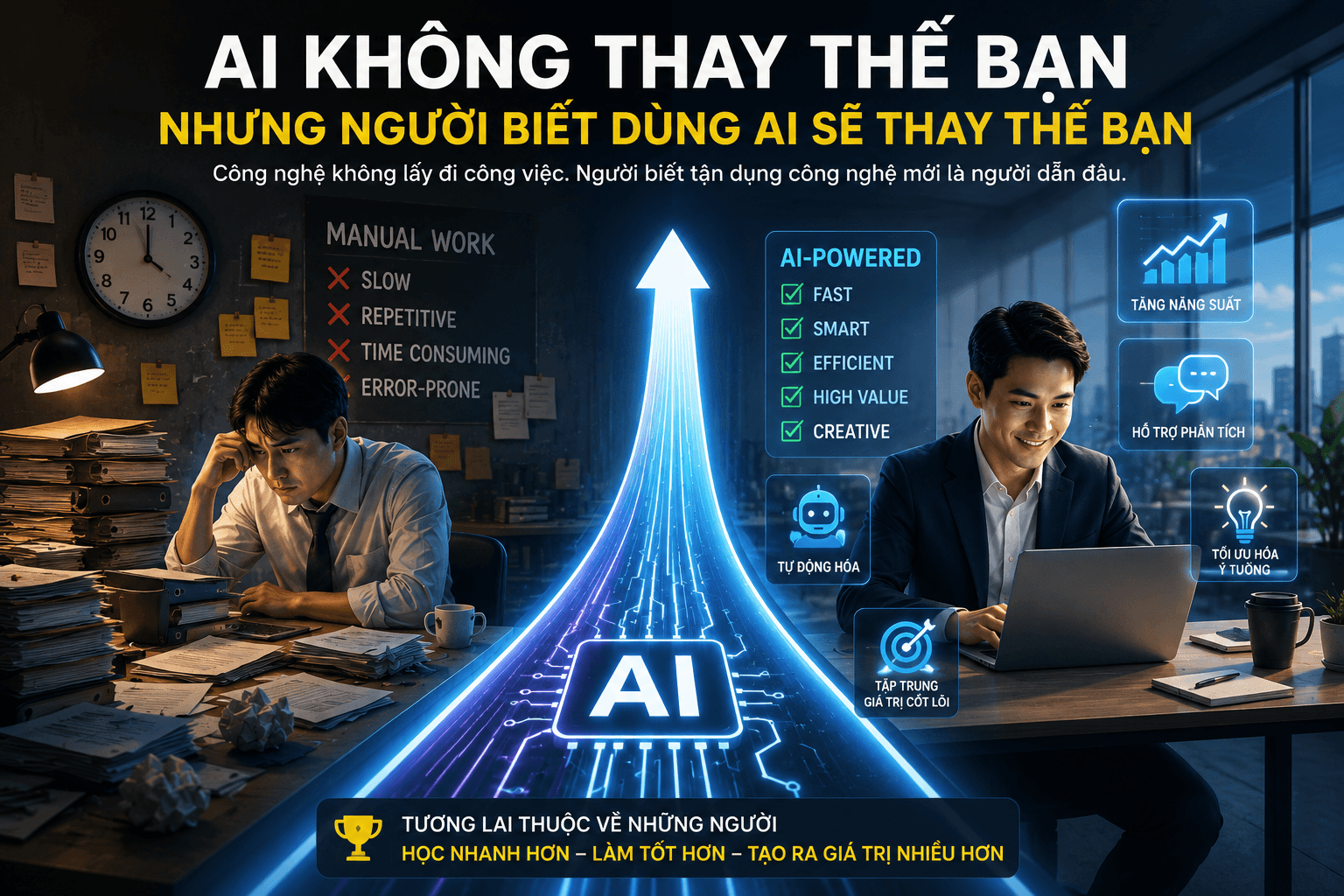
AI Won’t Replace You — But Someone Who Knows How to Use AI Will
Have you ever heard the phrase, “AI is going to take our jobs”?
It sounds alarming. But after several years of living alongside ChatGPT, Claude, Copilot, and countless other AI tools, reality is unfolding in a far more nuanced way:
AI itself is not directly replacing people. The person sitting next to you, doing the same job as you, but using AI effectively—that person is far more likely to replace you.
This is not just another catchy social media quote. It is a pattern that has repeated throughout every major technological revolution in history. The difference this time is speed.
History Has Never Been Kind to Those Who Stand Still
Consider a few familiar examples.
When Excel was introduced, accountants did not disappear. But accountants who relied solely on manual calculations gradually lost ground to those who mastered spreadsheets.
When Photoshop became mainstream, artists did not become obsolete. But designers who embraced digital tools gained a significant advantage over those who worked entirely by traditional methods.
When Google became everyone's go-to source of information, experts did not vanish. However, the value of simply “knowing things” declined, while the ability to find information quickly and evaluate it accurately became far more important.
The common thread across all these transitions is simple:
Technology itself never fired anyone. People who used technology more effectively outperformed those who did not.
AI follows the same pattern.
The only difference is how quickly it is happening.
Excel took decades to become universal. Generative AI has entered nearly every industry in just a few years.
What Does “Knowing How to Use AI” Really Mean?
This is where many people misunderstand the situation.
Knowing how to use AI does not mean:
- Opening ChatGPT and typing, “Write this email for me.”
- Asking AI to do your work and blindly copying the output.
- Using AI as an excuse to avoid learning fundamental skills.
That is not using AI.
That is becoming dependent on AI.
And people who are dependent on AI can be replaced just as easily as people who ignore it entirely—perhaps even more easily—because they add little value beyond copying and pasting.
True AI proficiency is a different skill set altogether.
1. Knowing How to Delegate Effectively
Just like a great manager, you must provide context, objectives, constraints, and clear expectations.
Vague questions produce vague answers.
Thoughtful questions often produce remarkable results.
2. Knowing How to Evaluate the Output
AI can confidently produce incorrect information, flawed code, or incomplete analysis.
People who truly understand AI are able to identify mistakes within seconds instead of blindly trusting every response.
3. Knowing How to Integrate AI into a Workflow
The goal is not to use AI occasionally for fun.
The goal is to redesign how work gets done.
What should AI draft?
What decisions should humans make?
Where should quality checks happen?
This is the difference between people who “play with AI” and people who “work with AI.”
4. Maintaining Strong Core Expertise
The biggest paradox of the AI era is this:
The better you want to become at using AI, the more important real expertise becomes.
Only people who deeply understand their field can accurately judge whether AI is right or wrong, complete or incomplete, useful or misleading.
The Simple Math That Changes Everything
Here is a calculation many managers are already making.
Imagine a traditional employee completes 10 units of work per week.
An AI-enabled employee, earning the same salary, completes 25 units of work with equal or better quality because AI handles repetitive tasks while the human focuses on higher-value thinking.
If a company needs to become leaner, which employee is more likely to stay?
The answer has nothing to do with AI “wanting” to replace anyone.
It comes down to productivity.
More importantly, the gap continues to widen.
People who use AI effectively learn faster because they effectively have a tutor available 24/7.
They produce more work.
They gain more experience.
As a result, they become even better at using AI.
This is the power of compound growth in skills.
Meanwhile, those who remain on the sidelines fall a little further behind every day.
Where Should You Start? A Practical Four-Step Roadmap
The good news is that you do not need to become an AI expert.
You simply need to start—and start correctly.
Step 1: Use AI in Your Daily Work
Do not learn AI purely through theory.
Use it for tasks you already perform every week: writing reports, drafting emails, summarizing documents, coding, planning projects, or conducting research.
Real proficiency comes from practical use, not from watching endless videos about “10 ChatGPT tips.”
Step 2: Learn How to Ask Better Questions
Popular prompt templates may become outdated within months.
What remains valuable is the underlying thinking:
- Provide sufficient context.
- Clearly explain your objective.
- Include examples.
- Ask AI to challenge its own conclusions.
Treat every interaction with AI as practice in effective delegation.
Step 3: Always Be the Final Reviewer
Adopt one non-negotiable rule:
Never publish, submit, or send anything generated by AI without reviewing it carefully and being willing to take responsibility for it.
This protects your reputation while forcing you to maintain genuine expertise.
Step 4: Go Deeper Into What AI Still Struggles With
Human communication.
Empathy.
Understanding customers.
Making decisions under uncertainty.
Taking responsibility.
Building trust.
These remain areas where humans have a significant advantage.
The combination of expertise + AI + human skills is one of the hardest combinations to replicate.
Don’t Fear AI—Fear Your Own Delay
Let's return to the statement in the title:
“AI won’t replace you—but someone who knows how to use AI will.”
At first glance, it sounds like a warning.
In reality, it is encouraging.
The decision is still yours.
You do not need to compete against machines. That is a race nobody wins.
You simply need to avoid standing still while others move forward.
AI is perhaps the greatest leverage an ordinary individual has ever had access to: a tireless assistant with knowledge across countless domains, available at minimal cost.
The only question left is:
Will you be the person using that leverage, or the person watching from the sidelines?
The best time to start learning AI was two years ago.
The second-best time is today.
How are you currently using AI in your daily work?
And what is the biggest thing holding you back from using it more effectively?