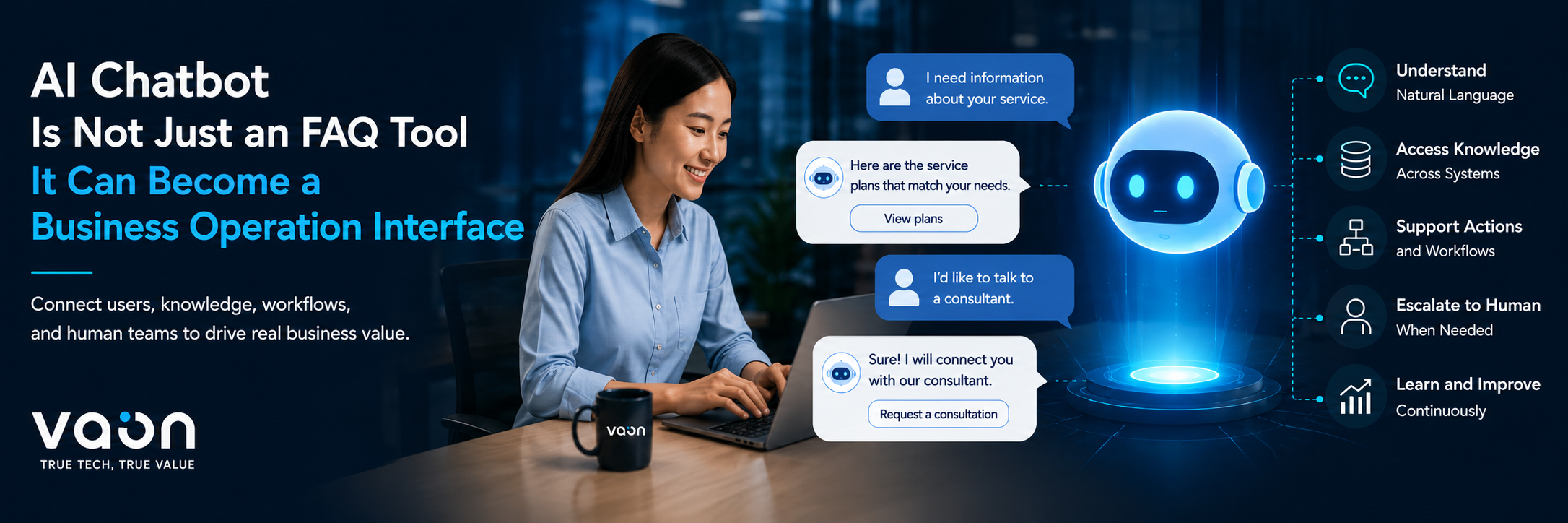
An AI Chatbot Is Not Just an FAQ Tool — It Can Become a Business Operation Interface
For many years, chatbots were mainly used as FAQ tools.
A customer asks a common question.
The chatbot finds a prepared answer.
If the answer is not available, the user is redirected to a human operator.
This model is useful, but limited.
Today, AI chatbots can do much more than answer simple questions. With the right design, an AI chatbot can become a business operation interface — a place where users can access information, complete tasks, receive guidance, and connect with business workflows.
The difference is important.
A traditional chatbot answers questions.
An AI-powered business chatbot supports actions.
At VAON, we believe the real value of AI chatbots is not only in conversation. It is in connecting conversation with business operations.
The Problem with Traditional Chatbots
Traditional chatbots often depend on fixed scenarios.
They work well when the user follows a predefined path. But when the question is slightly different, the chatbot may fail.
Users may experience answers such as:
“Sorry, I do not understand.”
“Please choose from the menu.”
“Please contact support.”
This creates frustration because users do not want to learn how the chatbot works. They want the chatbot to understand what they need.
Traditional chatbots also tend to become difficult to maintain.
Every new question requires a new scenario.
Every business change requires manual updates.
Every exception creates a new branch.
Over time, the chatbot becomes complex, but not necessarily smarter.
This is why many chatbot projects start with high expectations but lose effectiveness later.
AI Changes the Role of Chatbots
AI changes the chatbot from a fixed menu into a more flexible interface.
An AI chatbot can understand natural language better.
It can search across internal documents.
It can summarize information.
It can classify user intent.
It can support multilingual communication.
It can suggest next actions.
This makes the chatbot more useful for both customers and employees.
For customer support, AI can help users find answers faster.
For internal operations, AI can help employees search policies, manuals, procedures, and project information.
For sales and marketing, AI can guide users to the right service or inquiry form.
For product teams, AI can collect repeated questions and reveal user pain points.
However, AI alone is not enough.
A chatbot becomes truly valuable only when it is designed around real business workflows.
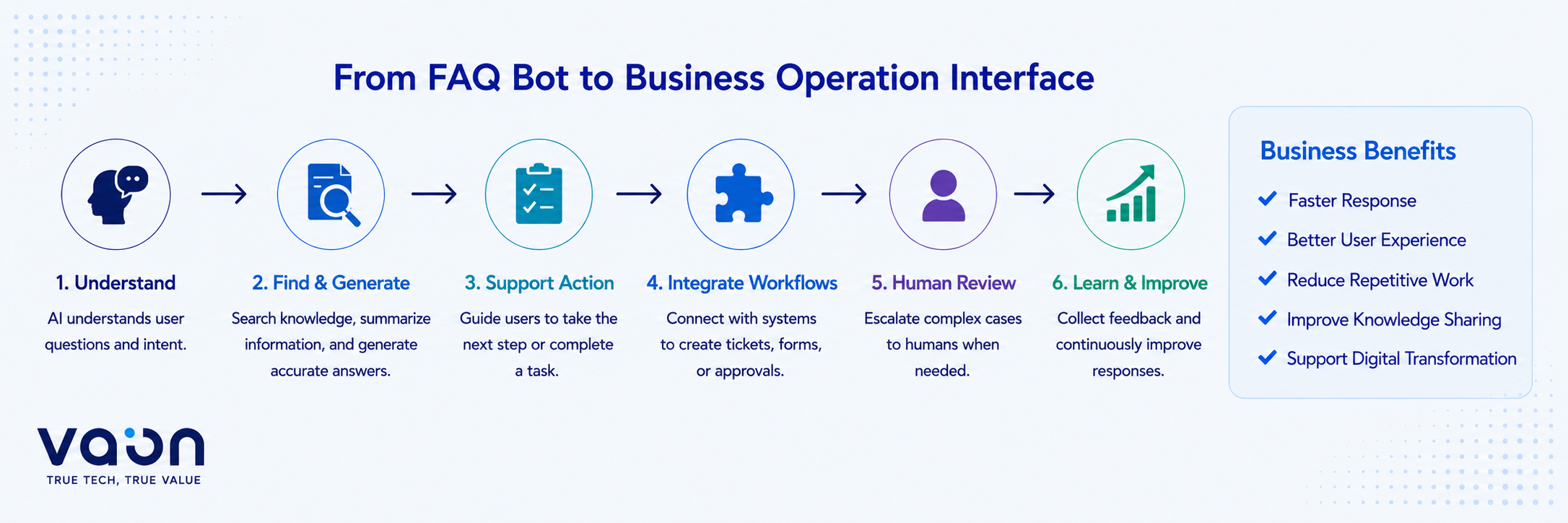
From FAQ Bot to Business Operation Interface
The next generation of AI chatbots should not be designed only as “answer machines.”
They should be designed as business operation interfaces.
This means the chatbot should be able to support not only information retrieval, but also business actions.
For example:
A customer asks about service pricing.
The chatbot explains the plan options and guides the customer to request a consultation.
An employee asks about an internal procedure.
The chatbot provides the correct policy and links to the related form or workflow.
A user reports an issue.
The chatbot collects the required information and creates a support ticket.
A sales team member asks about a past proposal.
The chatbot searches internal knowledge and provides relevant context.
In these cases, the chatbot is not just answering.
It is helping the business move forward.
That is the real transformation.
Good AI Chatbots Need Good Knowledge Design
An AI chatbot is only as useful as the knowledge it can access.
If the source data is outdated, the chatbot may give outdated answers.
If the documents are inconsistent, the chatbot may generate inconsistent responses.
If business rules are not clearly defined, the chatbot may provide unclear guidance.
If access control is weak, the chatbot may expose information to the wrong users.
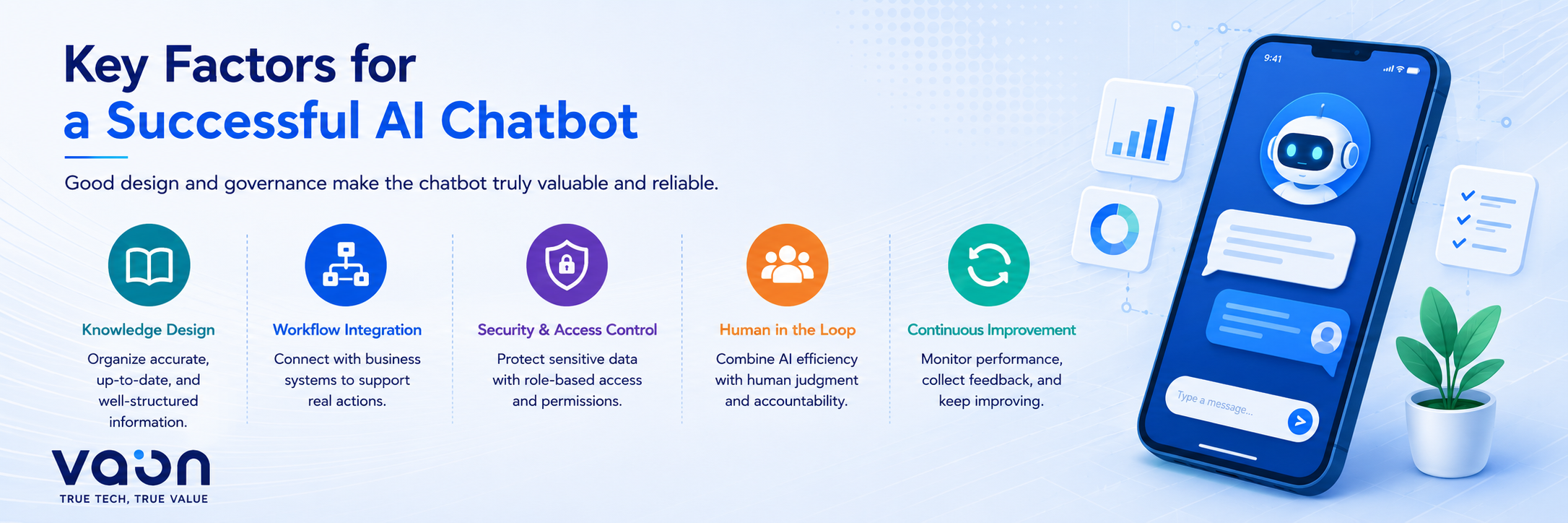
This is why knowledge design is essential.
Before building an AI chatbot, companies should ask:
Where is the official knowledge stored?
Who owns each type of information?
How often is it updated?
Which information is public, internal, or confidential?
How should the chatbot respond when it is not confident?
Who reviews and improves incorrect answers?
Without these rules, AI chatbot implementation can become risky.
With these rules, the chatbot becomes a reliable gateway to business knowledge.
Human Review Still Matters
AI chatbots should not be treated as fully autonomous decision-makers.
They are powerful assistants, but human review remains important.
This is especially true when the chatbot handles customer claims, legal information, financial data, HR policies, technical incidents, or contract-related questions.
A good AI chatbot should know when to answer and when to escalate.
It should be able to say:
“This requires human confirmation.”
“I found related information, but please review before using it.”
“I will create a ticket for the responsible team.”
This design creates trust.
The goal is not to make AI replace people.
The goal is to let AI handle repetitive work while humans focus on judgment, responsibility, and relationship-building.
Multilingual AI Chatbots for Global Teams
For companies working across countries, multilingual AI chatbots can create significant value.
In Japan–Vietnam collaboration, for example, language differences can affect communication speed and knowledge sharing.
An AI chatbot can support Japanese, Vietnamese, and English communication by helping users search and understand information across languages.
This is useful for:
Customer support
Internal manuals
Project documentation
Onboarding materials
FAQ and service explanation
Technical knowledge sharing
However, multilingual support should be designed carefully.
Business terms should be standardized.
Important answers should be reviewed.
Sensitive content should be controlled.
The chatbot should not freely translate critical legal or contractual information without proper review.
Multilingual AI can improve collaboration, but governance is still necessary.
The VAON Perspective
At VAON, we see AI chatbots as part of a broader digital transformation strategy.
A chatbot should not be built only because AI is popular. It should be built because it solves a real operational problem.
That is why we focus on understanding the customer’s workflow before designing the chatbot.
Who will use it?
What problems should it solve?
What knowledge should it access?
What actions should it support?
When should it escalate to a human?
How will the business improve it over time?
For products like Onebot, the goal is not simply to create conversations. The goal is to help businesses respond faster, organize knowledge better, and connect users with the right actions.
A good AI chatbot should be practical, secure, maintainable, and connected to real business value.
Conclusion
AI chatbots are no longer just FAQ tools.
They can become business operation interfaces that connect users, knowledge, workflows, and human teams.
But to achieve this, companies need more than an AI model.
They need clear knowledge design.
They need workflow integration.
They need human review.
They need security and access control.
They need continuous improvement.
When designed well, an AI chatbot can reduce repetitive work, improve response speed, support internal knowledge sharing, and create a better experience for both customers and employees.
The future of AI chatbots is not just conversation.
It is action, connection, and smarter business operations.