The Operational Strain of Project-Based Revenue for Digital Agencies
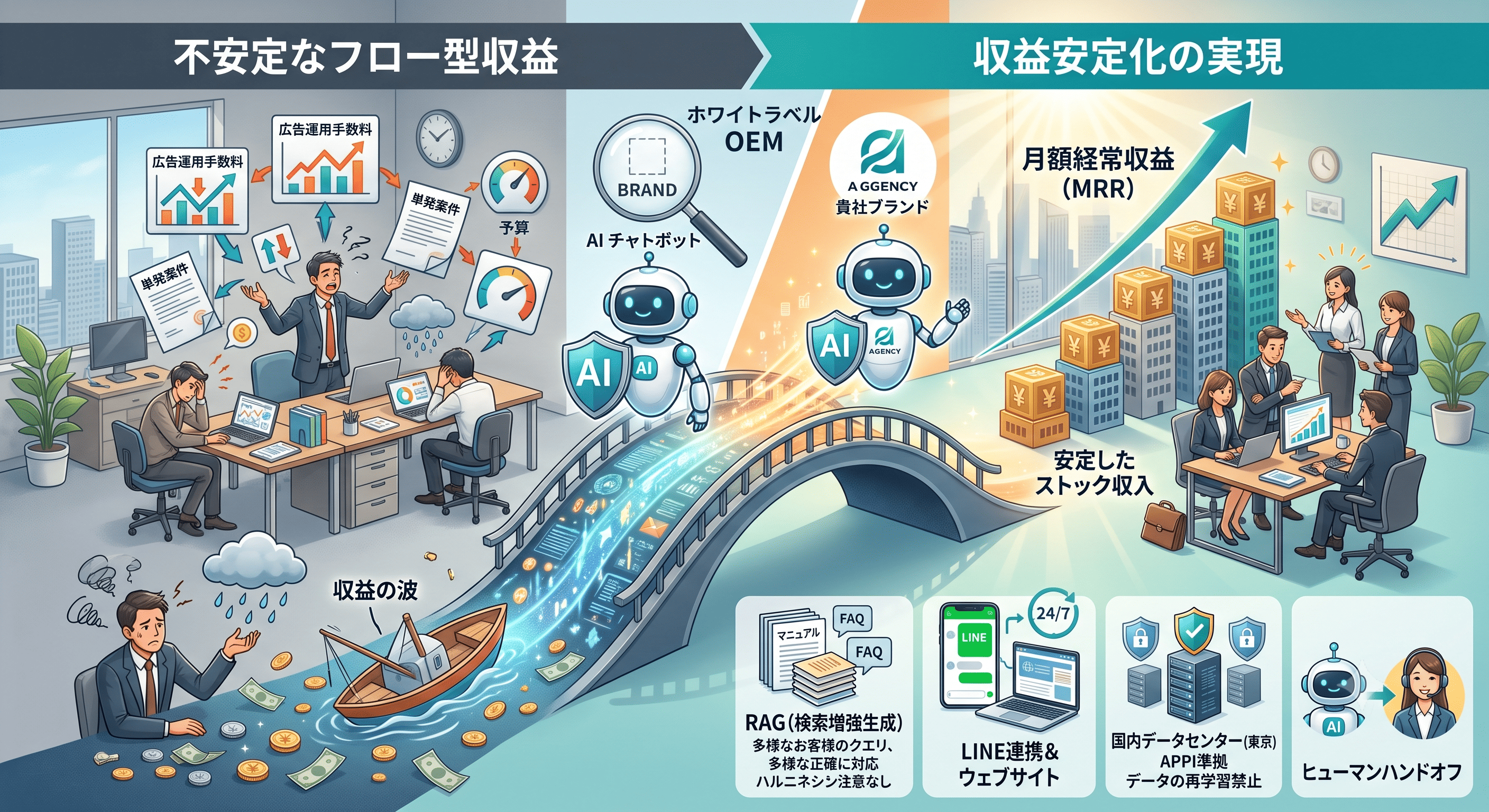
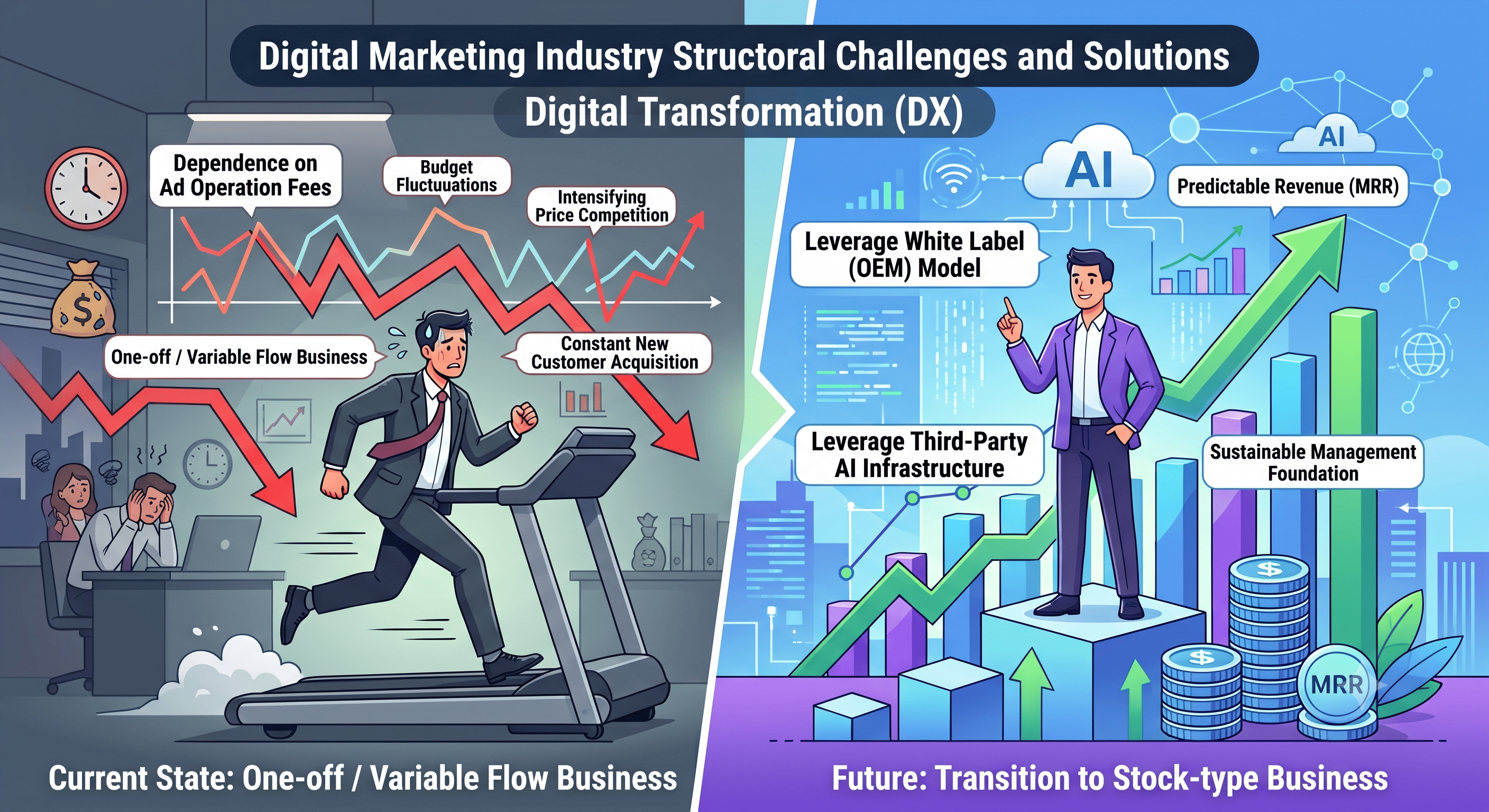
For digital marketing agencies, custom web developers, IT system integrators, and digital transformation (DX) consultants, building a predictable, resilient corporate financial foundation is a top-tier management priority. However, in today’s highly commoditized market environment, most B2B service firms are constrained by an identical structural vulnerability: an over-reliance on volatile, project-based transactional revenue—the traditional "flow model."
Within the digital advertising space, as major advertising platforms automate optimization algorithms, traditional ad management commissions (margins) face aggressive compression. Firms are constantly dragged into price wars and margin undervaluing. While a major corporate contract may trigger a substantial upfront cash injection, a client’s sudden budget reduction or account termination immediately destabilizes the agency's quarterly balance sheet. Forcing a firm into an endless, resource-draining cycle of client acquisition just to cover rigid corporate overheads stymies long-term strategic investment.
The definitive remedy to this unstable financial architecture is a permanent migration toward Software-as-a-Service (SaaS) business modeling—specifically, the cultivation of Monthly Recurring Revenue (MRR). Yet, designing, launching, and maintaining a proprietary B2B software platform from scratch requires millions of dollars in upfront engineering capital, intense structural risk, and ongoing maintenance liabilities. How can an agency bypass these technical entry barriers, leverage its existing client trust portfolio, and launch a branded SaaS product instantly? The answer lies within institutional White-Label (OEM) infrastructure deployment.
Why AI Chatbots? Capitalizing on Explosive Enterprise Operational Demand
In 2026, corporate customer operations (CS) across all tiers—from mid-market companies to large-scale enterprises—are overwhelmed by severe personnel shortages and rising operational overheads. For organizations managing digital properties and premium messaging channels like LINE Official Accounts, instant engagement is no longer a luxury; it directly dictates the baseline conversion rate (CVR). A response delay of more than 3 to 5 minutes causes severe pipeline leaks, yet maintaining an internal 24/7/365 multi-shift human customer support infrastructure places an unsustainable financial anchor on corporate margins.
Legacy decision-tree (scenario-based) chatbots have thoroughly failed this challenge. By forcing users through brittle, rigid conditional logic trees, they fail to grasp abstract intent and alienate qualified consumers. Conversely, the maturation of advanced Retrieval-Augmented Generation (RAG) coupled with leading Large Language Models (LLMs) has completely transformed the technical landscape.
An intelligent AI agent capable of digesting complex unstructured data silos and engaging consumers with human-grade fluidness is currently the highest-converting B2B software proposal in the industry. For digital agencies, embedding an automated operational layer into their existing core offerings represents the fastest path to capturing market share and deepening account stickiness.
The 4-Step Operational Framework to Launching Your Branded AI SaaS
By leveraging the enterprise-ready White-Label program engineered by OneBot (developed by VAON), your organization can position itself as a premium software owner and take an institutional AI platform to market within exactly 2 weeks, completely eliminating software engineering overheads.
Step 1: Structural Brand Alignment and Custom Domain Mapping
The framework completely strips away all visible footprints, licenses, and technical references to VAON. Your agency establishes its own proprietary product nomenclature, visual styling assets, corporate logos, and secure custom domains. Throughout the entire user journey—including client admin dashboards and public front-end chat widgets—the software presents itself as a multi-million-dollar internal technology asset developed exclusively by your firm. This allows you to package the product alongside your core marketing or development retainers under a single premium corporate offering.
Step 2: Extracting Immediate Value from Active Portfolios
Launching an OEM business does not require massive immediate ad spend. The fastest path to conversion lies within your existing ecosystem of trusted corporate accounts. Audit your active clients' communication pipelines. Identify accounts experiencing delayed customer response times or heavy churn rates on their landing pages. By building a hyper-personalized, fully functional AI prototype utilizing their actual corporate data, you can demonstrate concrete operational value during the initial pitch.
Step 3: Knowledge-Base Synthesis and Advanced RAG Initialization
Upon contract execution, the implementation phase begins. Your account managers ingest the client's unstructured data silos—such as internal corporate manuals, product specifications, complex PDFs, and real-time website URLs—into OneBot's secure vector storage. Because OneBot’s RAG architecture forces the AI to restrict its contextual reasoning strictly to verified corporate knowledge assets, it achieves complete data integrity and zero hallucination. This initial prompt calibration and data structure engineering is packaged and billed as a premium, high-margin upfront "AI Implementation & Onboarding Fee."
Step 4: Omnichannel Integration and Scaling the Subscription Engine
Deploy the validated AI agent to the client's live environment (such as their LINE Official Account or custom JavaScript website widgets) via seamless API mappings. OneBot features a unified data matrix that consolidates conversational logs from both web and messaging environments into a single backend management interface, ensuring an effortless client hand-off. The moment the platform goes live, your recurring software subscription engine activates, delivering predictable monthly cash flow.
Revenue Architecture: Maximizing Profit Margins via a Three-Tiered Financial Model
The defining commercial advantage of a white-label OEM architecture is that your firm retains absolute autonomy over the pricing matrix and contract terms. By applying a structured three-tiered monetization framework, your agency secures both immediate cash injections and long-term asset value:
| Monetization Layer | Functional Execution | Long-Term Agency Advantage |
|---|---|---|
| 1. Software Subscription Fee (MRR) | Recurring fees mapped to backend database resource consumption, active chatbot instances, and monthly message caps. | Generates compounding, highly predictable monthly revenue that directly multiplies your firm’s enterprise market valuation. |
| 2. Upfront Onboarding & Setup Fee | Data cleaning, knowledge-base synthesis, RAG prompt tuning, and cross-channel API integration. | Delivers immediate upfront cash flow to fully offset initialization personnel costs and accelerate capital recovery. |
| 3. Managed AI Optimization Retainer | Monthly conversational log analysis, prompt adjustments, and continuous ingestion of new corporate policy updates. | Insulates the account from external competitors, maximizes Customer Lifetime Value (LTV), and secures long-term advisory status. |
Unlike traditional project-based deliverables that terminate upon execution, this model yields continuous compounding margins as long as the account remains active. Because the backend technical scaling is managed completely by VAON, your agency bypasses the structural liabilities of engineering overheads, unlocking true software-scale profit margins.
Passing Enterprise Technical Audits: Sovereign Japanese-Grade Security
Within mature enterprise software ecosystems, a application's features are functionally irrelevant if the underlying data architecture fails to pass rigid corporate compliance parameters. OneBot is pre-engineered with robust security protocols out of the box, granting your agency absolute confidence when pitching to high-ticket corporate accounts:
- Sovereign Tokyo Server Clustering: 100% of interaction logs, training contexts, and corporate knowledge bases reside exclusively on secure localized servers in Tokyo, Japan. This guarantees full alignment with strict localized data residency mandates and geostrategic corporate policies.
- Flawless APPI Compliance Framework: Native architecture features automated real-time PII (Personally Identifiable Information) data scrubbers, neutralizing data leak liabilities under Japan's Act on the Protection of Personal Information.
- Isolated Private Contexts (Zero Re-Training): OneBot contractually guarantees that proprietary corporate intellectual property and end-user conversational logs are entirely isolated within private cloud instances and are never utilized to train public open-source LLM datasets.
- Advanced BYOK Encryption Matrix & TLS 1.3: Data in transit is secured via TLS 1.3 protocols, while data at rest supports Bring Your Own Key (BYOK) architectures. This grants the corporate client exclusive ownership of decryption keys; even VAON platform engineers cannot read internal data logs.
- Contract-Level 99.5% Uptime SLA: Platform availability and architectural performance metrics are legally backed by a clear Service Level Agreement (SLA), providing the structural validation demanded by institutional enterprise buyers.
Concrete Operational Value for the End-Client
When presenting this solution to your enterprise portfolio, your sales teams can lead with verified, contractually backed performance metrics:
- 60% Customer Support Automation: OneBot successfully resolves up to 60% of inbound, repetitive customer support volumes within 1.5 seconds, instantly driving down human capital costs.
- 2-Week Rapid Deployment Matrix: Eliminates long, cobs-heavy custom development cycles. The AI goes from raw corporate documentation to full production readiness in 14 business days with zero internal IT personnel required.
- Instant Access to 95M+ Users (LINE Native Integration): Offers flawless native API mapping to Japan's dominant communication lifeline, capturing consumer engagement inside a friction-free, high-retention environment.
- Intelligent Human Handoff Protocol: When encountering complex inquiries or escalation-sensitive claims, the AI smoothly routes the session to a live human agent. The entire historical context of the AI interaction is preserved and mapped to the operator's dashboard in real-time, preventing user frustration and protecting brand equity.
Conclusion: Scale Your Agency into a Branded Software Empire
Surviving within the hyper-commoditized, project-driven B2B landscape of 2026 requires software asset ownership. OneBot’s White-Label (OEM) partnership program offers your agency an immediate, risk-free pathway to establishing a proprietary enterprise software business line. Capitalize on your existing client trust, secure recurring margins, and build an unshakeable stream of compounding Monthly Recurring Revenue (MRR).
🤝 Deploy the power of an enterprise technology giant under your own brand today.
To request our granular Technical Function List, Security Whitepapers, or the comprehensive OEM Partner Proposal, connect with the OneBot engineering team via our official corporate platform.
🔗 Official Website: https://onebot.cloud/