Behind the Glittering AI Boom: The "Silent Risks" You Cannot Ignore
In 2026, Generative AI has transitioned from an experimental playground into a critical commercialization and implementation phase that determines corporate survival. Countless executives and Digital Transformation (DX) leaders are racing to deploy cutting-edge AI chatbots to automate customer support and streamline internal workflows. The promise of 24/7 instantaneous responses, mitigating labor shortages, and boosting conversion rates (CVR) is undeniably compelling.
However, behind these glowing success stories, corporate legal departments and Chief Information Security Officers (CISOs) are increasingly hitting the brakes due to terrifying vulnerabilities.
"An employee uploaded a confidential proprietary proposal into a free AI tool, and now that data has leaked globally." "An overseas AI chatbot failed to comply with local privacy regulations, resulting in an immediate regulatory crackdown and government sanctions."
These scenarios are not distant anomalies—they are harsh, everyday corporate realities. No matter how much operational efficiency you unlock, a single data breach or regulatory violation can instantly vaporize the social trust a company has painstakingly built over decades. The dangerous era of sacrificing data integrity for short-term operational speed is officially over.
Why Deploying Standard Overseas AI Services in Japan is a High-Stakes Gamble
While hundreds of AI chatbots flood the global market, the vast majority are engineered exclusively around Western cloud infrastructures and regulatory frameworks (such as GDPR). When attempting to force these solutions into the Japanese business landscape—particularly within strict Enterprise and SMB sectors—you will inevitably collide with three insurmountable barriers.
1. Stringent Compliance with the Amended APPI Laws
Japan's Act on the Protection of Personal Information (APPI) sees its penalties and enforcement metrics tightened systematically every year. Handling customer names, emails, or chat logs requires meticulous corporate governance. Cross-border data transfers via foreign cloud infrastructures often struggle to legally satisfy these uncompromising APPI baselines.
2. The Borderless Outflow of Data and Jurisdictional Uncertainty
Hosting data in foreign servers means that data is inherently subject to the surveillance powers and legislative mandates of host nations (e.g., the US Patriot Act). In an era defined by unpredictable geopolitical shifts, storing core corporate knowledge outside your home borders introduces severe operational fragility.
3. Exploitation of Proprietary Data for Public AI Re-Training
This is perhaps the most insidious risk. Standard consumer-grade AI services often utilize user prompts, uploaded internal manuals, and customer chat logs as training fodder to align their public models. This creates an existential threat where a competitor utilizing the same public AI could inadvertently trigger it to output your proprietary trade secrets.
The Japanese Culture of "Anshin" and the 5 Non-Negotiable Prerequisites
The Japanese market operates heavily on a deep-rooted corporate philosophy known as "Anshin" (安神 - Absolute Peace of Mind). It means a state where all potential operational risks are systematically anticipated, addressed, and completely neutralized. To confidently deploy AI internally—or for agencies to successfully distribute it to enterprise clients—five foundational security benchmarks must be met.
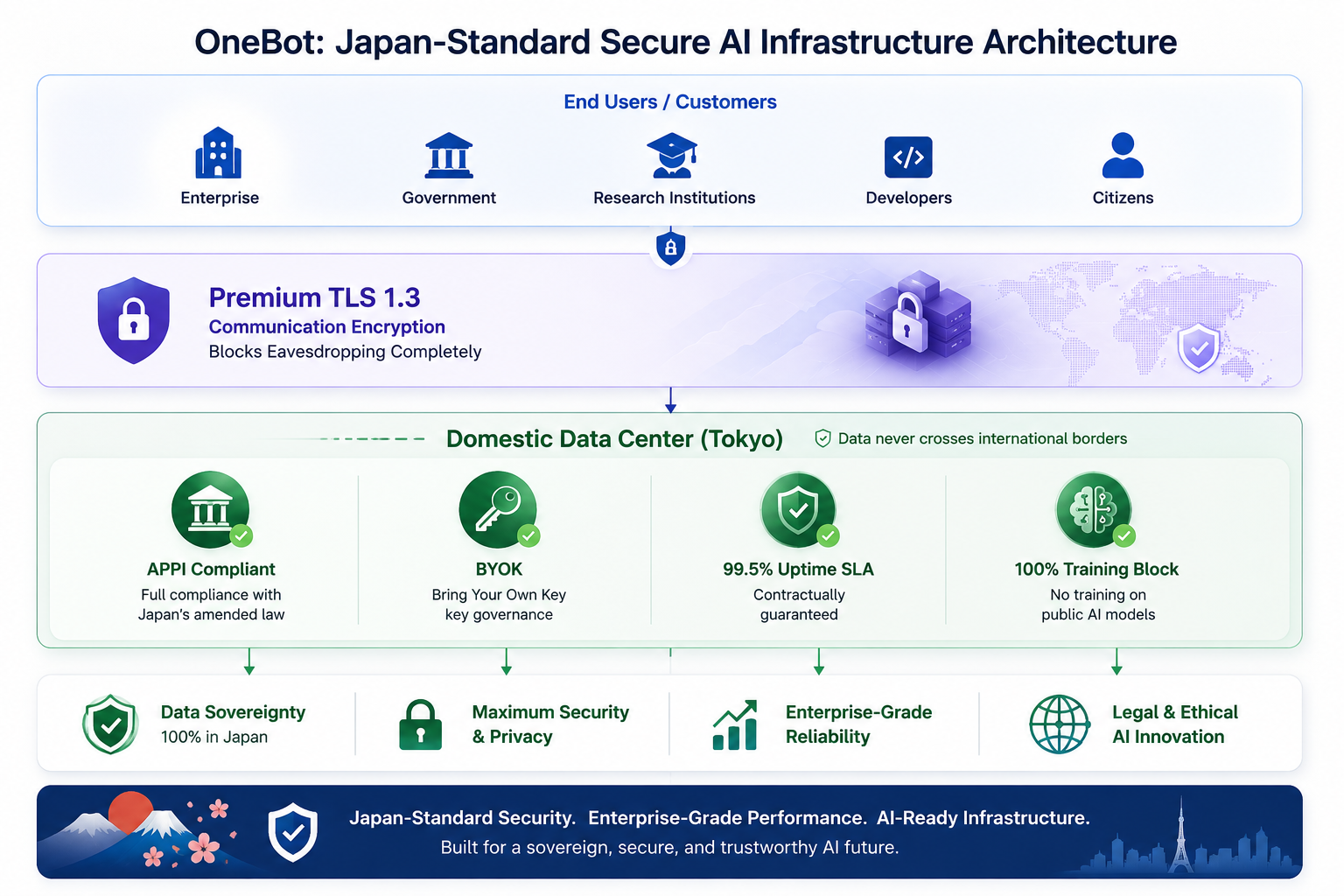
OneBot, developed by VAON, was engineered specifically to satisfy these strict requirements. Let us analyze its robust enterprise architecture:
Benchmark 1: Is Data Siloed within a "Domestic Data Center (Tokyo)"?
OneBot hosts its entire system infrastructure and customer databases exclusively within on-shore data centers in Tokyo, Japan. Data never leaves domestic soil. Because all data remains permanently under Japanese legal jurisdiction, it shields your confidential corporate assets from foreign legal intervention and geopolitical volatility.
Benchmark 2: Is the Platform Fully Compliant with the Japanese APPI?
OneBot enforces data handling protocols that are 100% compliant with Japan’s APPI. It features standard automated PII (Personally Identifiable Information) filtering and immutable audit log tracking. This allows your platform to effortlessly clear strict compliance audits, minimizing legal liabilities for the board while maximizing AI performance.
Benchmark 3: Is Customer Data Categorically Blocked from Public AI Re-Training?
All enterprise knowledge bases, documents, and conversation logs processed through OneBot are strictly isolated and never utilized for public AI model training. Your corporate data is siloed within an independent, walled container environment, ensuring your proprietary intellectual property remains exclusively yours forever.
Benchmark 4: Is Next-Gen Encryption (BYOK × TLS 1.3) Active?
Data in transit is fully secured using TLS 1.3, the most secure encryption protocol available, effectively rendering man-in-the-middle attacks impossible. For data at rest, OneBot supports Bring Your Own Key (BYOK). This grants your company exclusive ownership over its cryptographic keys. Even in a catastrophic infrastructure breach scenario, unauthorized data remains mathematically unreadable.
Benchmark 5: Is System Reliability Bound by a 99.5% Uptime SLA?
An AI chatbot serving as critical business infrastructure cannot afford frequent downtime or latency spikes. OneBot provides a legally binding 99.5% Uptime Service Level Agreement (SLA). With contractually transparent refund clauses if baselines are missed, it delivers an institutional standard of accountability aligned with premium Japanese Quality.
Unleashing Massive Commercial Value Across All Stakeholders
OneBot’s robust security architecture is not just a defensive compliance checklist—it is an offensive commercial driver that unlocks clear competitive advantages:
- For Executives & CISOs: Eliminate data leak anxieties and legal compliance bottlenecks. While your competitors are stuck in months of internal security gridlock, your organization can rapidly scale secure AI across departments, capturing immediate first-mover advantages.
- For End Customers: Users converse freely, sharing high-intent inquiries with the absolute certainty that their personal records are fiercely protected under sovereign data standards. This builds impenetrable brand loyalty.
- For Agencies & Tech Partners: Completely dismantle your clients' number-one objection: "security anxiety." By leveraging OneBot's OEM (White-Label) Program, you can instantly launch a sovereign, Japan-standard secure AI platform under your own brand, logo, and domain. Avoid destructive price wars, close high-value enterprise accounts, and secure scalable Monthly Recurring Revenue (MRR).
Conclusion: Organizations That Invest heavily in Security Will Dominate 2026
In 2026, enterprise AI integration is no longer about testing basic features—it is about managing data integrity and protecting corporate trust. Compromising security for cheap, unverified overseas tools is an obsolete, high-risk strategy that puts your brand at risk.
OneBot is the definitive enterprise AI chatbot built from the ground up to match the rigorous compliance and cultural ethos of "Anshin."
Protect your corporate legacy and secure your clients' future with premium Japanese standard engineering.
🤝 Empower Your Agency or Enterprise with Sovereign AI Tech. To request comprehensive technical specifications, security whitepapers, or explore our OEM Partner Program, contact us today via our official link.
🔗 Official Website: https://onebot.cloud/